Amphibian Quarantine, Acclimation, and Water Hardness: The Full Guide
On This Page▾

Bringing home a new amphibian, an axolotl, a fire-bellied toad, a tiger salamander, isn't the same job as bringing home a new fish, and treating it like one is where a lot of avoidable trouble starts. Amphibian skin is thin, permeable, and easily torn by fine mesh, which rules out the net-and-dip routine most fishkeepers do without thinking. Amphibian disease risk includes at least one pathogen that has already caused wild population collapses in Europe. And the water question that follows quarantine, how hard or soft it needs to be, turns out to have a real, honest gap in it once you go looking for where the commonly repeated numbers actually come from. This guide covers both halves in order: getting a new animal through quarantine safely, then the water it goes into once quarantine is over.
Why Amphibian Quarantine Isn't Optional
Every reptile and fish keeping guide mentions quarantine as good practice. For amphibians, it's closer to mandatory, because of two fungal pathogens that specifically target this group and behave differently enough from each other that they're worth telling apart.
Batrachochytrium dendrobatidis (Bd) is the older and more broadly documented of the two. Chytridiomycosis, the disease it causes, has been linked to amphibian population declines going back to the 1970s, and the US Geological Survey's National Wildlife Health Center notes that Bd is known to affect more than 200 amphibian species, frogs, toads, and salamanders alike, making it the broader of the two threats by host range.
Batrachochytrium salamandrivorans (Bsal) is newer, first identified after mass die-offs in European fire salamanders, and it's far more narrowly focused: the USGS describes it as an emerging pathogen capable of causing significant morbidity and mortality in salamanders specifically, the group that includes axolotls, newts, and mudpuppies alongside terrestrial salamanders. It is not a documented frog or toad pathogen the way Bd is. Studies cited by the USGS suggest Bsal is likely endemic to Asia and was introduced into Europe through the global pet trade, with captive-to-wild spillover strongly suspected as the route into wild European salamander populations. The USGS also puts a number on the exposure this creates in the US: over 750,000 salamanders were imported into the country between 2010 and 2014 alone, creating what the agency calls a high probability that Bsal could be introduced domestically the same way it reached Europe.
That's the actual argument for taking amphibian quarantine seriously even if your axolotl or salamander never sees the outdoors. The risk isn't just a sick new arrival infecting an existing collection, though that happens too. It's that the pet trade itself is the documented pathway these pathogens have already used to jump continents, and every new arrival that skips a quarantine period is one more unchecked node in that same pathway. This is also the entire reason releasing an unwanted amphibian outside, or letting one escape into a local waterway, is such a serious biosecurity problem regardless of intentions, a captive animal carrying either pathogen becomes a wild exposure event the moment it's loose.
Setting Up a Quarantine Space
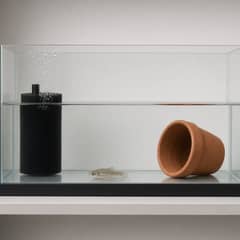
A quarantine setup doesn't need to be elaborate, but it does need to be separate. A second tank or a large plastic tub with a secure, ventilated lid, its own net or scoop that never touches the main tank, and its own siphon and cleaning tools is the baseline. Bare-bottom or a simple paper towel substrate makes daily monitoring and any needed treatment far easier than a fully planted setup would, and it can always be dressed up once the animal clears quarantine.
| Standard | Minimum quarantine window |
|---|---|
| General veterinary guidance for a new amphibian | 6 to 8 weeks |
| Zoo minimum before release from quarantine | 30 days, extended if any animal dies of an unidentified cause |
| Zoo preferred standard | 60 days, extended by clinical findings |
A home keeper isn't running a zoo's quarantine program, but landing closer to the 6-to-8-week veterinary range than to the shortest end of it is the more defensible choice, especially for any salamander or newt where Bsal is a live concern. The clock should reset, not just pause, if the animal shows any illness partway through.
Handling: Use a Container, Not a Net
Fish handling habits don't transfer to amphibians, and axolotls are the clearest example of why. Physical restraint should be avoided whenever possible to prevent damage to the delicate skin and exterior gills, and a soft mesh net should only be used briefly if there's genuinely no alternative. The feathery external gills that make axolotls so recognizable are also the part most easily snagged, folded, or abraded by net fibers, on top of the mucus-coated skin every amphibian depends on for both hydration and a first line of defense against infection.
The practical alternative is a container, not a net. For moving an animal into quarantine, into a new tank, or just for a closer look, the method is to place the animal along with some of its own tank water into a small, clear, water-tight container, which lets you view it from any angle without ever needing to touch it directly or force it through mesh. This same container method works for terrestrial and semi-aquatic species too, a wide-mouthed cup or deli container does the job for a fire-bellied toad or a salamander that a net would only stress out further, and it's the method to default to any time an amphibian needs to be moved, not just at the point of first arrival.
Temperature-First Acclimation
Acclimation for an amphibian should start with temperature, not chemistry. The National Research Council's own laboratory husbandry guidelines for amphibians state the underlying reason plainly: water quality must be rigidly controlled because sudden physical or chemical changes can severely stress the animals, and a fast temperature swing is one of the most common ways a new arrival gets pushed into that kind of stress in the first place. A transport bag or container that's noticeably warmer or colder than the destination tank should be allowed to equalize gradually, floated or set beside the new water until a thermometer reads the same in both, before the animal is moved across at all.
Only once temperature is matched does it make sense to worry about slowly blending water chemistry, mixing in small amounts of the destination water over time rather than dumping the animal straight from one chemistry into another. Zoos apply the same principle when releasing quarantined animals back to a wild site: water and cage environments should be slowly adjusted to the parameters the animal is entering, rather than swapped all at once. The same logic runs in reverse for an animal arriving into a home tank, and it matters more for amphibians than for most fish because permeable, absorbent skin means an abrupt shift in dissolved chemistry reaches the animal's system faster and more directly than it would through gills and scales alone.
The Fecal Screen During Quarantine
A fecal exam is one of the few genuinely low-effort, high-value steps in an amphibian quarantine period, and it's worth building into the plan rather than skipping it because the animal looks fine. Fresh stool can be collected by placing the animal on a clean, moist surface shortly after it eats, which keeps the sample from picking up environmental organisms that would muddy a parasite reading. Zoo and aquarium quarantine programs run parasite testing on a regular schedule throughout an incoming animal's time in quarantine, reflecting how routinely enteric parasites travel with new arrivals even when the animal shows no outward symptoms.
A home keeper doesn't need a zoo's testing calendar, but a single fecal exam run through an exotics vet at some point during the quarantine window is a reasonable, achievable version of the same idea. Many amphibians carry some baseline load of commensal organisms that don't need treatment on their own, so the point of the screen isn't to chase a zero result, it's to catch a parasite load heavy enough to actually warrant treatment before that animal joins an established collection where it can spread further.
Bd's host range crossing 200 documented amphibian species, per the USGS, is part of why it's treated as a broader ecological threat than Bsal, which so far has a much narrower, salamander-specific footprint. Different pathogen, different risk profile, and neither one is a reason to skip quarantine for the other group.
The Water It Goes Into: Hardness, and the Honest Gap
Axolotl care information across the internet repeats a range of general hardness (GH) and carbonate hardness (KH) numbers as settled fact, usually some version of moderately hard to hard water with a specific KH band for pH stability. Having gone looking for where those specific figures actually originate, from a peer-reviewed source, a veterinary publication that cites its own numbers, or an academic husbandry manual, they don't trace back cleanly to one. The pages repeating them present the ranges as given, without pointing to a study, a species-specific water chemistry trial, or any other primary source behind the figures. That's a real gap in amphibian care information, not a minor omission, and this article isn't going to paper over it by printing a number that can't be backed up just because it's the one that keeps circulating.
What can be said with actual backing is narrower, but it's not nothing. One water-source choice does have a documented consequence: distilled water and reverse-osmosis (RO) water are usually not electrolyte-balanced, and using either without rebalancing through added buffers, electrolytes, and pH adjustment can be fatal to amphibians. That's not a hardness target, it's a floor. An aquatic amphibian's skin and gills are in constant, direct contact with dissolved minerals in its water, and stripping essentially all of them out, which is what RO and distillation do by design, removes something the animal's physiology depends on rather than something it's indifferent to.
There is no well-sourced GH or KH number for axolotls, because one doesn't appear to exist in the reliable literature, and repeating an unsourced figure just because it's common wouldn't make it true. What is documented: don't use straight RO or distilled water for an aquatic amphibian without remineralizing it, dechlorinate ordinary tap water instead as the more practical default, and bring an exotics vet or a source with real citations into the conversation before chasing a specific hardness number for a species this under-studied on that particular point.
The same holds for the other amphibians commonly kept at home. No veterinary or husbandry reference gives a GH or KH target for the fire-bellied toad, the tiger salamander, the pacman frog or White's tree frog, so the rules that do have backing are the whole answer for all four. Their water has to be free of chlorine, chloramine, ammonia, nitrite, pesticides and heavy metals. Chloramine needs a dechlorinating agent such as sodium thiosulfate to split it, since standing or carbon filtration alone only removes chlorine. And straight RO or distilled water stays out unless it has been remineralized. How much that matters scales with how much of the animal's life is spent in water. A fire-bellied toad lives in an enclosure that is roughly half water, and a tiger salamander larva lives in water full time, so for them the whole water volume is the concern. An adult tiger salamander, a pacman frog or a White's tree frog meets water in a soaking dish and in misting, and the same treated tap or spring water in both covers it.
Laboratory amphibian care has its own answer to a related but distinct problem, not hardness, but reducing bacterial and fungal infection risk during the vulnerable larval and juvenile stage. Holtfreter's solution, a balanced saline first described for amphibian embryo research, shows up in laboratory-animal husbandry references as a component of media used for housing young amphibians like axolotl juveniles, where infection risk from ordinary tap or pond water is a genuine concern in a research colony setting. That's institutional laboratory practice built around a specific developmental stage and a specific research context, not a home tank recommendation, and nothing here should be read as a home keeper needing to mix a laboratory saline into a healthy adult's water. If hardness, softness, or a suspiciously cloudy or stressed-looking animal is a real concern in your own tank, an exotics vet and a proper water test kit are the right next step, not a homemade recipe pulled from a research protocol.
Dechlorinating the Water You Actually Have
For most home setups, the practical starting point isn't hardness at all, it's simply making tap water safe in the first place. Untreated municipal water routinely carries chlorine or chloramine at levels that are fine for humans and lethal for an amphibian's permeable skin and gills. A water conditioner formulated to neutralize both chlorine and chloramine, checked against a liquid test kit rather than assumed, covers the water-safety step that actually has clear backing, ahead of chasing a hardness figure that doesn't. Our why axolotls need cold, clean water guide walks through the rest of the water quality picture, ammonia, nitrite, nitrate, and the cycling those numbers depend on, in more depth, and our freshwater pH, GH, and KH guide is a useful primer on what those hardness terms actually mean if this is the first time you're running into them.
Putting It All Together
The version of this that actually holds up under scrutiny is less tidy than a single checklist, and that's fine. Quarantine a new amphibian for something closer to six to eight weeks than to a quick look-over, because Bd and, for salamanders specifically, Bsal are real pathogens with a documented pet-trade pathway behind them. Move the animal with a container, with a soft net only briefly when nothing else works, especially for an axolotl's gills and any amphibian's skin. Match temperature before chemistry, and give the water itself time to blend rather than swapping it all at once. Run a fecal screen somewhere in that window. And on water hardness specifically, hold the line on saying what's actually known: dechlorinated water and a real electrolyte balance are documented needs, a specific GH or KH target for axolotls has no solid backing in the literature, and that's worth knowing plainly rather than papered over with a number borrowed from a hobby page that never sourced it either. For everything else this species needs long after quarantine ends, our axolotl tank setup guide and axolotl health issues guide cover the rest of the picture.
Sources & Further Reading
Last reviewed 14 Sep 2026 · 5 sources
- USGS National Wildlife Health Center: Batrachochytrium salamandrivorans (Bsal)
- Merck Veterinary Manual: Environment and Husbandry for Amphibians
- LafeberVet: Basic Information Sheet, Axolotl
- AZA Amphibian Taxon Advisory Group: Amphibian Husbandry Resource Guide, Chapter 3, Amphibian Quarantine Guidelines
- National Research Council (US) Subcommittee on Amphibian Standards: Amphibians, Guidelines for the Breeding, Care, and Management of Laboratory Animals (NCBI Bookshelf)
Frequently Asked Questions
How long should I quarantine a new amphibian before it joins my main tank or collection?
6 to 8 weeks is typically adequate for a new amphibian, based on the risk profile of the collection and where the animal came from. Zoos and aquariums run stricter numbers, a 30-day minimum and 60 days preferred before release from quarantine, with the animal cleared only once it has stopped losing individuals to unexplained causes and is feeding, defecating, and behaving normally. A single pet keeper can reasonably land in the middle of that range rather than at the minimum.
Why can't I just net my axolotl the way I'd net a goldfish?
Physical restraint should be avoided whenever possible to prevent damage to the delicate skin and exterior gills of this species, and that a soft mesh net should only be used briefly when there's no other option. A small, clear, water-tight container that the animal is guided into, rather than scooped up in mesh, is the standard alternative, and it's also what most exam and observation guidance recommends for actually looking the animal over.
What is Bsal, and why should it matter to someone who never lets their pet outside?
Batrachochytrium salamandrivorans, or Bsal, is a fungal pathogen the USGS's National Wildlife Health Center describes as capable of causing significant morbidity and mortality in salamanders, a group that includes axolotls. It's believed to have spread from Asia into Europe through the pet trade, and captive-to-wild spillover is strongly suspected there. The USGS notes that over 750,000 salamanders were imported into the US between 2010 and 2014 alone, which is the exposure risk that quarantine, and never releasing or dumping a captive amphibian, is built to manage, regardless of whether any single animal ever leaves your house.
Is RO or distilled water safe to use for an axolotl or other aquatic amphibian?
Not on its own. Distilled and RO water are usually not electrolyte-balanced and can be fatal to amphibians without rebalancing with buffers, electrolytes, and pH adjustment. An amphibian's skin and gills exchange dissolved substances directly with the water around them, so water with essentially nothing dissolved in it isn't neutral for that animal, it's a real physiological problem. Dechlorinated tap water, checked with a test kit, is the more practical starting point for most home keepers.
What actually happens during a fecal screen in amphibian quarantine?
A fresh stool sample is collected, often by placing the animal on a clean, moist surface after feeding, and examined for parasites under a microscope. Zoo quarantine programs run fecal parasite testing on a regular schedule for incoming animals, and while a home keeper won't run a zoo's testing calendar, a single fecal exam through an exotics vet during quarantine catches the enteric parasites most likely to arrive with a new animal, before they have a chance to spread to an existing collection.
Does Holtfreter's solution have a place in home amphibian care?
Not really. It's a balanced saline originally described for amphibian embryo work and referenced in laboratory-animal husbandry literature for larval and juvenile housing, where sudden losses to bacterial and fungal infection are more of a concern than they usually are for a healthy pet in a clean, cycled tank. It's lab practice, not a home aquarium additive, and reaching for it or a similar homemade saline without professional guidance is more likely to create a new problem than solve one.
🦎 How Much Does an Axolotl Really Cost?
🐸 How Much Does a Fire-Bellied Toad Really Cost?
🐸 How Much Does a Pacman Frog Really Cost?
🦎 How Much Does a Tiger Salamander Really Cost?
🐸 How Much Does a White's Tree Frog Really Cost?
🦎 Should You Handle an Axolotl? Only When You Truly Have To
🐸 Fire-Bellied Toads Have Genuinely Toxic Skin, Here's What That Means
🐸 Should You Handle a Pacman Frog? Rarely, and Carefully
🦎 How to Handle a Tiger Salamander (And Why You Mostly Won't See One)
🐸 How to Handle a White's Tree Frog
🦎 Common Axolotl Health Issues (Most Trace Back to Temperature)
🐸 Common Fire-Bellied Toad Health Issues (Water Quality Is Everything)
🐸 Common Pacman Frog Health Issues and What Causes Them
🦎 Common Tiger Salamander Health Issues
🐸 Common White's Tree Frog Health Issues (Obesity Is the Signature Risk)
🦎 Axolotl Tank Setup: Cold Water and No Gravel
🐸 Fire-Bellied Toad Enclosure Setup: Half Fish Tank, Half Terrarium
🐸 Pacman Frog Enclosure Setup: Small Footprint, One Big Rule About Substrate
🦎 Tiger Salamander Enclosure Setup: Deep Substrate for a Species That Lives Underground
🐸 White's Tree Frog Enclosure Setup: What Your Frog Actually Needs

Written by Michael Ryan
Mike keeps two rescued bearded dragons, Dex and Cera, and writes the care guides on BeastlyFacts from his own research and mistakes. He is not a veterinarian.
More about Michael Ryan →