How to Handle a Tiger Salamander (And Why You Mostly Won't See One)
On This Page▾

Tiger salamanders are more outgoing than a lot of amphibians, they'll learn feeding routines and emerge from their burrow when they sense you nearby. That personality doesn't translate into a handling relationship though, and understanding why comes down to biology, not temperament.
A Largely Underground Animal
This species is fossorial, spending most of its time burrowed underground rather than visible on the surface the way a more aquatic amphibian might be. Don't mistake a salamander that's rarely visible for one that's unhealthy or hiding from stress, this is genuinely normal behavior for the species, and it's exactly why deep, burrowable substrate matters so much.
Why Handling Stays Minimal
Direct handling should genuinely be avoided with this species. Oils naturally present on human skin can interfere with a salamander's sensitive mucus layer, and like many amphibians, tiger salamanders produce toxic skin secretions that are dangerous if ingested. Excessive handling also causes real stress and can lead to overheating, since amphibians regulate temperature very differently than reptiles or mammals do.
If Handling Is Necessary
Wear wet, powder-free nitrile gloves and keep any handling brief. This isn't a species built for regular physical interaction, and treating it that way risks genuine harm to an animal with permeable, sensitive skin.
Tiger salamanders spend so much time burrowed that a keeper who barely sees theirs for weeks at a stretch might assume something is wrong. It usually isn't, this is completely normal fossorial behavior for the species, not a sign of stress or hiding.
First-Timer Mistakes
- Handling too often, assuming an outgoing personality means tolerance for regular handling.
- Using bare, dry hands instead of wet gloves when handling is unavoidable.
- Feeding prey that's too large, which can cause impaction or even paralysis.
- Overfeeding generally, this species doesn't reliably self-regulate portions.
How This Compares to the Axolotl
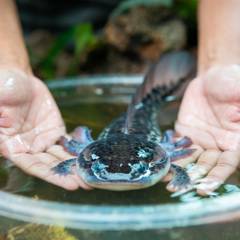
This is the most useful comparison to understand. Juvenile and larval tiger salamanders look and are cared for almost exactly like axolotls, fully aquatic, gilled, and living entirely in water, in much the same setup. But unlike the axolotl, which stays aquatic its entire life, tiger salamanders metamorphose as they mature, losing their gills and becoming the terrestrial, burrowing adult described above.
Tiger salamanders are part of a four species comparison, and Green Anole, Argentine Tegu, Fire-Bellied Toad & Tiger Salamander compared shows how they stack up.
❓ Frequently Asked Questions
Can I handle my tiger salamander regularly?
No. Skin oils interfere with the sensitive mucus layer a salamander depends on, and the species produces toxic skin secretions that are dangerous if ingested. Keep contact rare and purposeful.
Why does my tiger salamander stay hidden underground so much?
This species is fossorial and spends most of its time burrowed rather than visible on the surface. A salamander that's rarely visible isn't unhealthy or stressed, that's normal behavior, and it's exactly why deep, burrowable substrate matters so much.
What should I do if handling is necessary?
Wet, powder-free nitrile gloves, and keep it short. This isn't a species built for regular physical contact.
What are common first-timer handling mistakes with tiger salamanders?
Handling too often on the assumption that an outgoing personality means tolerance for regular handling, using bare dry hands instead of wet gloves, feeding prey that's too large, which can cause impaction or paralysis, and overfeeding generally since this species doesn't reliably self-regulate portions.
How does a tiger salamander compare to an axolotl for handling?
Juvenile and larval tiger salamanders look and are cared for almost exactly like axolotls, fully aquatic, gilled, and living entirely in water. But unlike axolotls, which stay aquatic their entire lives, tiger salamanders metamorphose into terrestrial, burrowing adults, so the adult setup and handling needs end up looking completely different from an axolotl tank.
Is a tiger salamander an outgoing pet?
More outgoing than a lot of amphibians, yes, they'll learn feeding routines and emerge from their burrow when they sense you nearby. But that personality doesn't translate into tolerance for regular handling.
📰 More on the Tiger Salamander
📘 Tiger Salamander care guide
🦎 How Much Does a Tiger Salamander Really Cost?
🦎 Common Tiger Salamander Health Issues
🦎 Tiger Salamander Enclosure Setup: Deep Substrate for a Species That Lives Underground
🦎 Tiger Salamander Enrichment: Underground Is Where the Animal Lives
🦎 Is It Legal to Own a Tiger Salamander? Three Separate Rules Explained

Written by Michael Ryan
Mike keeps two rescued bearded dragons, Dex and Cera, and writes the care guides on BeastlyFacts from his own research and mistakes. He is not a veterinarian.
More about Michael Ryan →Comments
No comments yet - be the first!