White's Tree Frog Feeding: Reading the Ridges Above the Eardrum
On This Page▾

Two facts about this species collide at the food dish. It is sedentary by temperament, spending most of the day sitting still, and it has an appetite that does not moderate itself. Put those together and a well-meaning keeper produces an overweight frog without ever feeling like they were overdoing it.
What to Offer
Crickets carry the diet. Around them, the useful additions are moths, beetles, cockroaches, grasshoppers and earthworms, with dubia roaches a common staple in their own right.
The fatty feeders need a ceiling. Waxworms and superworms go in once a week at most, and a pinkie mouse sits a step further out, no more than once a month for an adult, with nothing about the diet requiring it. This is a species that puts on weight easily, so the rich items are the ones to count rather than the ones to reach for.
A frog that hunts naturally does better with prey it can find at its own level, so insects that climb the planting and the branches suit it better than something that immediately vanishes into the substrate. Insects can go loose in the enclosure or be offered from blunt, round-tipped forceps, whichever the individual frog responds to.
How Often, and How Much
Growing frogs eat daily.
Adults slow to two or three times a week, at roughly three to four appropriately sized insects a sitting. A frog over three inches takes a few larger crickets at that interval; a smaller adult takes about three-week-old crickets on the same schedule.
Those counts are a starting point, and the animal corrects them. Larger items, an earthworm or a fuzzy mouse, come no more than once a month for an adult. Feed in the evening, when this nocturnal frog is awake and hunting, and pull any insects still loose a few hours later, before they drown in the water dish or scatter into the planting.
The Ridge Test
The ridge test replaces guesswork with something checkable in a few seconds.
Look at the ridges that sit just above the frog's eardrum. Three readings:
- No visible ridges. The frog is likely underweight. Feed more, or feed more often.
- Ridges present and defined. This is the shape to aim for.
- Ridges prominent, sagging, or folding over. The frog is obese and should be eating less.
That last state is not merely cosmetic. In an overweight White's tree frog the excess fat shows up clinically: a cloudy appearance to the eyes caused by lipid deposits in the cornea, a coelom that looks enlarged from fat laid down inside it, and fat in the crests above the eyes heavy enough to start interfering with vision. The correction is unglamorous and effective, less food and more opportunity to move.
Supplements
A feeder insect is a delivery mechanism, and an unfed cricket delivers very little. Both halves of fixing that, feeding the insects properly beforehand and dusting them on the way in, are covered in the gut-loading guide, including the timing window and why the two jobs are not interchangeable.
What is specific to this frog is the frequency. Calcium and a multivitamin on the insects runs about once a week for an adult and twice a week for a growing juvenile. Whether the calcium carries vitamin D3 depends on the lighting, since a frog under working UVB makes its own and one without it does not.
Where This Connects
Overfeeding and underfeeding are both husbandry problems before they are dietary ones, and the fat deposits of an obese White's tree frog are where overfeeding ends up.
The other half is opportunity to move. A frog with height, dense planting and places to climb burns more than one sitting on a bare branch, which makes the enclosure itself part of the weight equation.
Sources & Further Reading
Last reviewed 9 Sep 2026 · 5 sources
- Exotics Keeper Magazine: A Vet's Care Guide for White's Tree Frogs
- Dr. Gregory Rich, Avian and Exotic Animal Hospital: White's Tree Frog Care Sheet
- Zilla: Husbandry Handbook, White's Tree Frog
- Chicago Exotics Animal Hospital: White's Tree Frog Care
- Tree of Life Exotic Pet Medical Center: White's Tree Frog Care
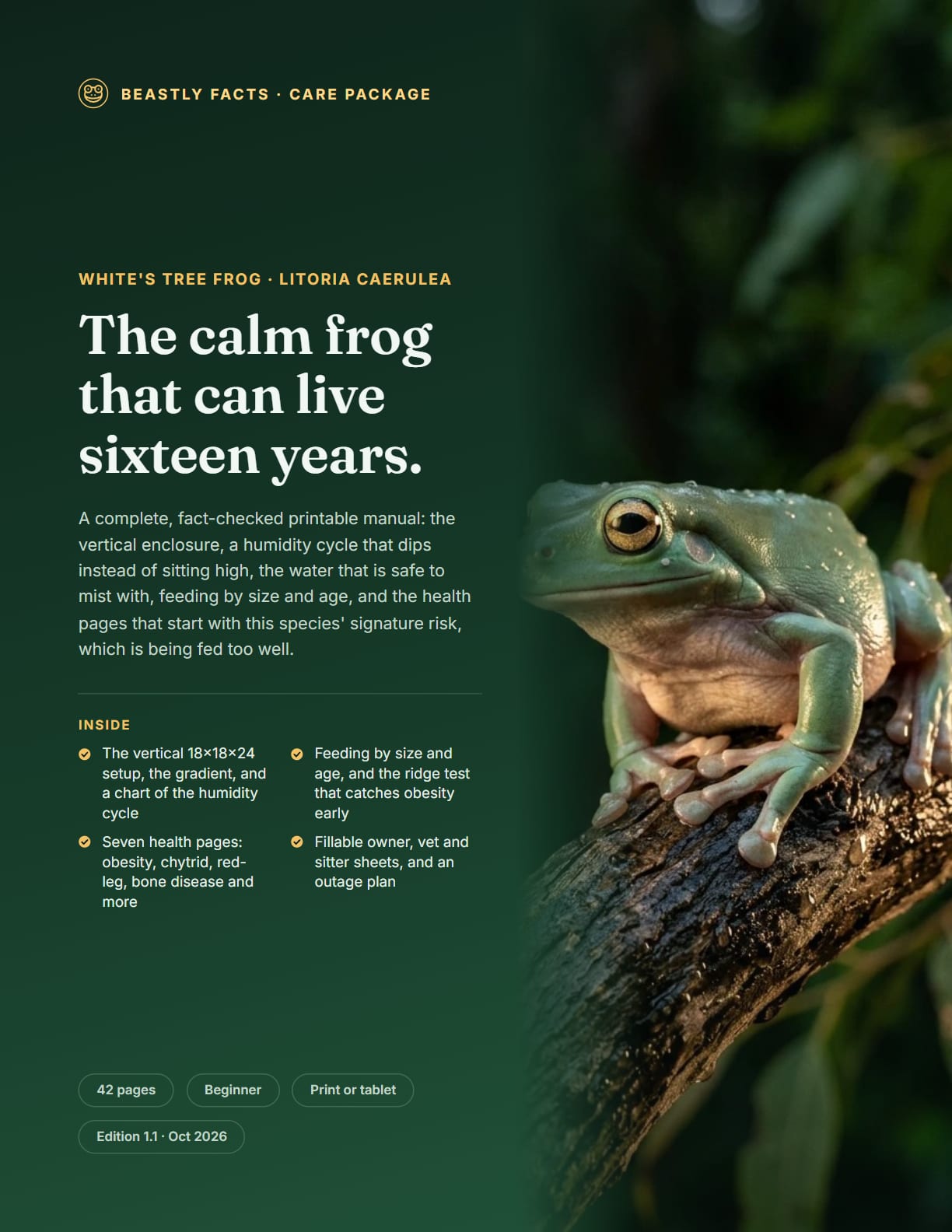
The White's Tree Frog Care Package puts the feeding section, an owner log and a pet-sitter sheet on paper, in a 42-page PDF you can keep by the enclosure, $8.99.
Frequently Asked Questions
What should a White's tree frog be fed?
Crickets as the staple, with moths, beetles, cockroaches and grasshoppers broadening it out. Dubia roaches and the occasional waxworm are common additions, and an earthworm or, for a fully grown adult, a pinkie mouse is a once-a-month extra at most. Insects can go straight into the enclosure or be offered from blunt, round-tipped forceps.
How often should a White's tree frog be fed?
Juveniles daily, adults two or three times a week, at roughly three to four appropriately sized insects a sitting. The amount matters more than the interval, and body condition is what settles it.
How do I tell if my frog is overweight?
Look at the ridges sitting just above the eardrum. If no ridges are visible the frog is probably underweight and needs more food or more frequent meals. If the ridges are prominent and starting to sag or fold over, the frog is carrying too much and should be eating less.
Do feeder insects need supplements?
Yes, on two fronts: gut load the insects beforehand and dust them on the way in. For this species the dusting runs about once weekly for an adult and twice weekly for a juvenile. The gut-loading guide covers the timing and why dusting does not replace it.
More on the White's Tree Frog
White's Tree Frog care guide
🐸 How Much Does a White's Tree Frog Really Cost?
🐸 How to Handle a White's Tree Frog
🐸 Common White's Tree Frog Health Issues (Obesity Is the Signature Risk)
🐸 White's Tree Frog Enclosure Setup: What Your Frog Actually Needs
🐸 White's Tree Frog Enrichment: Plants Changed the Frogs, Not Just the Tank

Written by Michael Ryan
Mike keeps two rescued bearded dragons, Dex and Cera, and writes the care guides on BeastlyFacts from his own research and mistakes. He is not a veterinarian.
More about Michael Ryan →