Should You Handle a Pacman Frog? Rarely, and Carefully
On This Page▾

Pacman frogs are sit-and-wait ambush predators by nature, sedentary, mostly buried, and built to strike at anything that moves close enough to eat. That last trait is exactly why this isn't a species built for regular handling.
Why Handling Stays Minimal
Pacman frogs have a powerful, painful bite, and they're prone to lunging at anything finger-shaped that moves near their face, not out of aggression, but because their entire biology is built around striking at movement. This is fundamentally a display animal, one best appreciated for its appearance and dramatic feeding response rather than for interaction.
In a 2017 bite-force study, a Cranwell's horned frog with a head under 2 inches wide bit down with about 33 newtons. Bite force climbs faster than head size, and the study's authors extrapolated from that curve that the largest living horned frogs could reach close to 500 newtons at mid-jaw, the range of medium-sized mammalian carnivores. That figure is an estimate from scaling, not a measurement. Either way, it belongs to an animal that spends nearly all its time sitting motionless, half buried.
When Handling Is Necessary
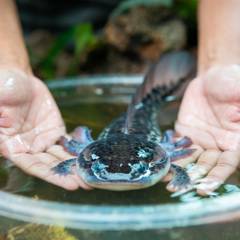
Keep sessions brief and infrequent, and put on powder-free gloves wetted in dechlorinated water first: this frog's skin is delicate and absorbent, and whatever is on a dry hand goes into it. Support the frog gently from underneath, or grasp it gently but firmly around the base of the rear legs, and be ready for a sudden jump, Pacman frogs leap without much regard for the distance or surface below them. Wash your hands thoroughly before and after, both to protect their sensitive skin from oils and residue, and to protect yourself from Salmonella.
Protecting Yourself
Even a healthy Pacman frog can carry Salmonella in its gut. Wash with soap and running water after touching the frog, its feeders, its water, or anything from the enclosure, and before eating. Children younger than 5 should not handle the frog or touch the enclosure at all, since they are the most likely to become seriously ill, and the dish and decor get cleaned in a laundry sink or bathtub, never where food is prepared.
Never Hand-Feed
This is the single most important rule with this species. Feed with forceps, tongs, or by dropping food into a dish, never with your fingers. A Pacman frog genuinely cannot always distinguish a finger from prey, and the bite that follows a feeding mistake is a real, painful injury, not a minor nip.
First-Timer Mistakes
- Hand-feeding. By far the most common way people get bitten.
- Housing two together. Pacman frogs are cannibalistic and will eat a cage-mate given the chance, this species always goes one per enclosure.
- Handling for enjoyment or bonding, which isn't really what this animal offers or needs.
Telling Males From Females
This isn't something you can check on a young frog, sex-linked traits only show up at maturity, commonly by around 5 to 6 months old. From then on, males are the easier sex to confirm: look for a dark, rough nuptial pad on the first digit of each front foot and loose skin across the throat where the vocal sac sits, and listen for calling, a loud, repetitive croak used to attract a mate. Females don't develop nuptial pads or call, and they grow substantially larger than males, sometimes close to double the body mass.
How They Compare to Other Large Amphibians
Pacman frogs are often mentioned alongside African bullfrogs, another large, voracious, floor-dwelling ambush predator. Pacman frogs stay smaller, typically 4 to 7 inches, and are even more sedentary, spending the vast majority of their time buried and motionless, waiting instead of exploring.
This is worth contrasting directly with White's tree frog. White's tree frogs are calm, docile, and genuinely tolerant of careful handling, one of the few amphibian species suited to it at all. The Pacman frog is essentially the opposite case, and honestly, it's the reason the general "don't handle amphibians" rule exists in the first place. If you're deciding between the two species partly on how much interaction you want from a pet, that difference alone is worth weighing heavily.
Sources & Further Reading
Last reviewed 24 Sep 2026 · 5 sources
- PetMD: Pacman Frog Care Sheet
- Tree of Life Exotic Pet Medical Center: Pacman Frog Care
- Reptiles and Amphibians, Healthy Pets, Centers for Disease Control and Prevention
- Reptiles Magazine: Pacman Frog Care and Information
- Bite force in the horned frog (Ceratophrys cranwelli) with implications for extinct giant frogs, Scientific Reports 7:11963 (Lappin, Wilcox, Moriarty, Stoeppler, Evans, and Jones, 2017)
Frequently Asked Questions
Can you handle a Pacman frog?
Rarely, and only when something needs doing. This is a sit-and-wait ambush predator that strikes at whatever moves close enough to eat, which makes a hand a poor thing to wave in front of it. Treat it as a display animal.
How do you safely pick up a Pacman frog when you have to?
Briefly, and not often. Support it from underneath, or hold gently but firmly around the base of the rear legs, and expect a jump with no regard for what's below. Wash your hands before and after.
Why should you never hand-feed a Pacman frog?
Because a Pacman frog can't reliably tell a finger from prey. The bite that follows a feeding mistake is a real, painful injury, not a nip. Feed with forceps, tongs, or by dropping food into a dish.
What are the most common first-timer mistakes with Pacman frogs?
Hand-feeding, which is how most bites happen. Housing two together, since these frogs are cannibalistic and will eat a cage-mate. And handling for the sake of bonding, which isn't what this animal offers.
How does handling a Pacman frog compare to handling a White's tree frog?
They're opposites. A White's tree frog is calm and docile enough for careful handling, one of the few amphibians that is. The Pacman frog is why the general rule against handling amphibians exists.
How can you tell if a Pacman frog is male or female?
Not as a juvenile, these traits only appear once a frog matures, typically by around 5 to 6 months old. Mature males develop a dark nuptial pad on the first digit of each front foot, have loose throat skin over the vocal sac, and are the ones who call, a loud, repetitive croak. Females never develop nuptial pads and grow considerably larger, sometimes close to twice a male's body mass.
More on the Pacman Frog
Pacman Frog care guide
🐸 How Much Does a Pacman Frog Really Cost?
🐸 Common Pacman Frog Health Issues and What Causes Them
🐸 Pacman Frog Enclosure Setup: Small Footprint, One Big Rule About Substrate
🐸 Pacman Frog Feeding: Schedule, Diet, and Why They Stop Eating
🐸 Pacman Frog Enrichment: An Animal Built to Do Nothing

Written by Michael Ryan
Mike keeps two rescued bearded dragons, Dex and Cera, and writes the care guides on BeastlyFacts from his own research and mistakes. He is not a veterinarian.
More about Michael Ryan →