How Much Does a White's Tree Frog Really Cost?
On This Page▾

White's tree frogs, sometimes called dumpy tree frogs for their round, waxy-skinned build, are one of the more affordable and forgiving amphibians to keep, both to buy and to maintain long term.
The Frog Itself: $20 to $60
Standard animals run $20 to $60, with blue and other designer color morphs commanding a bit more. Captive-bred animals are widely available and are the better choice over wild-caught, which often carry parasites and disease and adjust less well to captivity.
Telling Sex and Color Apart Before You Buy
Sex. Most frogs for sale are juveniles, and a juvenile usually cannot be sexed: the adult features may not have appeared yet, and the species takes about two years to mature. In an adult, look under the chin. A male has a grayish, wrinkled vocal sac there; a female's throat is plain white. Males are also slimmer and smaller, about 3 inches against a female's 4, and in breeding condition a male grows a dark nuptial pad at the base of each thumb for gripping a female. A frog heard calling is a male. For a single pet none of this matters, since both sexes cost and live the same, but for a pair it decides whether the keeper ends up with eggs.
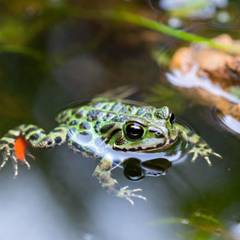
Color. A normal White's tree frog already ranges from light blue-green through emerald to almost gray, with scattered white or gold spots along the sides, and it can change shade somewhat. Its skin carries blue and green pigment under a yellow layer, and where that yellow layer is thin or worn the frog looks blue. That is why a bluish frog in a store is not proof of a blue morph: one shade on one day proves little, and a frog paying a morph price should come from a breeder who can say what its parents were.
Upfront Setup: $355 to $745 With the First Vet Exam
| Item | Cost Range |
|---|---|
| 18x18x24 in+ arboreal terrarium, front-opening with a mesh top (check the dimensions before you buy) | $100 - $200 |
| Broad-leafed live plants | $15 - $35 |
| Artificial foliage for the dense parts | $10 - $20 |
| Cork bark and PVC pipe hides | $15 - $30 |
| Sturdy climbing branches, mounted high | $15 - $30 |
| UVB fixture and 5.0 (5%) T5 HO UVB tube, a low-output hood that runs across the 18 in top (check the length against your enclosure) | $45 - $75 |
| Plug-in timer for the lights, 12 hours on and 12 off | $5 - $15 |
| Digital thermometer and hygrometer | $15 - $25 |
| Side-mounted heat mat with a thermostat, on the outside of one side wall (check the mat size against your enclosure) | $25 - $40 |
| Coarse orchid bark, coco husk, or a bioactive soil mix (check the quantity against your enclosure's floor) | $25 - $40 |
| Shallow water dish that's easy to keep clean | $5 - $15 |
| Fine mist spray bottle, kept for treated water only | $5 - $15 |
| Water conditioner that neutralizes chlorine and chloramine | $5 - $15 |
| First supply of calcium with D3 and a multivitamin, in one powder | $15 - $25 |
| Blunt, round-tipped feeding forceps for offering insects | $5 - $15 |
| First vet exam with an amphibian-experienced vet | $50 - $150 |
| Setup total | $355 - $745 |
Typical price ranges across retailers.
Highly recommended, not counted in the total: a UV index meter, about $240 to $265. It is the only way to check that the UVB tube sits at the right height and to know when the tube needs replacing; UV cards do not measure UVB.
The terrarium is the largest single expense in that list. Every row above the vet exam adds up to $305 to $595, and the first exam brings the setup to $355 to $745, before the frog itself. A T5 tube's wattage is not its length: a 24-watt tube is about 22 inches long, a 39-watt tube about 34 inches and a 54-watt tube about 46 inches, so go by the length in inches when you match a hood to your enclosure's top. The heat mat goes on a side wall rather than under the floor, since this frog lives high up and the substrate holds water. The spray bottle and the water conditioner are small lines that do a real job: a frog drinks through its skin, so the water in the mister and the dish has to be treated, never straight from the faucet.
Ongoing Costs: $150 to $245 a Year, Before the Vet
Feeder insects, supplement top-ups, two UVB tubes a year, and water conditioner top-ups make up the recurring total, with substrate and modest electricity on top of it. This isn't a species with heavy recurring expenses once the enclosure is built. Broken out across a year, the recurring line items look like this:
| Item | Annual Cost |
|---|---|
| Gut-loaded live insect feeders: crickets or dubia roaches | $80 - $150 |
| Supplement top-ups | $15 - $20 |
| UVB tube replacement, budgeted every 6 months (two a year) | $40 - $45 |
| Water conditioner top-ups | $15 - $30 |
| Annual vet exam | $50 - $150 |
Typical price ranges across retailers.
The four supply lines total $150 to $245 a year, which is where the $10 to $25 a month comes from, and the annual exam brings the year to $200 to $395.
One zoo White's tree frog lived 21 years in human care, nearly a third longer than the species' already-long average lifespan of about 16 years. For a pet a lot of people picture lasting a summer, that's a genuinely long-lived amphibian.
Vet Costs
An exotic or amphibian-experienced vet exam commonly runs $50 to $150, based on published exotic-clinic pricing. A dedicated exotic emergency visit fee alone often starts around $250 at specialty hospitals, before any treatment. Amphibian veterinary care has real limitations, and prevention through correct husbandry does more work here than treatment ever will.
Lifespan: Longer Than Most People Expect
The average lifespan is about 16 years, with one individual recorded living 21 years in human care, and a more conservative 10 to 15-plus years is also widely cited for excellent care. Either way, this is a genuinely long-term amphibian commitment, closer to a decade and a half than the year or two some people assume for a frog.
The Bottom Line
White's tree frogs are one of the more budget-friendly, low-maintenance amphibians available, cheap to acquire, modest to maintain, and hardy compared to many frogs and toads. The main financial risk isn't the routine cost, it's the long runway. Budget for 10 to 15-plus years of ongoing care, not just the first year's setup.
Pacman frogs, another amphibian in this same lineup, carry a similarly modest price tag but a very different day-to-day care style built around tongs instead of hands, which the Pacman frog cost guide prices out, and Four Pets, Four Different Lessons sets this species alongside the hamster and blue-tongue skink as well.
The White's Tree Frog encyclopedia profile covers the species itself, beyond keeping one.
Sources & Further Reading
Last reviewed 16 Jul 2026 · 5 sources
- Smithsonian's National Zoo: White's Tree Frog
- Tree of Life Exotic Pet Medical Center: White's Tree Frog Care
- Litoria caerulea, Animal Diversity Web, University of Michigan
- Reptiles Magazine: White's Treefrog Care Sheet
- Zoo Med Laboratories: ReptiSun 5.0 UVB T5 HO and T5 HO ReptiSun 10.0 UVB product pages, lengths and wattages
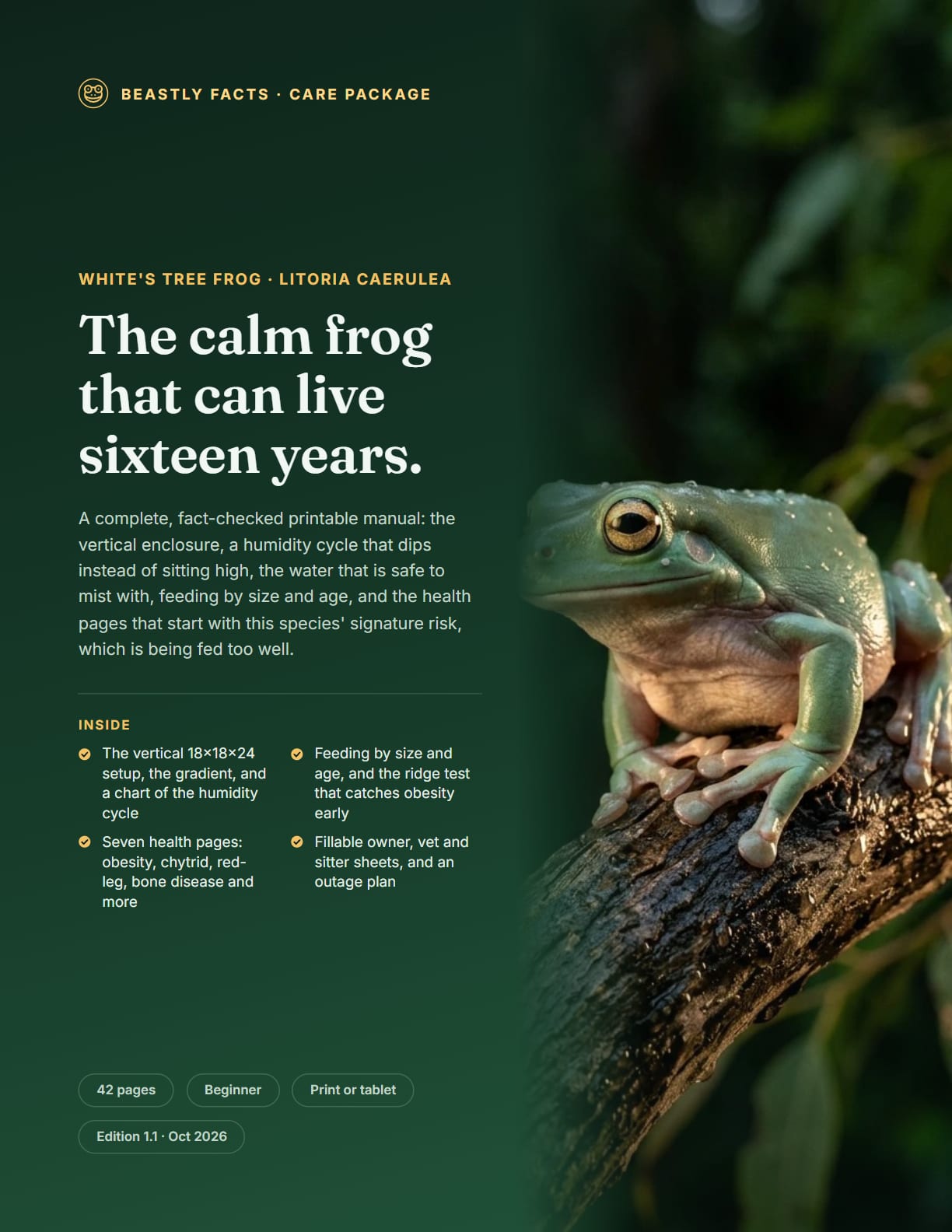
The White's Tree Frog Care Package adds one line to this budget: $8.99 for a 42-page PDF with the setup shopping list, the budget sheet and the whole care guide on paper.
Frequently Asked Questions
How much does a White's tree frog itself cost?
$20 to $60 for a standard animal. Blue and other designer color morphs cost a bit more. Captive-bred stock is widely available, and it's the better choice over wild-caught.
What does a full White's tree frog setup cost upfront?
$305 to $595, and $355 to $745 with the first vet exam. That covers an 18x18x24 inch vertical terrarium, a side-mounted heat mat on a thermostat, a low-level UVB fixture, a timer for the lights, a thermometer and hygrometer, coarse substrate, live and artificial plants, hides, climbing branches, a shallow water dish, a spray bottle, water conditioner, blunt feeding forceps and the first supply of supplements.
What are the ongoing monthly costs for a White's tree frog?
Roughly $10 to $25 a month. The recurring line items, feeder insects, supplements, two UVB tubes a year and water conditioner, come to $150 to $245 across a year, $200 to $395 with a yearly vet exam, and substrate and modest electricity go on top of that. This isn't a species with heavy recurring expenses once the enclosure is built.
How much does veterinary care cost for a White's tree frog?
$50 to $150 for an exam with an exotic or amphibian-experienced vet. An emergency visit fee alone often starts around $250 at specialty hospitals, before treatment. Amphibian veterinary care has real limitations, which puts the weight on husbandry.
How long do White's tree frogs live, and how does that affect budgeting?
The average is about 16 years, and one individual reached 21 in human care. More conservative figures run 10 to 15-plus years. Either way, plan on well over a decade of ongoing care.
More on the White's Tree Frog
White's Tree Frog care guide
🐸 How to Handle a White's Tree Frog
🐸 Common White's Tree Frog Health Issues (Obesity Is the Signature Risk)
🐸 White's Tree Frog Enclosure Setup: What Your Frog Actually Needs
🐸 White's Tree Frog Feeding: Reading the Ridges Above the Eardrum
🐸 White's Tree Frog Enrichment: Plants Changed the Frogs, Not Just the Tank
Recommended Gear
As an Amazon Associate I earn from qualifying purchases through the links above, at no extra cost to you.

Written by Michael Ryan
Mike keeps two rescued bearded dragons, Dex and Cera, and writes the care guides on BeastlyFacts from his own research and mistakes. He is not a veterinarian.
More about Michael Ryan →