White's Tree Frog Enclosure Setup: What Your Frog Actually Needs
On This Page▾

White's tree frogs are a forgiving amphibian to set up correctly once you understand the one detail that trips up a lot of first-time keepers: humidity that's too constantly high causes more problems than humidity that dips a bit low between mistings.
Enclosure Size
18 inches long by 18 inches wide by 24 inches tall is the standard minimum for one adult, sized for a vertical, arboreal species. A 18x18x24 inch terrarium is the size to buy for a single frog; a 20-gallon tall tank is the smallest figure veterinary sources give, and 24x18x24 inches works well for a small group of two to four.
Temperature
Keep a gradient: cool side around 70 to 75°F, a basking area around 80 to 85°F, dropping into the mid-70s at night. A low-wattage bulb or a side-mounted heat mat provides the warmth, this species doesn't need intense heat, just a gentle, reliable gradient.
Humidity: The Detail Worth Getting Right
Keep a baseline around 50 to 60%, with misting spikes up to 70 to 80% once or twice daily, then let it drop back down between mistings. Mist in the evening, when this nocturnal frog wakes up. Constant, unbroken high humidity is directly linked to bacterial and red-leg issues, so resist the instinct to keep things perpetually damp.
Use only dechlorinated tap water or spring water for misting and drinking, never distilled or reverse-osmosis water. The amphibian quarantine and water guide has the reason: distilled and RO water are usually not electrolyte-balanced, and can be fatal to an amphibian without rebalancing.
Substrate
Coarse orchid bark, coco fiber or coco husk, or a bioactive soil mix, kept lightly moist rather than soggy. Avoid fine, loose substrate that's easy to accidentally ingest during feeding.
Lighting
Low-level UVB is recommended, this species survives without it but genuinely does better with it. A low-output 5% T5 HO bulb works well, positioned so the basking branch sits at least 6 inches below the fixture.
A T5 UVB bulb can keep glowing visibly long after its actual UVB output has crashed. That's exactly why the bulb gets replaced every 6 to 8 months on a schedule, regardless of whether it still looks like it's working.
Furnishings
Sturdy branches for climbing, since this is an arboreal species that spends real time off the ground, along with broad leaves or platforms for resting, and a water dish that's easy to keep clean. Make it wide enough for the frog to sit in and soak, but shallower than the frog is tall when it sits with its legs folded: tree frogs are weak swimmers, and a deep dish can drown one.
Cleaning Routine
- Daily: spot clean, wiping droppings and waste off the leaves, branches and glass, and pull uneaten insects within a few hours of feeding. Empty, rinse and refill the water dish every day, or at the very least every other day, because the frog soaks and defecates in it.
- As needed, the more often the better: take out bark and moss and wash them. Paper towel lining, if used, is changed often.
- Soil: replace it when it starts to smell or stays waterlogged, since wet, dirty substrate is what builds ammonia.
Clean with plain hot water. Soap and disinfectant can leave a residue the frog absorbs through its skin, so when something does need disinfecting, rinse it very well and dry it completely before it goes back. Refill the dish with dechlorinated water, never fresh tap water. Do the washing in a dedicated tub or a utility sink, never a kitchen sink or a bathtub people use, and wash your hands afterward: a healthy frog can still carry Salmonella.
Once this setup is dialed in, this is a species that, unlike the Pacman frog, tolerates being picked up.
UVB is the one item on this list where the bulb distance matters as much as the bulb, and the complete UVB lighting guide sets both by bulb type.
Sources & Further Reading
Last reviewed 16 Jul 2026 · 5 sources
- Dr. Gregory Rich, Avian and Exotic Animal Hospital of Louisiana: White's Tree Frog Care Sheet
- Tree of Life Exotic Pet Medical Center: White's Tree Frog Care
- Chicago Exotics Animal Hospital: White's Tree Frog Care
- Dr Michaela Betts, Exotics Keeper Magazine: A Vet's Care Guide for White's Tree Frogs
- Reptiles and Amphibians, Healthy Pets, Centers for Disease Control and Prevention
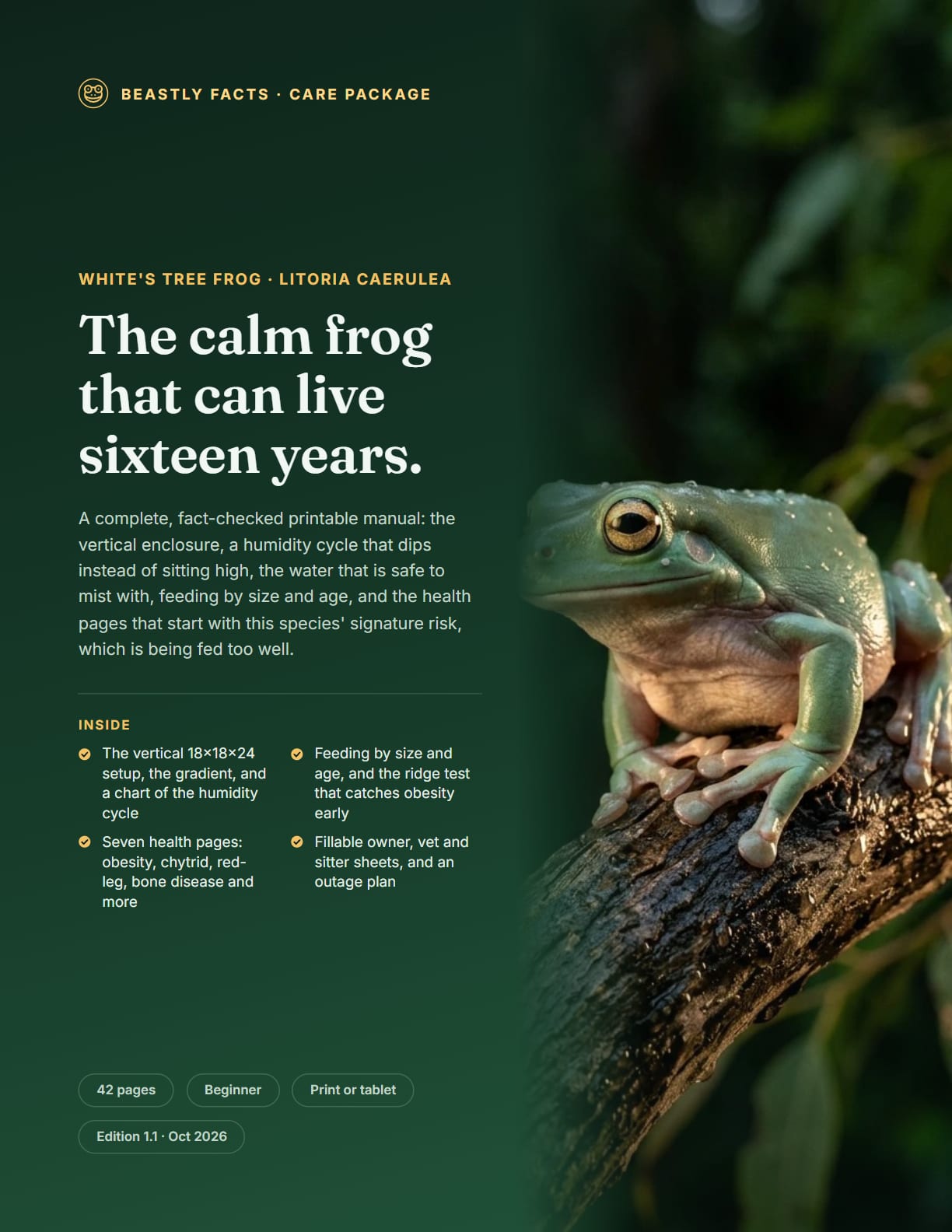
The White's Tree Frog Care Package carries this setup as a checklist with the targets to hit, in a 42-page PDF you can keep by the enclosure, $8.99.
Frequently Asked Questions
What size enclosure does a White's tree frog need?
18x18x24 inches is the standard minimum for one adult, with the height there because this is a vertical, arboreal species. A small group of two to four does well in 24x18x24 inches.
What temperature range does a White's tree frog need?
Cool side 70 to 75°F, basking area 80 to 85°F, mid-70s overnight. Intense heat is not the goal here, so a low-wattage bulb or a side-mounted mat is enough to hold that gentle, reliable gradient.
What humidity level is correct for a White's tree frog?
Hold a baseline of 50 to 60% and let misting push it to 70 to 80% once or twice a day, then let it fall. Humidity that never drops is linked to bacterial and red-leg issues, so damp around the clock is the thing to avoid.
Does a White's tree frog need UVB lighting?
Recommended, though not strictly required: the species survives without UVB and does better with it. Use a low-output 5% T5 HO tube with the basking branch at least 6 inches below the fixture, and replace it every 6 to 8 months even while it still lights up.
What substrate is safe for a White's tree frog?
Coarse orchid bark, coco husk, or a bioactive soil mix, kept lightly moist and not soggy. Skip fine, loose substrate, which is easy to swallow during feeding.
More on the White's Tree Frog
White's Tree Frog care guide
🐸 How Much Does a White's Tree Frog Really Cost?
🐸 How to Handle a White's Tree Frog
🐸 Common White's Tree Frog Health Issues (Obesity Is the Signature Risk)
🐸 White's Tree Frog Feeding: Reading the Ridges Above the Eardrum
🐸 White's Tree Frog Enrichment: Plants Changed the Frogs, Not Just the Tank
Recommended Gear
As an Amazon Associate I earn from qualifying purchases through the links above, at no extra cost to you.

Written by Michael Ryan
Mike keeps two rescued bearded dragons, Dex and Cera, and writes the care guides on BeastlyFacts from his own research and mistakes. He is not a veterinarian.
More about Michael Ryan →