Common White's Tree Frog Health Issues (Obesity Is the Signature Risk)
On This Page▾

White's tree frogs are hardy for an amphibian, but they have one health issue that shows up more in this species than almost any other pet frog, driven by the same "enthusiastic eater" trait that makes them such satisfying feeders to watch.
Obesity
This is the defining health risk for the species, often described as a notorious tendency. Fat deposits build up visibly over the tympanum (the external eardrum) and in the armpit area, and sustained obesity raises the risk of hepatic lipidosis, a serious fatty liver condition.
This is manageable entirely through diet: limit high-fat feeders like waxworms and superworms to once a week at most, and keep adult feeding to roughly 3 to 4 appropriately sized insects, 2 to 3 times a week, instead of free-feeding. Advanced cases with liver involvement need a vet.
White's tree frogs are sometimes nicknamed "dumpy tree frogs" for their round, waxy-skinned build, and a moderate fat roll over the shoulders is actually normal for the species rather than a sign of overfeeding. The line between the breed's natural "dumpy" look and genuine obesity comes down to fat visibly bulging over the tympanum and armpits, not the frog's general roundness.
Chytridiomycosis
A fungal disease that spreads through introduced or contaminated animals and water, causing lethargy, weight loss, and, without treatment, death. This is a genuine emergency, quarantine any new or suspect animal immediately and get to a vet right away. Prevention through proper quarantine of new frogs, which is where the actual window sits, is the real defense here, since treatment options are limited once it takes hold.
Red-Leg Syndrome
A bacterial infection, typically Aeromonas, showing up as redness on the belly and legs, lethargy, and loss of appetite. This needs a vet. It's usually traced back to a dirty or poorly ventilated enclosure, exactly the kind of environment that's fully within an owner's control.
Bacterial and Skin Infections
Enclosures kept too humid without adequate ventilation, or with an infrequently cleaned water dish, invite these. Always see a vet if signs appear, but the real fix is usually in the setup itself, keeping humidity from sitting constantly high and using a properly conditioned, regularly cleaned water dish.
Normal Skin Sloughing
A White's tree frog sheds the whole outer layer of its skin on a regular cycle, and at room temperature that cycle is short: about every 2 days at 73 to 91°F and every 3 to 4 days in cooler conditions. The frog eats its shed skin as it comes away, so a keeper rarely sees a shed happen, and almost never finds shed skin lying in the enclosure. That is normal.
Two things are not. Shed skin lying uneaten in the enclosure is a warning sign, because a sick frog loses its appetite and stops eating its slough. And a frog sloughing far more often than usual can be fighting a skin infection: in chytrid-infected frogs, heavier infections go with faster sloughing. Either one is a reason to book the vet, with a note of what you saw.
Household Chemicals and Scents
A frog's skin absorbs what touches it, and the frog sits in the water dish that collects whatever lands on it. Scented cleaners are the main household danger: phenol products such as Pine-Sol and Lysol, and formaldehyde and other aldehydes, are highly toxic to amphibians. Keep them out of the frog's room entirely, and ventilate the room whenever any cleaner or spray has to be used nearby, because the fumes are part of the hazard. Water for the dish and the mister has to be dechlorinated, and live plants go in free of fertilizer or pesticide residue, in the pot and on the leaves.
Clean the enclosure itself with plain hot water. Soaps and disinfectants can leave residue the frog absorbs, so when disinfecting is necessary, rinse very well and let everything dry before the frog goes back in.
Metabolic Bone Disease
From inadequate calcium supplementation or missing UVB. This needs a vet, and it's preventable with proper calcium supplementation and low-level UVB lighting from the start.
The Husbandry Pattern Worth Remembering
Overfeeding, especially with fatty feeder insects, is directly responsible for the obesity that defines this species' most common health problem. A dirty or under-ventilated enclosure leads to both red-leg and general bacterial infections. And skipping quarantine on a new frog is how chytrid fungus and other contagious issues get introduced to an otherwise healthy setup. All three are entirely preventable, and a reliable thermometer and hygrometer makes it easy to catch the humidity swings before they become an infection.
Pacman frogs, a very different amphibian, have their own signature health risks tied to their sedentary ambush-predator lifestyle.
Sources & Further Reading
Last reviewed 16 Jul 2026 · 5 sources
- Tree of Life Exotic Pet Medical Center: White's Tree Frog Care
- Cramp RL, McPhee RK, Meyer EA, Ohmer ME and Franklin CE (2014). First line of defence: the role of sloughing in the regulation of cutaneous microbes in frogs. Conservation Physiology 2(1): cou012
- Ohmer MEB et al. (2017). Skin sloughing in susceptible and resistant amphibians regulates infection with a fungal pathogen. Scientific Reports
- Roscoe D. Keeping It Clean: Cleaning and Disinfecting Your Reptile or Amphibian's Enclosure, Wisconsin Herpetological Association
- Dr. Gregory Rich, Avian and Exotic Animal Hospital of Louisiana: White's Tree Frog Care Sheet
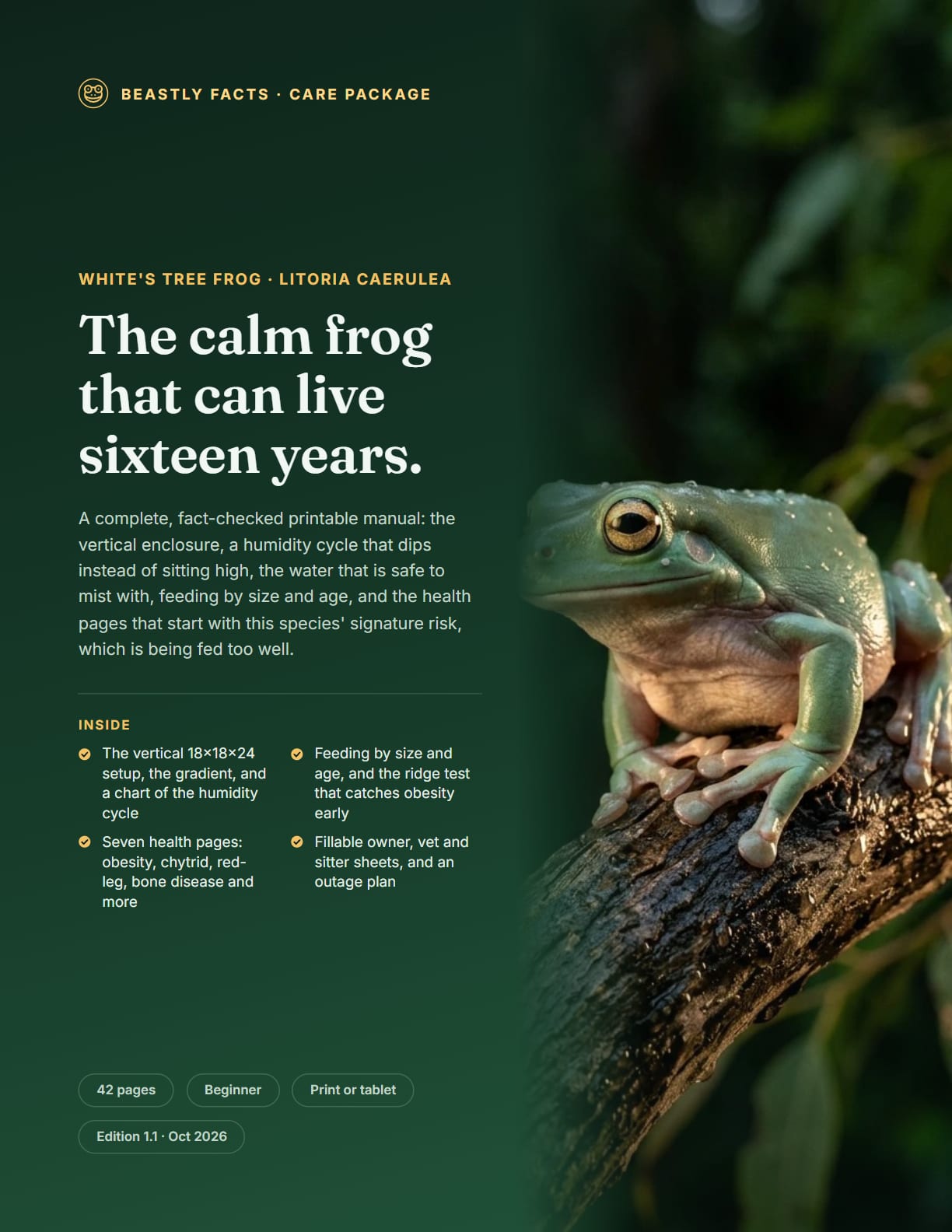
A sick White's tree frog is no time to be scrolling. The White's Tree Frog Care Package puts these red flags, a symptom quick reference and an emergency card on paper, in a 42-page PDF, $8.99.
Frequently Asked Questions
Why do White's tree frogs get obese so often?
It's a notorious tendency in the species, driven by an enthusiastic-eater trait combined with overfeeding, especially fatty feeders like waxworms and superworms. Fat deposits build up visibly over the tympanum and in the armpit area, and sustained obesity raises the risk of hepatic lipidosis, a serious fatty liver condition.
How do I prevent obesity in a White's tree frog?
High-fat feeders, waxworms and superworms, go to once a week at most. For an adult, 2 to 3 feedings a week of roughly 3 to 4 appropriately sized insects, rather than free-feeding. Advanced cases with liver involvement need a vet.
What is chytridiomycosis and why is it an emergency?
A fungal disease carried in by introduced or contaminated animals and water. It causes lethargy, weight loss, and death without treatment. Quarantine any new or suspect animal immediately and get to a vet, treatment options are limited once it takes hold.
What causes red-leg syndrome?
Bacteria, typically Aeromonas. Redness on the belly and legs, lethargy, and loss of appetite are the signs. The source is usually a dirty or poorly ventilated enclosure, which is fully within an owner's control. It needs a vet.
What's the pattern behind most White's tree frog health problems?
Three things. Overfeeding, fatty feeder insects especially, drives the obesity that defines this species' most common problem. A dirty or under-ventilated enclosure brings red-leg and other bacterial infections. And skipping quarantine on a new frog is how chytrid fungus gets in. All three are entirely preventable.
More on the White's Tree Frog
White's Tree Frog care guide
🐸 How Much Does a White's Tree Frog Really Cost?
🐸 How to Handle a White's Tree Frog
🐸 White's Tree Frog Enclosure Setup: What Your Frog Actually Needs
🐸 White's Tree Frog Feeding: Reading the Ridges Above the Eardrum
🐸 White's Tree Frog Enrichment: Plants Changed the Frogs, Not Just the Tank
Recommended Gear
As an Amazon Associate I earn from qualifying purchases through the links above, at no extra cost to you.

Written by Michael Ryan
Mike keeps two rescued bearded dragons, Dex and Cera, and writes the care guides on BeastlyFacts from his own research and mistakes. He is not a veterinarian.
More about Michael Ryan →