Common Pacman Frog Health Issues and What Causes Them
On This Page▾

Pacman frogs are hardy, but two specific problems, both directly tied to how they're fed and housed, account for the vast majority of health issues in this species.
Obesity
Pacman frogs are, in a very real sense, programmed to eat whenever the opportunity presents itself, and they don't self-regulate the way some other pets do. This is genuinely one of the most common issues keepers run into.
Manageable entirely through disciplined feeding: adults should eat roughly 1 to 3 times a week, not on the more frequent schedule appropriate for a growing juvenile. Overfeeding, especially with fatty prey like pinky mice as a dietary staple, is the direct cause.
Impaction
This is the health issue most specific to this species, and it can be fatal. Pacman frogs strike explosively at prey and, in the process, frequently ingest whatever is on the ground around it, loose substrate, sand-coated feeders, or prey that's simply too large to pass safely.
Watch for: a hard lump in the belly, bloating, and refusal to move.
Mild cases sometimes resolve with warm soaks, but a blockage that doesn't pass needs a vet, this can be fatal if left untreated. Prevention is straightforward: use fine coco fiber rather than gravel or coarse bark, and feed with tongs into a separate dish rather than directly on the substrate, both meaningfully reduce the chance of accidental ingestion.
When conditions turn hot and dry, wild Pacman frogs can seal themselves inside a hardened mucus cocoon and go dormant for months at a time, a survival behavior called estivation. It's a genuine adaptation, not illness, though a young frog under about a year old going dormant in captivity is a different story and worth a vet call instead of a wait-and-see approach.
Metabolic Bone Disease
Caused by missing calcium and vitamin D3 supplementation, which is what covers this species when no UVB is provided.
Watch for: a droopy jaw, bowed legs, and twitching.
This needs a vet, and it's fully preventable with proper calcium and vitamin D3 supplementation from the start.
When a Healthy Adult Aestivates
A frog kept at steady humidity has no reason to aestivate, so an adult that digs in, stops eating, and wraps itself in layers of dry, shed skin is telling the keeper the enclosure has dried out or cooled down. It is not an illness in an adult, and it is not something to force as routine.
Leave the cocoon alone: peeling it off strips the water the frog is holding. Check the thermometer and hygrometer, then bring the frog out slowly over a few days by raising the temperature back into the 75 to 85°F daytime range and re-moistening the substrate, the way a summer rain soaks down into the soil. The cocoon softens, the frog sheds it, and it urinates heavily, so mist regularly and spot clean the fouled substrate as it wakes.
One case goes to the vet instead of waiting. A dormant frog's metabolism slows so far that food still in its gut decays and turns toxic, which is why breeders empty the gut before any planned dormancy. An adult that sealed itself up within a few days of a large meal, or that stays dormant after the enclosure is back in range, needs an exam.
Normal Shedding
Some Pacman frogs shed daily and others every few weeks. A healthy shed comes off in one complete piece and the frog usually eats it, so many keepers never see one. Shed that stays stuck in patches points to humidity below the 60 to 80% the species needs.
Red-Leg and Bacterial Infections
Red spots on the belly or thighs, cloudy eyes, and lethargy point here. This is an emergency, quarantine and get to a vet promptly. It's usually tied to a dirty enclosure, dirty water, or general stress, and shows up more often in new or young frogs whose immune systems haven't fully settled.
Bloat and Edema
Severe swelling combined with an inability to right itself is a genuine emergency, it could be advanced impaction, organ failure, or fluid retention, and needs immediate veterinary attention, with no wait-and-see.
The Husbandry Pattern Worth Remembering
Feeding on loose or coarse substrate is the direct cause of the impaction risk that defines this species' most dangerous health problem. Unlimited or overly frequent feeding causes the obesity that's nearly as common. And a dirty, poorly maintained enclosure invites the bacterial infections rounding out this list. Get feeding discipline and substrate choice right, and this is a genuinely low-drama pet to keep healthy, an easy substrate swap and a dish-and-tongs feeding routine prevent most of what's on this list. This is also exactly why hand-feeding is a mistake, a bite mistake and an impaction mistake trace back to the same underlying instinct: this species strikes at anything nearby without discriminating.
The Yearly Vet Visit
A Pacman frog should see a vet that treats amphibians once a year, and sooner for dry skin, eye or nasal discharge, skin lesions, lethargy, or appetite loss outside a known cause. A healthy frog at that visit has clear eyes, intact moist skin, a pink mouth, a round body, and a good appetite.
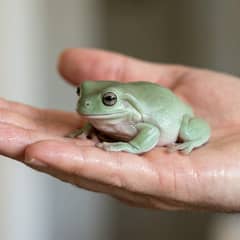
The White's tree frog, a climber that is fed less aggressively and sits on branches instead of in substrate, shares the obesity and bone disease risks but not the substrate-strike impaction that defines this species.
Sources & Further Reading
Frequently Asked Questions
What is the most common health issue in Pacman frogs?
Obesity. These frogs eat whenever food appears and don't self-regulate the way some pets do. Adults should eat roughly 1 to 3 times a week, not on the juvenile schedule, and overfeeding on fatty prey like pinky mice as a staple is the direct cause.
What causes impaction in Pacman frogs, and is it serious?
Yes, it can be fatal. A Pacman frog strikes explosively and often swallows whatever is on the ground with the prey: loose substrate, sand-coated feeders, or an item too big to pass. A hard lump in the belly, bloating, and refusal to move are the signs. Warm soaks sometimes clear a mild case, but a blockage that doesn't pass needs a vet.
How do you prevent impaction in a Pacman frog?
Fine coco fiber instead of gravel or coarse bark, and feeding in a separate dish instead of straight off the substrate. Both cut the chance of swallowing substrate, which is what drives the most dangerous problem this species has.
What does metabolic bone disease look like in a Pacman frog?
A droopy jaw, bowed legs, and twitching. Too little calcium and vitamin D3 in the diet is the cause, since a properly supplemented diet is what stands in for UVB here. Get a vet involved, and supplement correctly from the start to avoid it entirely.
What are the signs of red-leg or a bacterial infection in a Pacman frog?
Red spots on the belly or thighs, cloudy eyes, and lethargy. Treat it as an emergency: quarantine the frog and get to a vet promptly. The usual trigger is a dirty enclosure, dirty water, or stress, and it turns up more in new or young frogs.
More on the Pacman Frog
Pacman Frog care guide
🐸 How Much Does a Pacman Frog Really Cost?
🐸 Should You Handle a Pacman Frog? Rarely, and Carefully
🐸 Pacman Frog Enclosure Setup: Small Footprint, One Big Rule About Substrate
🐸 Pacman Frog Feeding: Schedule, Diet, and Why They Stop Eating
🐸 Pacman Frog Enrichment: An Animal Built to Do Nothing
Recommended Gear
As an Amazon Associate I earn from qualifying purchases through the links above, at no extra cost to you.

Written by Michael Ryan
Mike keeps two rescued bearded dragons, Dex and Cera, and writes the care guides on BeastlyFacts from his own research and mistakes. He is not a veterinarian.
More about Michael Ryan →