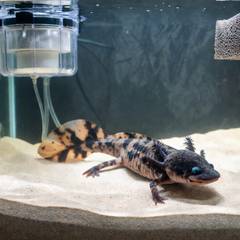
Tiger Salamander Feeding: Worms and Crickets at Night, Twice a Week, and an Animal That Never Says No
On This Page▾

A tiger salamander will eat anything it can fit in its mouth and will keep eating as long as food appears, which is why it is one of the easiest amphibians to feed and one of the easiest to make fat. Here is the diet, the portion the animal will not set for itself, the supplement schedule by age, and the one reason a salamander stops eating that is not a problem.
Feeding Schedule by Age
| Age | How often | How much |
|---|---|---|
| Larva, in the water | Daily | Small live foods: blackworms, daphnia, small earthworm pieces |
| Juvenile, on land | Every 1 to 2 days | Small amounts, more often |
| Adult | 2 to 3 times a week | Small measured quantities, at night |
The portion is the keeper's, because the salamander does not stop when it has had enough. Two or three earthworms or a few crickets is a meal for an adult, and a salamander that is going round and heavy behind the front legs is getting more than that. Young salamanders are fed smaller amounts more often, which suits a growing animal better than large meals.
Feed at night, off the substrate. A tiger salamander is active only after dark and hunts by striking hard at movement, and one that strikes at a worm on loose soil takes a mouthful of soil with it. Offer food from soft-tipped tongs, on a flat dish, or in a bare feeding tub.
What Tiger Salamanders Eat
In the wild, worms, snails, slugs, insects and spiders, and anything small enough to swallow, from young mice and small frogs to snakes and other salamanders. The larvae start on small crustaceans and insect larvae and grow into eating tadpoles, smaller salamander larvae and small fish. A captive adult is fed a narrower version of that.
Worms and crickets as the bulk. Earthworms and nightcrawlers with crickets make up the majority of a good captive diet, offered in small quantities. Waxworms, superworms, silkworms and roaches rotate in for variety, and an earthworm is the best single item on the list: soft, wet, calcium-rich and easy to portion.
Gut-load the insects. A cricket is only as good as what it ate, and the gut-loading guide covers the feeder diet. Earthworms need no loading.
Dust by age. A calcium and vitamin D3 supplement plus a multivitamin goes on the food at every feeding while the animal is growing, and every second to fourth feeding once it is adult. The pacman frog feeding guide runs the same schedule for the other amphibian that eats until stopped.
Mice, rarely if ever. Some large adults will take a pre-killed pinky or fuzzy mouse, and it is a rare treat at most, never a staple and never live. A salamander on regular rodents is on the road to the obesity below.
Foods to Avoid
Anything wider than the head. Live rodents, which bite. Mealworms as a staple, which are hard-shelled and fatty. Wild-caught insects from sprayed ground. Any feeder that has been in contact with soap, pesticide or fertilizer, since a salamander absorbs what it touches through its skin as readily as what it eats. And a second meal because the animal is still begging, which it always will be.
The Problem the Species Runs Into
Obesity. A tiger salamander that is fed whenever it looks hungry, which is always, becomes a heavy, lethargic animal with fat deposits behind the head and legs and a shortened life. The fix is the schedule above and nothing else: measured meals, two or three times a week, and the will to ignore an animal that comes to the glass every evening.
Why Tiger Salamanders Stop Eating
It is going down for the winter. Wild tiger salamanders spend most of the year in burrows and move only during autumn rains to breed in winter or early spring, and a captive adult follows the same clock: it slows in autumn, eats less, and may vanish under the substrate for weeks. A fossorial salamander that is rarely visible is not a sick one.
It is cold. A room in the low 60s slows feeding to nothing; the species needs no heat, but it does need the room to hold above about 60°F.
It is in shed. A day off food, and a salamander that eats its shed.
It is metamorphosing. A larva turning into a land animal stops eating for days around the change, as its gills go and its diet switches from the water to the land.
It is new. A week to settle, in the dark, with a shallow dish of conditioned water.
When to Worry
Because this species eats so readily, a refusal is a signal. A salamander that is burrowed in autumn in a cool room is resting. One that refuses in a warm enclosure, or that is losing weight, bloated, or showing reddened or ulcerated skin, sees an exotic vet, and the tiger salamander health guide sorts those signs. The amphibian tubbing and salt baths guide covers the first-aid tub for the skin problems that stop a salamander eating.
Two or three worms at night, twice or three times a week, dusted, from tongs. A tiger salamander fed that way and left to burrow when it wants to will live fifteen years and never once turn down a meal. The restraint is the keeper's.
Sources & Further Reading
❓ Frequently Asked Questions
How often should I feed a tiger salamander?
A growing juvenile every one to two days, in small amounts. An adult two to three times a week, in small measured quantities, at night. The animal does not stop when it has had enough, so the portion is the keeper's decision, and obesity is the problem this species runs into most.
What do tiger salamanders eat?
Earthworms and nightcrawlers with crickets make up the bulk of it, with waxworms, superworms, silkworms and roaches rotated in. In the wild they take worms, snails, slugs, insects and spiders, and anything small enough to swallow, including other salamanders. A thawed pinky mouse is a rare treat at most for a large adult, and never a live one.
Do I need to dust the food?
Yes. A calcium and vitamin D3 supplement plus a multivitamin on the feeders at every feeding while the animal is growing, and every second to fourth feeding once it is adult. Offer food from tongs or off the substrate, since a salamander that strikes at a worm takes a mouthful of whatever the worm was lying on.
Why has my salamander stopped eating?
This is such a voracious species that a refusal is a signal rather than fussiness. In autumn it is usually the animal slowing toward a burrowed winter rest, and a cold room does the same. A refusal in a warm enclosure, with weight loss, a bloated belly or skin changes, is the vet visit.
📰 More on the Tiger Salamander
📘 Tiger Salamander care guide
🦎 How Much Does a Tiger Salamander Really Cost?
🦎 How to Handle a Tiger Salamander (And Why You Mostly Won't See One)
🦎 Common Tiger Salamander Health Issues
🦎 Tiger Salamander Enclosure Setup: Deep Substrate for a Species That Lives Underground
🦎 Tiger Salamander Enrichment: Underground Is Where the Animal Lives
🛒 Recommended Gear
As an Amazon Associate, we earn from qualifying purchases through the links above - at no extra cost to you.
Written by Michael Ryan
Mike keeps two rescued bearded dragons, Dex and Cera, and writes the care guides on BeastlyFacts from his own research and mistakes. He is not a veterinarian.
More about Michael Ryan →Comments
No comments yet - be the first!