Rummy-Nose Tetra Feeding: Wild Diet, Staples, and How Often to Feed
On This Page▾

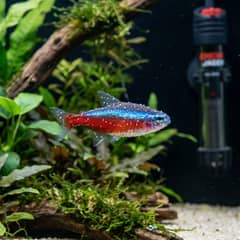
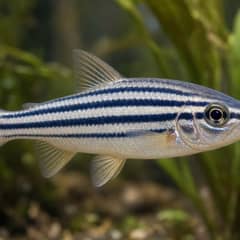
The rummy-nose tetra (Petitella bleheri, formerly Hemigrammus bleheri) eats almost anything put in front of it, as long as it fits. An adult reaches only about 2 inches (5 cm), it has a small mouth, and the whole job of feeding one comes down to three things: small food, plenty of variety, and portions the school can finish.
Feeding Schedule by Life Stage
Rummy-nose fry are notoriously hard to feed, juveniles get several small meals, and adults need food at least once a day.
| Stage | What | How often and how much |
|---|---|---|
| Fry | Infusoria for the first few days after they swim free, then live vinegar eels, microworm or a powdered fry food, and live baby brine shrimp as soon as they can take it | Up to 5% of body weight a day, in portions small enough to be cleared |
| Juvenile | The adult foods at a smaller size: nano pellets, finely crumbled flake, baby brine shrimp | Three to four small meals a day, tapering to the adult schedule |
| Adult | Flake, granules or micro-pellets as the staple, with small live and frozen foods alongside | At least once a day, about 3% of body weight: a very small pinch spread across the whole school |
The eggs hatch in 24 to 36 hours and the fry swim free 3 to 4 days later. Both are sensitive to light early on, so the rearing tank stays dim. The fry are so tiny that feeding them is the hard part of breeding this fish, and a mature 10-gallon breeding tank with plenty of mulm gives them microfauna to pick at between meals. Moving them onto live baby brine shrimp as early as they can manage it improves both growth and survival. Adult rummy-noses eat their own eggs given the chance, so breeders move the adults out once eggs or fry appear.
For adults, judge the portion by watching the fish eat. If pellets are still sinking untouched once the school loses interest, cut the next pinch down, because leftovers rot into ammonia that the nitrogen cycle in a mature tank then has to process. Watching also shows whether the rummy-noses are eating at all.
What Rummy-Noses Eat, in the Wild and in the Tank
In the middle Rio Negro basin of Brazil, the stomach contents of 177 wild fish show an omnivore, and most of what it ate was produced inside the water itself rather than dropping in from the forest above. The menu shifted with the river. During the flood, microcrustaceans made up a larger share. In the dry season the fish leaned more on filamentous algae, chironomid (midge) larvae and fragments of plants.
That mix of tiny animal prey and plant material is the template for the tank: a dried staple that covers the basics, with small crustaceans and insect larvae offered alongside it.
Base the daily diet on a quality dried food: flake, granules or a slow-sinking micro-pellet. A varied diet is what brings out the best color and keeps any one nutrient from running short, so rotate between two or three dried foods instead of relying on one tub. Getting the fish to eat is seldom the problem: rummy-noses chase almost any community food across the tank, eagerly enough that at least one fish store uses them to try out new foods.
Size every food to the mouth. Pick nano or micro-pellet grades, crumble flake before it goes in, and choose live and frozen foods no bigger than baby brine shrimp or daphnia.
Small live and frozen foods round out the diet and come closest to the microcrustaceans and midge larvae of the wild menu. Good choices include baby brine shrimp, brine shrimp, daphnia and mosquito larvae. Krill and salmon-based foods are also fed for color.
Wild rummy-noses breed on the river's schedule. In the middle Rio Negro, females ripen as the flood rises between December and May, the same season wild fish carry their fullest stomachs, and spawning peaks as the flood ends, from March to May.
Source: Boletim do Instituto de Pesca (dos Anjos, Yamamoto and Magalhães 2017)
Daphnia, one of the closest live matches to the wild diet, comes with a catch: it and cyclops are common intermediate hosts of Camallanus, a parasitic worm that infects the fish that eat them.
An opened container of dried food kept at room temperature is thrown out 2 months after opening, and one kept in the freezer after 6 months. Frozen brine shrimp, bloodworm and similar foods last a year, and once thawed they never go back in the freezer.
Foods to Avoid
- Anything too big for the mouth. Flake and pellets sized for bigger fish are hard for a rummy-nose to take, and whatever it cannot eat rots on the substrate.
- Live tubifex worms. Tubificid worms are the host of the parasite behind whirling disease, and keeping fish away from them is how that disease is prevented.
- Pond-caught cyclops and daphnia. Wild-collected crustaceans are the same Camallanus hosts as cultured ones.
Why Rummy-Noses Stop Eating
- Boisterous or bigger tankmates. This is a gentle fish that loses out at feeding time to rowdy or much larger company, which can take most of a meal before it gets a share. Companions of similar size and calm temperament, picked with the compatibility checks for a shared tank, keep the food going to the fish it was meant for.
- Stress from the tank. Bad water and low temperatures both stress a rummy-nose, and in alkaline water rising nitrate can cause a marked loss of color as the first sign.
- Internal parasites. Spironucleus, an intestinal flagellate, causes weight loss and loss of appetite, and it kills fry and juveniles.
When to Worry
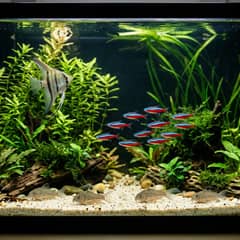
A well-fed rummy-nose school is busy and tight, with bright red heads and slightly rounded bellies. Mature females are noticeably rounder in the body than males, so a plump female is not a sign of overfeeding. The signs that need action:
- The whole school pale. Food alone will not keep the red nose bright, and a nose that fades on every fish at once points to the tank, and a school that has gone pale needs a water test and a look at the heater before anyone changes the menu. Fish that have just arrived or were just chased with a net can look washed out too, so give them half an hour, or another day, to color up before reading anything into it.
- A nose that stays pale after the water tests clean. Disease and bullying fade the red as well, and the rummy-nose tetra health guide sorts out which one it is.
- One fish thinning while the rest eat. That pattern points to the fish, not the tank, and an internal parasite needs a diagnosis before any medication goes in.
When You Go Away
Someone has to feed the fish while you are gone, either a person or an automatic feeder, and both can put in too much for a school this small.
For a sitter, measure out every meal before you go, for example into a labeled pill organizer with one compartment per feeding, so no extra food goes in. Show them once how it works, and leave your number.
For an automatic feeder, set it up and test it for several days before the trip, using a food it dispenses well, and check that it is not jamming or overfeeding.
A rummy-nose fed small, varied food in portions it can finish has almost everything the wild Rio Negro gave it.
Sources & Further Reading
Last reviewed 31 Oct 2026 · 3 sources
- Reproductive biology and feeding habits of Hemigrammus bleheri (Characiformes: Characidae), an ornamental fish in the middle Negro River Basin, Amazonas State, Brazil, dos Anjos, Yamamoto and Magalhães (2017), Boletim do Instituto de Pesca
- Petitella bleheri (Firehead Tetra), Seriously Fish
- Merck Veterinary Manual: Nutritional Diseases of Fish, Merck Veterinary Manual (Petty, Francis-Floyd and Yanong); Parasitic Diseases of Fish, Merck Veterinary Manual (Petty, Francis-Floyd and Yanong)
Frequently Asked Questions
What do rummy-nose tetras eat?
They are omnivores. A small dried food such as micro-pellets, granules or crushed flake makes the base, with baby brine shrimp, daphnia and mosquito larvae added live or frozen.
How often should I feed rummy-nose tetras?
At least once a day. Keep each portion small enough that the school clears it before any reaches the substrate.
Can rummy-nose tetras eat flakes?
Yes. Flake works as a staple once it is crumbled down to suit a fish of about 2 inches (5 cm) with a small mouth.
What do rummy-nose tetras eat in the wild?
A study of 177 wild fish from the middle Rio Negro found microcrustaceans, chironomid larvae, filamentous algae and plant fragments, with the mix changing between the flood and the dry season.
What do baby rummy-nose tetras eat?
Infusoria first, then live vinegar eels or a powdered fry food. Adults eat eggs, so fry are raised without them.
Why is my rummy-nose tetra not eating?
Check the tank before the food. Bigger or rowdier tankmates taking the meal, poor water, a cold tank and internal parasites are the usual causes, and a school whose red noses have faded at the same time points to the water.
How do I feed rummy-nose tetras while I'm on vacation?
Leave a sitter meals already measured into a labeled pill organizer, one compartment per feeding, or use an automatic feeder you have run at home for several days to make sure it neither jams nor overfeeds.
More on the Rummy Nose Tetra

Recommended Gear
As an Amazon Associate I earn from qualifying purchases through the links above, at no extra cost to you.
Written by Michael Ryan
Mike keeps two rescued bearded dragons, Dex and Cera, and writes the care guides on BeastlyFacts from his own research and mistakes. He is not a veterinarian.
More about Michael Ryan →You May Also Like

Subscribe - it's free
An occasional email when something new is worth your time. No spam.
Deep Dive
Health and More