Rummy-Nose Tetra
Fish
Beastly Facts · Updated
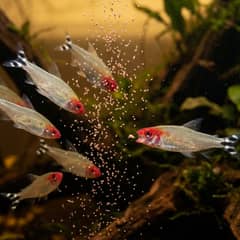
The red-nosed schooler that turns laps of a long tank in lockstep!
On This Page▾

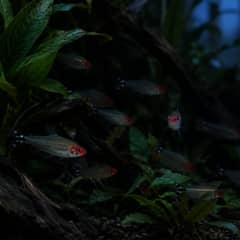
Did you know? Rummy-nose tetras school so tightly that physicists use them to study how groups decide where to go: in a ring-shaped tank, the U-turns that reverse the whole school mostly start with the fish at the front.
The first week
The numbers a new owner needs in the first week, each from the article it links to. Rows with no link come from the encyclopedia.
- How many
- A school of 10 or more.Handling guide →
- Tank size
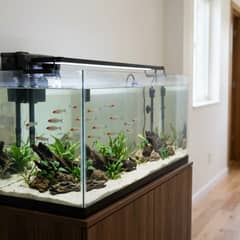
- At least 36 inches (90 cm) long for a school of 10, which puts it in the 30 to 40 gallon range. A 20-gallon long falls six inches short.Setup guide →
- Temperature
- 73 to 79°F (23 to 26°C), with the heater set inside that band. 79°F is the ceiling.Setup guide →
- Water chemistry
- pH 5.5 to 7.0 and a general hardness of 2 to 12 dGH. Soft, acidic water suits them best, and alkaline water dulls the red.Setup guide →
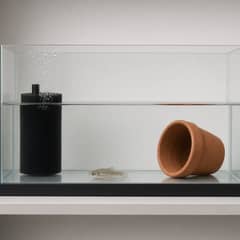
- Cycle first
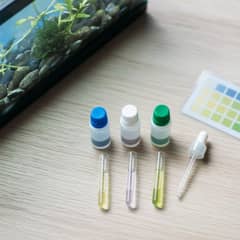
- Ammonia and nitrite both at zero before the school goes in. Rummy-noses are sensitive to stress, and a tank still cycling is a steady source of it.Setup guide →
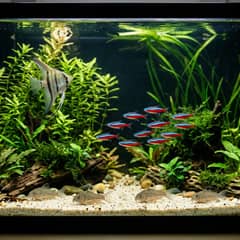
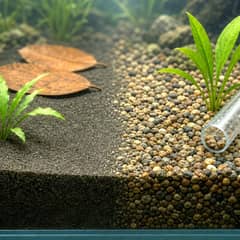
- Layout
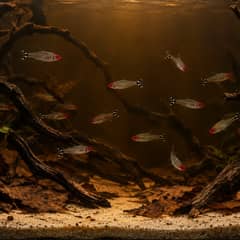
- A planted tank or a sparse layout of sand, wood and dried leaves both suit them.Setup guide →
- Diet
- Omnivores: micro-pellets, granules or crushed flake as the base, with baby brine shrimp, daphnia and mosquito larvae live or frozen.Feeding guide →
- Feeding schedule
- At least once a day, in portions the school clears before any reaches the substrate.Feeding guide →
- Acclimation
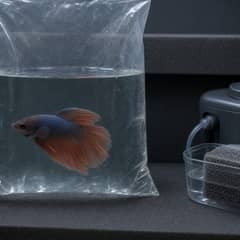
- Lights off, then small amounts of tank water into the bag every few minutes for 30 to 60 minutes. Net the fish across and throw the bag water away.Handling guide →
- Tankmates
- Peaceful. Add them before an angelfish so a resident fish does not bully the new school, and keep them out of discus tanks run above their 79°F top.Handling guide →
- The red nose
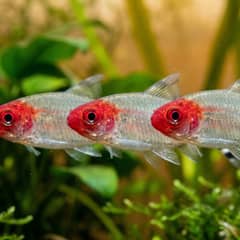
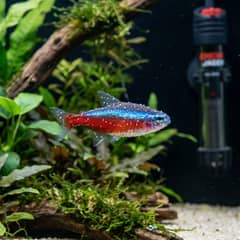
- A paler nose means stress or slipping conditions: test ammonia, nitrite and pH before anything else.Health guide →
- Quarantine
- At least 30 days in their own tank, longer if anything shows, before new fish meet the main school.Health guide →
- Ich
- No heat cure: most strains die above 86°F, past the 79°F ceiling. Warm slowly to 79°F with extra aeration and let a copper-free ich medication clear it. Salt is unproven for this species at the 4 to 5 grams per liter that kills ich.Health guide →
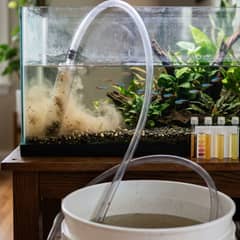
- Water changes
- 25 to 30% weekly from the substrate, with conditioned water at tank temperature. Test nitrate first: under 20 ppm the routine is right, past 40 ppm the next change is 50%.Aquarium Water Changes →
- Budget
- About $4 to $6.50 a fish online, closer to $9 in a local store; twelve come to $45 to $80 before shipping. Setup roughly $230 to $435.Cost guide →
- Lifespan
- About 5 years in a well-kept tank.Cost guide →
- Adult size
- About 2 inches (5 cm).
- Power outage
- Oxygen is the threat, not darkness. Unplug the filter rather than letting it sit dead in the water, and keep the surface moving.Power outage guide →
Emergency card
Test the water first, then act on these today.
- A red nose gone pale, on one fish or across the school
- Fish gasping at the surface or breathing fast
- Several fish showing the same sign together
- A dead fish: lift the body out before doing anything else
- White specks like grains of salt on the body or fins: treat for ich today
- Rapid breathing that keeps going after the water tests clean, since ich can settle in the gills
Watch and check again tomorrow.
- Flashing: darting at glass, wood or sand to scrape the body
- A slimy look from extra mucus on the skin
- A fish that turns sluggish or skips its food
- Clamped fins, or a fish losing weight while it still eats
The red nose is the early warning: when it fades, test the water before you treat anything.
Where to go next
How Much Does Rummy-Nose Tetra Ownership Cost?
$4 to $6.50 a fish, why a long tank is the real expense, and the $230 to $435 that goes into it.
Rummy-Nose Tetra Tank Setup: A 36-Inch Run, Soft Acidic Water, and Dim Light
A tank at least 36 inches long, soft acidic water at 73 to 79°F, and why the length matters more than the gallons.
Rummy-Nose Tetra Feeding: Wild Diet, Staples, and How Often to Feed
What wild fish eat across the flood and dry seasons, the captive staple, and food for fry.
Rummy-Nose Tetra Handling Comes Down to One Stressful Trip Home
Acclimation over 30 to 60 minutes, why rummy-noses go in before an angelfish, and the discus question.
Common Rummy-Nose Tetra Health Issues (and What a Fading Red Nose Is Telling You)
Reading the red nose, the 30-day quarantine, and why the ich heat cure stops at 79°F.
Rummy-Nose Tetra Enrichment: The School Physicists Study
The schooling research: how light, sight and the lateral line hold a school of rummy-noses together.
What to buy
As an Amazon Associate I earn from qualifying purchases. Underlined items are paid Amazon links, at no extra cost to you.
Prices and the reasoning behind each item are in How Much Does Rummy-Nose Tetra Ownership Cost?.
Full Rummy-Nose Tetra gear listFrequently Asked Questions
What size tank do rummy-nose tetras need?
One that is at least 36 inches (90 cm) long for a school of 10, which puts it in the 30 to 40 gallon range. Measure the front glass before reading the gallons on the label.
How often should I feed rummy-nose tetras?
At least once a day. Keep each portion small enough that the school clears it before any reaches the substrate.
Can you treat ich in rummy-nose tetras with heat?
Not with heat alone. Ich strains mostly die above 86°F, seven degrees past the rummy-nose's 79°F ceiling. Warm the tank slowly to 79°F with extra aeration and let a copper-free ich medication clear the parasite. Salt is unproven for this species at the 4 to 5 grams per liter that kills ich.
Encyclopedia
Rummy-Nose Tetra
Petitella bleheri (formerly Hemigrammus bleheri)
Subscribe - it's free
New care guides straight to your inbox. No spam.
Deep Dive

Health and More


Explore More