How to Tell If Your Fish Is Sick: Waste, Behavior, and Body Signs
On This Page▾

Most fish don't announce that something is wrong. There's no whimper, no limp, no obvious wound most of the time, just a series of small, easy-to-miss changes that add up over a day or two. A keeper who checks the tank once in the morning and once at night is working from incomplete information by design, since fish hide illness as a survival instinct, and the animal that looks fine at 8 a.m. can be clamped and hiding by dinner.
This guide is about noticing early rather than treating late. It covers the three things you can observe without touching the fish, its waste, its behavior, and its body, and it puts the most important piece of context first: a large share of what looks like disease is a water quality problem, and testing the water is the first move, not the last resort.
Test the Water Before You Do Anything Else
Here's the framing that should sit ahead of every other section in this guide: if a fish looks off, test the water before you reach for a diagnosis, and definitely before you reach for medication. Ammonia and nitrite are the two most common invisible culprits, and both are completely undetectable by eye. Unionized ammonia above roughly 0.05 mg/L is already enough to damage gill tissue, that lethargy and poor appetite follow chronic exposure, and that acute ammonia toxicity can produce neurologic signs like spinning and disorientation, symptoms that look a lot like an exotic disease to an owner who hasn't tested the water. Nitrite works differently but ends in a similar place: it converts hemoglobin into methemoglobin, the condition known as brown blood disease, and affected fish will seek out oxygen-rich water, congregating near filter outflows or gasping at the surface, exactly the same behavior you'd see from a fish that's simply short on oxygen.
That overlap matters because gasping at the surface is one of the most commonly misread signs in the hobby. It's easy to assume a fish gulping air at the top of the tank has a respiratory infection or a gill parasite. Far more often, it's plain physics: dissolved oxygen above 5 mg/L supports optimum fish health, that most species become distressed once levels drop to roughly 2 to 4 mg/L, and that mortality typically follows below about 2 mg/L, with surface gasping, sometimes called piping, as the visible warning sign along the way. A fish piping at the surface after a heat wave, a power outage that stopped the filter, or an overstocked, overfed tank is telling you about the water, not about a pathogen.
New setups carry a version of this risk that's worth naming directly, since it catches so many new keepers off guard. In "new tank syndrome," ammonia rises through the first two to three weeks of a new system because the biofilter's bacteria haven't finished establishing, a period made worse by overfeeding and overstocking. If a fish in a tank that's been running less than a month suddenly looks sick, the nitrogen cycle is the first suspect, not disease. An establishing biofilter can be built before any fish go in, which is how a new tank avoids the crash.
The practical upshot is simple: keep a liquid test kit on hand and use it the moment something looks wrong, before you assume the worst or start treating for something specific. A water test kit that reads ammonia, nitrite, nitrate, and pH gives you an answer in minutes, and it rules out or confirms the most common cause of a sudden sick-looking fish before you've spent money or added stress with a medication the fish may not have needed.
Reading Fish Waste: The Earliest Signal
Once the water checks out, waste is one of the few internal health signals a keeper can see without a microscope or a vet visit. Normal fish feces varies by species and diet, generally a solid, somewhat compact strand that roughly matches the color of what the fish has been eating and doesn't linger, trailing behind the fish for more than a few seconds before it drops or breaks off.
The signal worth paying attention to is a shift toward pale, clear, or white feces that trails behind the fish in a long, stringy thread rather than dropping normally. This is a real early-warning sign, but it is not, on its own, a diagnosis, and it's worth being honest about why. Weight loss and a pot-bellied look are signs of internal worms like Capillaria and Pseudocapillaria, while weight loss and a refusal to eat are signs of the intestinal parasite Spironucleus. In other words, the same outward sign fits several unrelated causes, not one single culprit. A fish that has simply stopped eating for a stretch, for any reason including a water quality problem, will often pass mostly mucus rather than digested food, which looks identical to a parasite-driven case from the outside.
That's the honest limit of reading waste at home: pale, stringy trailing feces tells you something is worth watching, most plausibly a fish that isn't eating well or is carrying an internal parasite load, but it doesn't tell you which. What it should trigger is closer observation over the next day or two, not an immediate treatment decision. Is the fish still eating at all? Is it losing visible weight or developing a pinched, sunken belly? Is anything else on this list showing up alongside it? A single odd dropping in an otherwise normal, eating, active fish is worth noting and rechecking, not panicking over. A pattern of it across several days, especially paired with weight loss or appetite loss, is the point where our fish quarantine and treatment guide becomes the next step, since isolating a sick fish and observing it closely in a hospital setup is the right response to a real pattern, not a single stool.
Stringy white or pale feces is useful as an early flag, but it's a nonspecific one. It shows up with internal parasites and with fish that have simply gone off their food. Treat it as a reason to watch closely, not as a diagnosis to treat.
Behavior Signs That Point to Trouble
Behavior changes tend to show up before anything visible does, because a fish can feel unwell long before a mark or growth appears on its body. The common ones: flashing, where a fish rubs against objects to relieve itching; piping, where it swims at the surface trying to gulp air; loss of appetite, loss of condition, dulled coloration and rapid breathing; and clamped fins, which with lethargy and dark coloration are among the clinical signs of ich.
Each of those has a slightly different likely meaning. Clamped fins, held tight against the body instead of spread naturally, are one of the more universal signs of stress or illness across species; clamped fins are a listed sign of ich (white spot disease), but they appear well beyond that one parasite too. Flashing or rubbing against decor, gravel, or the glass usually points toward an irritant on the skin or gills, commonly an external parasite, though it can also follow simple water chemistry irritation. Gasping at the surface deserves a second mention here specifically because it's so often misread: as covered above, it's more often a dissolved oxygen or ammonia and nitrite problem than a disease process, so it's the one behavior sign that should send you to a test kit before anything else.
A fish that hangs persistently in the current near a filter outflow or airstone, rather than moving through the tank normally, is often chasing the same thing a piping fish is chasing: the most oxygen-rich water available. Nitrite-stressed fish gather in oxygen-rich water, and so do fish under general water-quality stress, so this behavior belongs in the same "test the water" bucket as gasping.
Loss of appetite and isolation round out the behavioral picture. The standard list of fish illness signs includes not eating and abnormal swimming positions, floating, drifting, or resting somewhere a fish normally wouldn't, as core indicators, alongside outright lethargy. A normally social, mid-water fish that starts hiding behind decor or sitting alone at the bottom, even briefly, is worth a closer look the same day rather than a "let's see how it looks tomorrow." Abnormal buoyancy, a fish that can't hold a normal position in the water column, floats nose-down, or struggles to stay off the surface or the substrate, is a related sign that points toward an internal problem, whether that's a swim bladder issue, bloating, or something systemic. Swim bladder disorder shows up most often in fancy goldfish.
Physical Signs You Can See From Outside the Tank
Physical, visible signs are the ones most keepers wait for, but by the time several of these appear together, a fish has usually been unwell for a while. The core visible signs worth tracking are loss of color, discoloration or splotchiness, spots, ulcers, loss of scales, scales standing out from the body, swelling or bloating, and puffy or fuzzy growths.
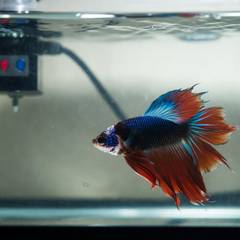
White spots, small and evenly distributed across the body and fins, are the hallmark of ich, which pairs that sign with lethargy, clamped fins, and dark coloration in affected fish. Grayish-white, cotton-like growths describe fungal infection, most often Saprolegnia, typically appearing on damaged skin, a healing wound, or already-stressed tissue rather than on a fish with intact, healthy skin. Ulcers or red, inflamed patches on the body point toward a bacterial process, and fin erosion, fins that look shortened, ragged, or reddened at the edges compared to how the fish normally looks, follows a similar bacterial pattern, generally worsening from the fin's edge inward if left unaddressed. Long-finned species such as the betta show fin rot clearly and often.
Bloating and popeye both point toward something happening internally rather than on the surface. A swollen abdomen can mean overfeeding and simple digestive backup, dropsy-like fluid retention, or in some cases the internal worms discussed in the waste section above, since Capillaria and Pseudocapillaria infections can give a fish a pot-bellied look. Popeye, one or both eyes visibly protruding or enlarged, is associated with bacterial infection and, like most of the signs on this list, isn't specific enough on its own to name the cause without a closer look. Color loss, a fish looking washed out, paler, or duller than its normal coloration, is a general illness indicator that often shows up before anything more specific does, making it one of the more useful "something's wrong, keep watching" signs precisely because it isn't tied to one disease.
When It's a Vet or Aquatic Specialist Situation
Most of the signs above are meant to prompt closer observation and, where relevant, a trip to the fish quarantine and treatment guide for next steps once water quality is ruled out. Some situations are past that point.
Call in an aquatic veterinarian or a fish-health specialist when illness is spreading across multiple fish in the tank rather than staying isolated to one, when you're looking at an open ulcer, significant bloating, or a badly protruding eye rather than a milder sign like clamped fins, when fin erosion or a white-spot outbreak is visibly advancing day over day despite a clean water test, or when a fish is listing to one side, resting on the bottom unresponsive, or otherwise showing signs well beyond the early behavioral changes above. These are the cases where guessing at a cause and treating for it at home risks losing time on the wrong problem, and where the lab work is the only way to move from a nonspecific sign to an actual answer. For many of these parasites, only a microscope on a sample of the diseased tissue confirms the diagnosis, which is not something an owner can do by looking at the tank.
It's also worth calling a specialist, rather than reaching for a general medication, whenever the honest answer to "what caused this" is "I don't know, and the water tested clean." Reading a stringy dropping, a clamped fin, or a pale patch correctly means recognizing what those signs can mean, not pretending any one of them, on its own, tells you what's wrong. That's the whole case for observing carefully and testing the water before treating: the earlier and more accurately a keeper reads these signs, the less guessing anyone has to do once real treatment starts.
How to Find a Vet Who Treats Fish
Most small-animal clinics do not see fish, and a general search for a vet will not say which ones do. A professional directory lists the vets who will. The American Association of Fish Veterinarians keeps a Find a Fish Vet map at fishvets.org, which covers North America only.
When it shows no one within reach, the AAFV gives three next moves. Ask a local vet, ideally one who already sees your other pets, whether they would take the case with guidance from a fish vet: the association will connect the two. Contact the AAFV directly, and it will email its members to look for someone near you. Or ask an aquarium shop or a local aquarium society, which usually know who in the area treats fish.
When Euthanasia Is the Kindest Option
Some fish will not recover, and a fish vet is the one to judge whether the case is past treatment. Once it is, ending the fish's life humanely is part of keeping it.
The first choice is a vet who treats fish. An overdose of anesthetic is the humane method, and a vet has a range of anesthetics and the training to use them, so leave it to a vet wherever one can be reached.
Where no vet can be reached, the method that animal welfare guidance gives for aquarium fish is a clove oil overdose, since clove oil contains the sedative eugenol. Use about 0.4 ml of clove oil per liter of aquarium water, in a container of water taken from the fish's own tank. Mix the oil with a little warm water first and add it to the container slowly over about five minutes. The fish loses consciousness, stops breathing and dies. Leave it in the solution for at least 30 minutes after the last gill movement. Only then, as a final check, can it go in the freezer until frozen.
The methods to rule out are the ones people reach for first. Flushing puts a live fish into chlorinated water. Freezing a live fish, boiling, cutting off the head without first stunning the fish, and leaving it out of water to suffocate all cause the suffering the whole exercise is meant to end. A fish that has run out of options still deserves the 30 quiet minutes the clove oil gives it.
Sources & Further Reading
Last reviewed 6 Sep 2026 · 4 sources
- Merck Veterinary Manual: Disorders and Diseases of Fish; Environmental Diseases of Aquatic Animals in Aquatic Systems; Parasitic Diseases of Fish
- UF/IFAS: Ruth Francis-Floyd, "Dissolved Oxygen for Fish Production" (FA27/FA002)
- American Association of Fish Veterinarians: Find a Fish Vet
- RSPCA Australia: What is the most humane way to euthanase aquarium fish?
Frequently Asked Questions
Is white stringy poop always a sign my fish has parasites?
No. Stringy, pale, or clear feces is a nonspecific sign, meaning several different things can cause it, including internal parasites, but also a fish that simply hasn't eaten in a while and is passing mucus instead of digested food. Weight loss and abnormal feces are clinical signs across multiple unrelated fish diseases, not one single cause, so the stool alone doesn't diagnose anything. Watch the whole fish, appetite, weight, and behavior, over the next day or two rather than reacting to one dropping.
Why is my fish gasping at the surface if the water looks clear?
Clear water doesn't mean safe water. Ammonia, nitrite, and low dissolved oxygen are all invisible to the eye, and fish become distressed once dissolved oxygen falls to roughly 2 to 4 mg/L and start dying below about 2 mg/L, with surface gasping ("piping") as the visible warning sign. A liquid test kit is the only way to rule out a water problem before assuming illness.
Should I medicate my fish as soon as I see a white spot or clamped fin?
Test the water first. A very large share of sudden 'sick fish' presentations trace back to ammonia, nitrite, or low oxygen rather than disease, and medicating before you've ruled that out can add stress to a fish that's already struggling with its environment. Once water quality checks out clean, quarantine in a hospital tank is the next step.
My fish is hiding near the filter outflow. Is that a bad sign?
It's worth investigating, not ignoring. Fish that hang in the current coming off a filter or airstone are often seeking the most oxygen-rich water in the tank, the same instinct behind piping at the surface, and fish under ammonia or nitrite stress congregate in oxygen-rich areas for the same reason. Test the water before assuming it's simple curiosity or aggression avoidance.
What physical signs mean I should stop waiting and call a vet or aquatic specialist?
Rapid spread across multiple fish, open ulcers, significant bloating or a badly protruding eye, fin erosion that's advancing day to day, or any fish that stays listed on its side or unresponsive are all past the point of home observation. An aquatic veterinarian or a fish-health specialist can examine a fecal or skin sample under a microscope, which is the only reliable way to identify what's causing a nonspecific sign like abnormal stool or clamped fins.
Can a healthy-looking fish still be sick?
Yes, and that's exactly why behavior matters as much as appearance. A fish that's eating less, swimming oddly, or isolating itself can be in the early stages of a problem well before a visible mark, spot, or growth shows up. The standard veterinary list of illness signs in fish leans heavily on behavior, lethargy, appetite, and swimming position, for this reason.
Recommended Gear
As an Amazon Associate I earn from qualifying purchases through the links above, at no extra cost to you.

Written by Michael Ryan
Mike keeps two rescued bearded dragons, Dex and Cera, and writes the care guides on BeastlyFacts from his own research and mistakes. He is not a veterinarian.
More about Michael Ryan →