Platies Aren't Handled Either, But They Do Need a Breeding Plan
On This Page▾

Platies are an observation and enjoyment pet, not a hands-on one, the same as most other community aquarium fish. What actually matters with this species isn't handling technique, it's understanding just how easily it breeds, since that's what determines whether your tank stays the size you set it up to be.
What Platies Are Like
Peaceful, active, and about as forgiving as community fish get, platies do best in a small group instead of alone. Adults run about 2 to 3 inches, with males the smaller sex. Two species are commonly sold, Xiphophorus maculatus and X. variatus, the variatus the better pick for a room-temperature tank.
Sexing: Gonopodium vs. Gravid Spot
Telling males from females gets easier as fish mature. Males develop a modified anal fin called a gonopodium, a slender, rod-like structure used to fertilize females internally. It appears as the fish matures, which for this species happens anywhere from about two to six and a half months, driven largely by the fish's own genotype: a sex-linked gene sets male maturation anywhere from eight weeks at around 21mm to 28 weeks at around 38mm, so two platies from the same tank can be months apart. Before the gonopodium forms, a young platy is genuinely hard to sex with confidence. Females keep a fuller, fan-shaped anal fin and develop a dark "gravid spot" on the belly when pregnant, clearest on olive, wild-type fish.
The Behavior That Matters Most: How Platies Breed
Platies are livebearers, females give birth to free-swimming fry directly rather than laying eggs that need separate incubation. Breeding is so reliable in this species that hobbyist sources routinely describe it as something you can't prevent by accident, only by actively separating the sexes.
A single mating can keep a female platy producing fry for months afterward. Females store sperm after mating and can use it to fertilize several separate broods without a male present again. Gestation runs roughly 4 to 6 weeks, and a typical brood lands between 20 and 50 fry, though the documented range under ideal conditions runs as high as 80. Put a male and female together with no plan, and the tank doesn't stay the size you started with.
Platy parents provide no care after birth, and adults will readily eat their own fry given the chance. If you want fry to survive, dense live planting or a dedicated breeding or nursery tank gives them somewhere to hide until they're large enough to hold their own.
Managing Population, Practically
Keep males and females in separate tanks if you want to avoid breeding entirely. Keep a males-only group instead for a colorful, breeding-free display. Let it happen and plan for it, rehoming or selling fry as they mature, or accepting that natural predation will keep numbers in check if you're not removing fry deliberately. If you do want controlled breeding, a ratio of roughly two to three females per male reduces how much the females get chased and stressed by repeated mating attempts.
What to Do With Fry You Don't Want
The decision point is the first sign of a gonopodium. The earliest male platies mature at about eight weeks, so a brood left together past that age starts its own brood. Sort young fish by sex as soon as the males can be picked out, and keep checking, because the late-maturing males keep turning up for months. A young fish with a fan-shaped anal fin at two months can still be a male.
Surplus platies have fewer outlets than new keepers expect, because the hobby is saturated with young livebearers.
- A local fish shop. Ask before bringing a bag in. Some shops take livebearer young, but expect little or nothing in exchange, and shops favor well-colored, matching fish of a similar size over a mixed bag of every color the tank produced.
- A local aquarium society. Livebearer breeders sell to clubs as well as shops, and a society's members are keepers with tanks already running, the likeliest home for a batch a shop turns down.
- Another keeper's tank. Friends starting a community tank, or a keeper with room and a plan of their own. Pass on the population warning with the fish.
The option that is never on the list is a pond, a stream or a storm drain. Released platies have established wild populations in several US states, including Florida and Hawaii, and on Oahu, platies and other introduced livebearers have been implicated in the decline of native damselflies. A fish that cannot be rehomed stays in the tank, and the lasting fix is a single-sex tank so the next brood never arrives.
First-Time Keeper Mistakes
- Buying a mixed-sex group with no population plan at all, the single most common mistake with this species, and one that compounds faster here than with most other fish
- Not quarantining new fish before adding them to an established tank, which lets stress-driven issues spread before you notice them
- Underestimating how much a "small" starting group of 5 or 6 platies can grow within two or three months of unmanaged breeding
How Platy Breeding Compares to Guppy and Molly Breeding
Platies, guppies, and mollies are all livebearers in the same family, Poeciliidae, and their breeding biology looks nearly identical on paper: all three store sperm internally, all three produce repeat broods from a single mating, and all three can overwhelm an unprepared tank within a couple of months. The guppy is the one that can be sexed within weeks of birth, and the molly the one whose males fight hardest in an all-male group.
The practical difference is mostly scale. Platy broods tend to run a bit larger than a guppy's but smaller than a molly's, and platies need less room to start than a molly does while asking for a touch more than a guppy, roughly splitting the difference between the two. For a keeper choosing between the three, the platy is the middle ground on both counts.
The Platy encyclopedia profile covers the species itself.
Sources & Further Reading
Last reviewed 15 Sep 2026 · 5 sources
- Seriously Fish: Xiphophorus maculatus
- Aquarium Co-Op: Care Guide for Platy Fish; How to Breed Livebearers for Profit
- Practical Fishkeeping: How to breed livebearing fish
- USGS Nonindigenous Aquatic Species: Southern Platyfish (Xiphophorus maculatus)
- Kallman & Borkoski (1978): A Sex-Linked Gene Controlling the Onset of Sexual Maturity in Female and Male Platyfish, Genetics
Frequently Asked Questions
Do you handle platies the way you'd handle a hamster or a bird?
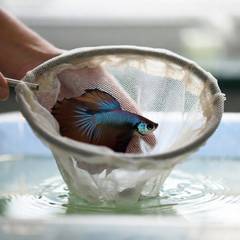
No. Platies are an observation and enjoyment pet, not a hands-on one. If you need to move one, guide it gently with a fine-mesh net rather than touching it directly, bare hands can damage the protective slime coat that keeps a fish healthy. Physical contact isn't part of normal platy care.
How can I tell if my platy is male or female?
Males develop a modified, rod-like anal fin called a gonopodium, used to fertilize females internally, appearing as the fish matures anywhere from about two to six and a half months depending on genotype. Females keep a fuller, rounded anal fin and often show a dark "gravid spot" near the vent, especially prominent when pregnant. It's a fairly reliable sexing method once the gonopodium has developed.
How do platies breed?
Platies are livebearers, females give birth to free-swimming fry directly rather than laying eggs. Female platies store sperm in the folds of their oviduct after mating, sometimes for months, which lets one encounter fertilize several separate broods without a male present again. A typical brood runs 20 to 50 fry, with a documented range up to 80, roughly every 4 to 6 weeks after a gestation period of about the same length.
How do I manage platy population if I don't want constant breeding?
Keep males and females in separate tanks to avoid breeding entirely, or keep a males-only group for a colorful, breeding-free tank. If you do want controlled breeding, a ratio of roughly two to three females per male cuts down on how much the females get chased and stressed by mating attempts.
What's the most common platy-keeping mistake?
Buying a mixed-sex group with no population plan, the same mistake that trips up new guppy and molly owners, and it happens even faster with platies since a single mating can seed several broods without any further intervention. Skipping quarantine on new fish is a close second.
More on the Platy
Platy care guide
🐠 How Much Does Platy Fish Ownership Really Cost?
🐠 Common Platy Health Issues (And the Truth About 'Platy Tumors')
🐠 Platy Tank Setup: A Real 10 Gallons, Hard Water, and a Plan for Fry
🐠 Platy Feeding: Schedule, Diet, and Why Overfeeding Is the Real Risk
🐠 Platy Enrichment: Hardy Is Not the Same as Unaffected

Written by Michael Ryan
Mike keeps two rescued bearded dragons, Dex and Cera, and writes the care guides on BeastlyFacts from his own research and mistakes. He is not a veterinarian.
More about Michael Ryan →