Aquarium Stocking and Tankmates: How Many Fish, and Which Ones Go Together
On This Page▾

Every fish and shrimp page here gives a minimum tank size and then stops. That leaves the two questions a new keeper actually has once the tank is bought: how many fish can go in it past that floor, and which species can share it. Neither has a single number, which is why the species pages never carried one. This page covers what the popular rule gets wrong, the three things that set a tank's real capacity, the four checks that decide whether two species belong together, the group sizes the welfare research supports, how to add fish without a fight, and a table of every fish and shrimp on the site with its floor and its known bad pairings.
What the Inch-per-Gallon Rule Gets Wrong
The rule everyone learns first is one inch of fish for every gallon of water. Aquarium Co-Op's stocking guide gives the honest version of it: the rule works for small community fish of 1 to 3 inches and fails for larger species, because a 10-inch fish needs vastly more space than ten 1-inch fish. The reason is that a fish's waste and its swimming room both scale with its bulk, not its length, and a fish twice as long is far more than twice the animal. The rule also counts the fish at the size it was bought, and a juvenile is bought small.
The older veterinary version of the rule is about surface area rather than volume. The Merck Veterinary Manual gives one inch of freshwater fish for every 12 square inches of surface area, which at least captures that oxygen enters at the surface and a tall narrow tank holds fewer fish than a long low one of the same gallons. It has the same limit, though: it is a rule for small fish, and it says nothing about temperament.
Both rules are a floor for small schooling fish, not a target for a tank. Past a 3-inch fish, throw them out and stock by the three limits below.
The Three Limits That Replace It
Aquarium Co-Op's guide replaces the rule with three factors, and they are the right three. Waste load: fish eat, produce waste, and the bacteria in a cycled filter and any live plants break it down, so the stock a tank can carry is set by how much waste the filter handles, not by the gallons. Swimming space: each fish needs room in proportion to its adult size and how active it is, and a fancy goldfish's 20-gallon long is sized for a 30-inch length and a 12-inch turning radius while an angelfish's 29 gallons is sized for its 8-inch height. Aggression: a peaceful community fish and an African cichlid need different stocking plans in the same tank.
The first limit is the one you can measure. The filtration guide explains why the filter's bacteria colony is the tank's real capacity, and the water changes guide gives the test that shows when that capacity is exceeded: nitrate before the weekly change. Aquarium Co-Op holds the same line, nitrate below 40 ppm through regular monitoring. A tank that sits under 20 ppm before its change has room for more waste. A tank drifting toward 40 is full, whatever the gallons say.
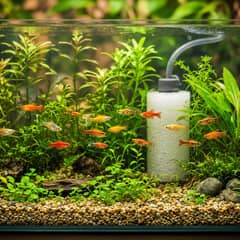
The practical rule that falls out of this is the one Aquarium Co-Op ends on: understock the aquarium at first and get more fish later if possible. Stock the schooling fish at their minimum number, wait two weeks, test, and add the next group only if the reading held.
| Limit | What sets it | How you check it |
|---|---|---|
| Waste | The cycled filter's colony and the water change schedule | Nitrate under 20 ppm before the weekly change |
| Space | Every fish at adult size, and the tank's length and height for the way that fish swims | The species page's minimum, then the adult length and turning room |
| Aggression | Territory, breeding and body shape, not just the species label | The four checks in the next section, and hiding places that divide the tank |
The Four Checks Before Two Species Share a Tank
A tankmate pairing has to pass four checks, and the ones that fail in practice usually pass three.
- Temperature overlap. The two species' ranges have to share a band the tank can sit in all year. The cardinal tetra page settles one common case: cardinals tolerate water to 86°F, neons top out near 77°F, so cardinals are the tetra for a warm discus tank.
- Water chemistry overlap. Soft acidic and hard alkaline water each have their fish, and the pH, GH and KH guide is the place to find out which your tap delivers before choosing. Fish chosen to match the water outlast water forced to match the fish.
- Size in both directions. Anything that fits in a mouth ends up there, and the Merck manual notes that aggression toward new fish is common among freshwater cichlids and other fish over 3 inches. The ghost shrimp tank setup guide makes the point that the check runs both ways: a ghost shrimp is prey to a betta as a juvenile and a predator of cherry shrimp as an adult.
- Temperament against body shape. A nipper and a long-finned fish never work, whatever else matches. PetMD's betta care sheet puts it in one line: avoid known fin-nippers like tiger barbs, and long-finned species the betta may spar with. Aquarium Co-Op's tiger barb guide says the same from the other side, keep them away from long-finned fish like betta and angelfish that may get nibbled, and from tiny fish small enough to get eaten.
Passing all four is the whole test. The tank mates PetMD lists as workable with a betta, corydoras catfish, mystery snails, ghost shrimp and some small tetras or rasboras, are the ones that pass: warm-water, peaceful, short-finned, and either too big to eat or too fast to catch.
The pairings that go wrong are rarely a mystery. They are a nipper with fins to nip, or a mouth with something that fits in it. Check size and fins before you check anything else.
Group Size: Why Six Is a Floor and Ten Is Better
Every schooling species page here says six minimum, and the research the advice rests on points higher. Saxby, Adams, Snellgrove, Wilson and Sloman tested four common aquarium fish at different group sizes for a 2010 paper in Applied Animal Behaviour Science. Neon tetras and white cloud mountain minnows showed reduced aggression and darting and spent more time shoaling in larger groups. Angelfish and tiger barbs were more variable, though larger groups shoaled more, and the analysis showed improved welfare in larger groups of neons, white clouds and tiger barbs, with no clear link between group size and welfare in angelfish.
Practical Fishkeeping's report on the study gives the sizes tested: the tetras and minnows were kept in groups of one, two, five and 10, and the groups of 10 had the greatest tendency to shoal. That is the number behind the neon tetra enrichment guide's case for a bigger school, and it settles the trade a new keeper faces at the shop: 10 of one species beats five each of two. The corydoras tank setup guide puts the same rule as one species of eight over two species of four.
The exception cuts the other way. For a fish that spreads its aggression across the group, numbers dilute it. Aquarium Co-Op keeps tiger barbs at a minimum of seven and prefers more than 12, in a 29-gallon tank or larger, because a small group of them concentrates the picking on whichever fish is weakest.
In the group-size study, the loneliest fish were not the worst off. Neon tetras were more aggressive in twos and fives than in a proper school, which is why a "pair" of schooling fish is the one stocking choice with no defense.
Adding New Fish Without a Fight
An established tank has an owner, and the Merck manual's advice for adding to it is about territory. Decorative objects divide the aquarium and let fish hold their own space, which matters most when space and territory are at a premium. When the new fish arrive, rearrange the decor while the bag floats, which breaks up the established territorial markers, and feed the resident fish at the moment the new ones are released. Both moves give a newcomer an hour without a defender.
The manual's other warning is the one that matters more: there is significant risk of introducing disease if the new fish have not been carefully quarantined. The quarantine guide covers the tank and the timeline. A new fish that skips it brings the shop's tank to yours.
Order matters too. The angelfish handling guide has angelfish added last, after the community is established, because an adult that has held the tank alone treats every later arrival as an intruder, and one over 3 inches eats a neon tetra it was raised with.
The Species on This Site
Each floor below is the figure from the species' own tank setup guide, which wins where the two disagree. The last column is the pairing that page or the linked guide warns against.
| Species | Floor | Group | Known bad pairing |
|---|---|---|---|
| Neon tetra | 10 gallons for a school of 6 | 10 or more | Adult angelfish, nippers, anything with a mouth big enough |
| Cardinal tetra | 10 gallons for 6, 20 long for 8 to 10 | 8 to 10 or more | Same as neon; the better tetra for a warm tank |
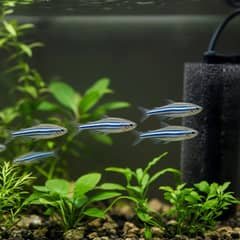
| Zebra danio | 10 gallons for 6, 20 long for 8 to 10 | 8 to 10 | Slow feeders they outcompete at the surface |
| Corydoras | 20 long for 6 standard cories, 10 for pygmies | 6 minimum, one species | Fast feeders unless fed after lights out |
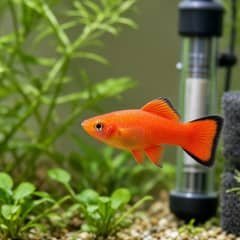
| Guppy | 5 gallons for a trio, 10 for 5 or 6 | 2 to 3 females per male | Bettas, goldfish |
| Platy, molly, swordtail | 20 gallons for a small group | 2 to 3 females per male | A male-heavy tank of their own kind |
| Betta | 5 gallons for one | One male; a female sorority needs 10 gallons and cover | Tiger barbs, any nipper, any long-finned fish, a second male |
| Angelfish | 29 gallons tall for one, 55 for 4 to 6 | Pairs and small groups; added last | Neon tetras and guppies once the angel passes 3 inches |
| Bristlenose pleco | 20 gallons for one, 10 more per extra | Singles, or one male per cave | A second male over one cave |
| Discus | 55 gallons as a floor, 75 or more | 5 to 6 or more | Cool-water and hard-water community fish |
| Goldfish | 20 long for a fancy, 55 for a single-tail | Fancy with fancy, single-tail with single-tail | Tropical tanks, guppies, anything slower than it at the food |
| Oscar | 75 gallons for one, 100 to 125 for a pair | One, or a pair in the larger tank | Anything that fits in its mouth |
| Koi | 250 gallons per adult, 1,000-gallon pond | Never alone | Indoor tanks past the juvenile year |
| Amano shrimp | 10 gallons, one per 2 gallons | Groups | Anything that eats shrimp |
| Cherry shrimp | 5 gallons | Colonies | Ghost shrimp, bettas, most fish for the shrimplets |
| Ghost shrimp | 5 gallons, 10 for a colony | Groups | Bettas until the shrimp passes 1.5 inches; cherry shrimp |
What Goes Wrong
- Stocking for the size in the bag. A 1-inch oscar or a 2-inch angelfish passes every rule at the shop. Both are counted at adult size or the tank is overstocked in a year.
- Two half-schools instead of one. Six neons and six rasboras looks like variety and gives each species a group at the floor. Ten of one is the better tank and the calmer one.
- A pairing that passed three checks. The temperature matched, the water matched, the sizes matched, and the barbs took the betta's tail apart in a week.
- Adding to a full tank because the fish look fine. Nitrate creeping toward 40 ppm is the tank saying no. The sick fish guide sees the result a month later.
The Takeaway
Take the species page's minimum as a floor, count every fish at adult size, and let nitrate say whether there is room for more: under 20 ppm before the weekly change means yes, past 40 means the tank is full. Before any two species share a tank, check temperature, water, size in both directions and fins against nippers. Buy schooling fish in tens, not sixes, and one species at a time.

Want this as a printable reference? The Betta Fish Care Package turns this guide into a 37-page PDF you can keep by the enclosure, $8.99.
Sources & Further Reading
6 sources
- Merck Veterinary Manual: Providing a Home for Fish
- Aquarium Co-Op: How Many Fish Can I Put in a Fish Tank?
- The effect of group size on the behaviour and welfare of four fish species commonly kept in home aquaria (Saxby, Adams, Snellgrove, Wilson and Sloman, Applied Animal Behaviour Science, 2010)
- Practical Fishkeeping: Study shows that schooling fish do best in larger numbers
- Aquarium Co-Op: Care Guide for Tiger Barbs
- PetMD: Betta Fish Care Sheet
❓ Frequently Asked Questions
Is the inch-per-gallon rule wrong?
It works for small community fish of 1 to 3 inches and fails for anything bigger. A 10-inch fish needs far more space than ten 1-inch fish, and it produces far more waste. Past small schooling fish, stock by adult size, waste and temperament, and let a nitrate test tell you whether the tank is keeping up.
How do I know if two species can share a tank?
Run four checks: their temperature ranges overlap, their water chemistry overlaps, neither adult fits in the other's mouth, and neither is a known nipper or bully toward the other's body shape. A pairing has to pass all four. Passing three is how a betta ends up with tiger barbs.
How many of a schooling fish do I need?
Six is the floor most species pages give, and the research points higher. In the group-size study behind that advice, neon tetras and white cloud mountain minnows showed the least aggression and darting in the larger groups, and groups of 10 shoaled the most. Ten of one species beats five each of two.
My tank is at the minimum for its species. Can I add more fish?
Only if the nitrate test says the filter and the water changes are keeping up: under 20 ppm before the weekly change, with room in the tank for every fish at adult size. Add a few at a time, retest for two weeks, and stop at the first reading that creeps. Understocked and growing into it is the version that works.
🛒 Recommended Gear
As an Amazon Associate, we earn from qualifying purchases through the links above - at no extra cost to you.

Written by Michael Ryan
Mike keeps two rescued bearded dragons, Dex and Cera, and writes the care guides on BeastlyFacts from his own research and mistakes. He is not a veterinarian.
More about Michael Ryan →Comments
No comments yet - be the first!