Rummy-Nose Tetra Enrichment: The School Physicists Study
On This Page▾

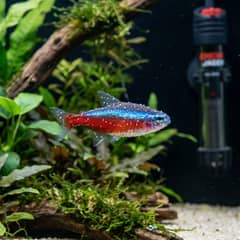
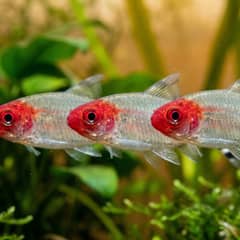
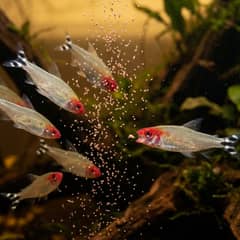
The rummy-nose tetra (Petitella bleheri, formerly Hemigrammus bleheri) is a fish about 2 inches long with a red head, and physics labs keep it to work out how a school of fish moves as one body.
Rummy-nose tetras are one of the more tightly shoaling small tetras. The research on them shows that a bigger group holds its course, that sight holds the school together and that the school needs light to function at all. Enrichment means a school of 10 or more, a tank at least 36 inches long, fairly dim but steady light, a layout of sand, wood and leaves, and varied small foods.
Life in the Rio Negro
The fish comes from the Rio Negro and Rio Meta basins of Brazil and Colombia. These are blackwater rivers: tannins leaching from rotting plant matter stain the water brown and make it strongly acidic, and aquatic plants are scarce.
Around Barcelos, on the middle Rio Negro, the fish is called rodostomo, and fishers find it in streams and in the igapós, the flooded forest. Asked how it lives, the fishers most often described a fish that travels in shoals, with 36 mentions. Seasonal migration came next with 32, while only 8 called it resident and 4 called it solitary. Rodostomo is one of the species in the arribação, the seasonal movement of fish that follows the rise and fall of the river.
So the wild picture is a group that stays together and keeps moving, through dark-stained water with little plant growth. The tank should give the school the same three things: company, room to travel, and that water.
The rummy-nose is the third biggest ornamental fish export of Brazil's Amazonas state, behind the cardinal tetra and Paracheirodon simulans. From 2006 to 2015 it made up 5.0% of about 142.5 million fish exported, a trade of about 14 million fish a year.
Source: Tribuzy-Neto et al. 2020, Boletim do Instituto de Pesca
Why the School Comes First
The target is 10 or more of this one species, and more is better. Rummy-noses are one of the more tightly shoaling small tetras.
The research shows what group size changes. Rummy-nose tetras swam around a ring-shaped tank in groups of 1, 2, 4, 5, 8, 10 and 20. Every so often a group reversed direction, and the turn usually began with a fish at the front, then ran back through the group one fish after another. Group size set how often that happened. A school of 10 turned around about once every 20 minutes, roughly a hundred times less often than a pair.
That is the keeper's case for buying the full group at once. A larger school is a steadier one: it settles on a direction and holds it, while two or three fish keep reversing. The fish are very peaceful and lose out to boisterous or much larger tankmates, so the rest of the stocking should be calm and similar in size.
Sight and the Lateral Line
A school needs each fish to keep track of its neighbors, and rummy-noses do it with two senses: their eyes, and the lateral line system that feels movement in the water.
Knocking out the senses one at a time shows what each does. Rummy-noses whose whole lateral system had been knocked out with an antibiotic treatment could not hold a shoal, and they only regained it as the system recovered over about a month. Fish with only a compromised lateral line still schooled by sight alone, but each fish swam about 79% farther from its neighbors.
Speed is the lateral line's part. In schools of 60 rummy-noses, fish with working flow sensing reacted to a schoolmate speeding up with a delay one-third shorter than fish without it. Put together, sight holds the school, and the lateral line makes it fast and tight. Vision is needed for schooling and is enough on its own to hold a school together; the lateral line adds the speed.
A keeper cannot do much about either sense directly. The light the eyes depend on is another matter.
Light: Enough to School By
Rummy-nose tetras are a blackwater fish and prefer fairly dim lighting. Dim is not the same as dark, though, and the research shows where the line falls.
Groups of five needed more than about 1.5 lux to school. Schools of about 50 fish were tested across a range of 0 to 900 lux. In too little light the fish could not form a coherent, cohesive group. As the light rose, the school first lined up and swam in one direction, and at higher light it settled into a steady, regular circling pattern, the whole group wheeling around together.
Light changes where the fish go as well as how they school. Across tests from 0.5 to 50 lux, the brighter the light, the closer each fish swam to the wall of the tank, and pairs of fish kept closer together as the light rose. In a home tank, more light pushes the school toward the glass.
The 1.5 lux threshold is tiny next to the top of that range, so a softly lit tank clears it easily. What the findings argue for is shade within a lit tank: driftwood and leaf litter under a light that stays on through the day. A timer keeps the day length regular, for example 14 hours of light to 10 of dark, a cycle laboratory schools of rummy-noses have been kept on. At lights out, expect the school to loosen and drift apart, and expect it to form again when the light returns.
A Long Tank Laid Out Like the River
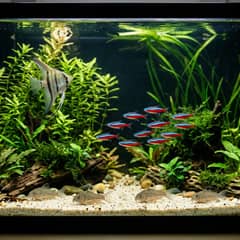
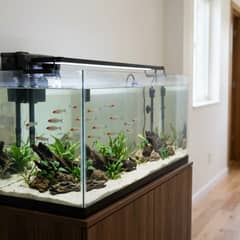
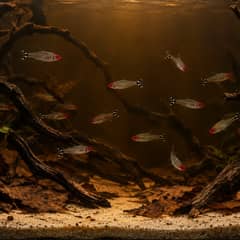
Buy for length. A school of 10 needs a tank at least 36 inches (90 cm) long, which in volume is a 30 to 40 gallon tank, because rummy-noses are active swimmers that cover the length of the tank in runs. Keep the middle and front open along the full length and put the decor at the back and ends.
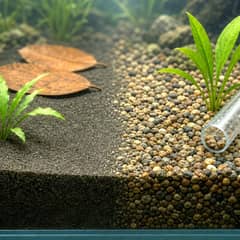
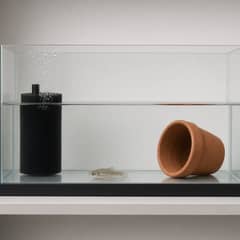
Model the rest on the river. River sand on the bottom, driftwood and roots for structure, and a few handfuls of dried leaves spread over the sand.
Plants are optional. They are not part of the fish's natural waters, but rummy-noses do well in a planted tank too. Planted or bare, the tank gets a partial water change every week: this fish loses color in poor conditions, so weekly changes are a must.
Clear Water or Tannin-Stained?
The wood and leaves in that layout tint the water, and whether the tint matters is a question about the fish, not the look of the tank.
The case for the stain starts with home. The rummy-nose's rivers run brown with tannins and are very acidic, and a rummy-nose in tea-colored water under dim light shows its best color. The dissolved organic matter in that water also does chemical work for this species. Rummy-noses are among the fish most sensitive to copper, and in natural Rio Negro water their copper toxicity fell as the share of river water rose. That is one more reason an ich treatment for a rummy-nose should be copper-free, stained tank or clear.
The case for clear water is how well the species manages without it. It does well in an ordinary well-planted tank, and no one has tested rummy-noses in stained against clear water. So the stain is a good fit for a rummy-nose, not a requirement.
For the stain, the wood and leaves already in the tank do the job, coloring the water like weak tea, with old leaves pulled every few weeks before they rot. A small net bag of aquarium-safe peat in the filter is the older way to the same effect, and it is not needed: peat collection is unsustainable and environmentally destructive.
Stained or clear, the water itself is soft and acidic: 73 to 79°F (23 to 26°C), pH 5.5 to 7.0 and 2 to 12 dGH. Their colors fade in alkaline water, so test pH and hardness as separate readings before the fish arrive.
Food the School Works For
Rummy-noses are omnivores that take almost anything offered, which makes it easy to vary what they get. Give a mix of dried flakes and granules alongside small live and frozen foods, all sized for a small mouth. Variety pays off in the fish: a mixed diet is what brings out the best color. Feed small portions at least once a day.
Priority Order
- A school of 10 or more rummy-nose tetras, one species
- A tank at least 36 inches (90 cm) long with open water along its length
- Fairly dim, steady light on a timer, never full darkness by day
- Soft, acidic water at 73 to 79°F, pH 5.5 to 7.0, changed in part every week
- Sand, driftwood, roots and dried leaves
- Calm, similar-sized tankmates
- Varied small foods, with live and frozen alongside flake and granules
What Not to Do
Do not buy three or four and plan to add the rest later. Do not put a school of 10 in a short tank. Do not turn the light so low that the fish cannot see one another. Do not keep them in hard, alkaline water. Do not add them to a tank that has not finished cycling, and do not skip quarantine for new fish.
On the Rio Negro, a rummy-nose spends its life inside a moving shoal. Give it enough companions, enough length and enough light to see them by, and the school does the rest.
Sources & Further Reading
Last reviewed 31 Oct 2026 · 4 sources
- Faucher, Parmentier, Becco, Vandewalle and Vandewalle (2010). Fish lateral system is required for accurate control of shoaling behaviour. Animal Behaviour 79: 679-687
- PubMed (U.S. National Library of Medicine): McKee, Soto, Chen and McHenry (2020). The sensory basis of schooling by intermittent swimming in the rummy-nose tetra (Hemigrammus rhodostomus). Proceedings of the Royal Society B 287: 20200568; Peterson AN, Zhou J, Mittal R and McHenry MJ (2026). The Lateral Line Facilitates Rapid Responses in Accelerating Fish Schools. Integrative and Comparative Biology 66: icag151; Lafoux, Moscatelli, Godoy-Diana and Thiria (2023). Illuminance-tuned collective motion in fish. Communications Biology 6: 585; Xue T, Li X, Lin G, Escobedo R, Han Z, Chen X, Sire C and Theraulaz G (2023). Tuning social interactions' strength drives collective response to light intensity in schooling fish. PLoS Computational Biology 19(11): e1011636; Lecheval, Jiang, Tichit, Sire, Hemelrijk and Theraulaz (2018). Social conformity and propagation of information in collective U-turns of fish schools. Proceedings of the Royal Society B 285: 20180251; da Silva Ladislau, Ribeiro, da Silva Castro, Pantoja-Lima, Aride and de Oliveira (2021). Ichthyological ethnoknowledge of the "piabeiros" from the Amazon region, Brazil. Journal of Ethnobiology and Ethnomedicine; Duarte RM, Crémazy A, Wood CM, Almeida-Val VMF and Val AL (2024). The biotic ligand model as a promising tool to predict Cu toxicity in amazon blackwaters. Environmental Pollution 341: 122988
- Seriously Fish: Petitella bleheri. Seriously Fish; Paracheirodon axelrodi (Cardinal Tetra)
- Tribuzy-Neto IA, Beltrão H, Benzaken ZS, Yamamoto KC (2020). Analysis of the ornamental fish exports from the Amazon State, Brazil. Boletim do Instituto de Pesca 46(4): e554
Frequently Asked Questions
How many rummy-nose tetras should be kept together?
Ten or more of the one species. In a ring-shaped test tank, groups of 10 reversed direction about once every 20 minutes, while pairs turned around about every 12 seconds.
Do rummy-nose tetras like dim light?
Fairly dim, yes, but never dark. A school of five stopped schooling once the light fell to about 1.5 lux, so shade the tank with wood and leaves and keep the light itself on.
Why does my rummy-nose tetra school spread out at night?
It is too dark for the fish to track each other. Rummy-noses coordinate mainly by sight, and in near darkness a school cannot stay coherent, so a loose group after lights out is normal.
Do rummy-nose tetras need live plants?
No. A bare-sand layout with roots and leaves is closer to their home rivers than a planted tank. Plants are fine to add, and either way the tank needs a weekly partial water change, because this fish loses color in poor conditions.
How long should a rummy-nose tetra tank be?
At least 36 inches (90 cm) for a school of 10, which in volume is a 30 to 40 gallon tank. Buy for length, because the school swims from one end to the other and back.
Why has my rummy-nose tetra lost its red nose?
The red fades when the fish is stressed or kept in poor conditions, so test the water before anything else.
Do rummy-nose tetras need blackwater?
No. The species also does well in an ordinary planted tank with clear water. Tea-stained water from wood and leaves suits its color and its origins, and no test has shown that the fish needs it.
More on the Rummy Nose Tetra
Recommended Gear
As an Amazon Associate I earn from qualifying purchases through the links above, at no extra cost to you.
Written by Michael Ryan
Mike keeps two rescued bearded dragons, Dex and Cera, and writes the care guides on BeastlyFacts from his own research and mistakes. He is not a veterinarian.
More about Michael Ryan →You May Also Like
Subscribe - it's free
An occasional email when something new is worth your time. No spam.
Deep Dive
Health and More