Aquarium Water Changes: How Much, How Often, and What the Number Is For
On This Page▾

Every fish and shrimp guide here tells you to do regular partial water changes, and until now none of them said what regular or partial meant. That gap sat on the hub of every aquarium species, because a water change schedule was one of the first things a new keeper asked for and the one thing no page carried a figure for. This is that page. It covers what a change removes that the filter cannot, the weekly baseline and the test that adjusts it, how to put the new water in without hurting anything, the species whose own articles override the default, and the one situation where the standard advice kills fish.
What a Water Change Removes That a Filter Cannot
A cycled filter does one job well: the bacteria on its media turn the ammonia fish excrete into nitrite, then into nitrate. The filtration guide covers how that colony works and why it is the part of the filter that matters. The part that guide does not cover is what happens after: nothing. Nitrate is where the biological filter stops. It is far less toxic than the two compounds before it, which is why a cycled tank keeps fish alive, but it does not leave the tank on its own. It accumulates, and the only routine way it leaves is in water you take out.
The endpoint of that accumulation has a name, old tank syndrome, and its cause is water changes that are small and infrequent. That is the whole reason for the routine. A water change is not cleaning in the sense of removing visible dirt. It is dilution, and the thing being diluted is invisible, which is why the schedule needs a number and a test, and a glance at the glass tells you nothing.
A clear tank is not a clean tank. Ammonia, nitrite and nitrate are all invisible, and the filter deals with the first two only. The water change is the tank's only nitrate export.
The Number, and the Test That Moves It
For a filtered, moderately stocked freshwater tank, 25 to 30 percent of the water once a week is the baseline. Most fish tolerate nitrate up to about 20 mg/L, and 40 ppm is the ceiling below which most fish are considered safe, so the two figures bracket the working range: under 20 is where a tank should sit, and 40 is where the schedule has failed and the next change gets bigger.
The test is what makes the baseline yours. Test nitrate before the weekly change for a month. If the reading stays under 20 ppm, the schedule matches the stocking and the feeding. If it climbs toward 40 between changes, the tank produces more nitrate than a 25 percent change removes, and the answer is a larger change, a second change in the week, or fewer fish and less food. A heavily stocked tank or a large messy fish can need 50 percent weekly, and that is not a sign of failure, only of bioload.
The arithmetic runs against you on small changes. A 25 percent change removes a quarter of the nitrate, so a tank that adds 20 ppm a week and gets a 25 percent change settles at a steady level of about 80 ppm and never drifts back to zero. A 50 percent change on the same tank settles near 40. That is why the response to a high reading is a bigger change, and why a tank whose reading never comes down under the baseline needs its change size raised.
| Nitrate before the change | What it means | What to do |
|---|---|---|
| Under 20 ppm | The schedule matches the bioload | Keep the 25 to 30 percent weekly change |
| 20 to 40 ppm | Nitrate is winning slowly | Move to 40 to 50 percent weekly, or add a midweek change, and feed less |
| Over 40 ppm | Past the safe line | A 50 percent change now with matched water, then retest in two days and find the cause |
| Over 40 ppm and the tank has not had a change in months | Old tank syndrome territory | Do not do the 50 percent change. Small daily changes, see the last section |
Why Nitrate Is Worth Chasing
The reason to hold the line at 20 rather than tolerate 40 is that nitrate harms fish well before it kills them, and the harm is in the blood. A 2020 study by Gomez Isaza, Cramp and Franklin exposed a freshwater fish to 50 and 100 mg/L of nitrate and measured a concentration-dependent fall in functional haemoglobin and a roughly threefold rise in methaemoglobin, the form that cannot carry oxygen. When low pH was added to the high nitrate, swimming speed fell 37 percent against controls. Those are laboratory concentrations, but 50 mg/L is a reading plenty of neglected home tanks return, and the mechanism is the one behind the lethargy, reduced appetite, reddened skin and faster breathing that are the signs of nitrate poisoning.
A 2005 review in Chemosphere by Camargo, Alonso and Salamanca went through the toxicity data across freshwater animals and concluded that 10 mg NO3-N/L, the US drinking water limit, can harm freshwater invertebrates and fish over long exposures, and that protecting the most sensitive species would need a limit nearer 2 mg NO3-N/L. Those figures are in nitrate-nitrogen, which most hobby test kits do not use; the kit reading in ppm nitrate is about 4.4 times higher for the same water, so 10 mg NO3-N/L is roughly 44 ppm on the kit. The review's point for a home keeper is that invertebrates sit at the sensitive end, which is why the shrimp pages run their own, stricter rules.
Putting the New Water In
The water going back in needs three things matched before it touches a fish: no chlorine, the tank's temperature, and roughly the tank's chemistry.
Chlorine first, because it is the one with no recovery. Municipal tap water carries chlorine or chloramine to kill bacteria, and chlorine is toxic to every fish: severe gill damage, then asphyxiation, and no effective treatment once it has happened. Chloramine is chlorine bonded to ammonia, and a conditioner that only handles chlorine leaves the ammonia behind, so use one labeled for both. Dose it as the water goes in: a third of the dose before the hose starts, a third at the halfway mark, a third at the end.
Temperature next. Mix hot and cold to land within a couple of degrees of the tank, checked with the same thermometer you read the tank with, since a bucket that feels fine to a hand can be ten degrees off. A change that drops the tank several degrees is the classic trigger for the white-spot outbreak that follows a week later.
Chemistry last, and this is the one that surprises people. Tap water and tank water drift apart between changes as the tank acidifies and its buffering is used up. On a tank changed weekly the gap stays small and a 30 percent change closes it gently. On a tank changed rarely the gap grows until the tap water itself is the shock, which is the subject of the last section. If your tap pH sits far from the tank's, the pH, GH and KH guide explains what to do about it, and the short version is smaller, more frequent changes, with no chemicals dosed against the tap.
Siphon from the substrate, not the surface. A gravel vacuum pulls the waste that settles into the gravel out with the water, which is where most of the nitrate is being made. On a planted tank hover the vacuum over the substrate without plunging it in. Rinse filter media in the bucket of old water while it is out, never under the tap.
The Species That Break the Rule
The baseline is for a community tank of ordinary fish. Several species carry their own figure, and for those the species article wins:
| Species | Its own rule | Why |
|---|---|---|
| Cherry shrimp | About 10 percent a week, or 20 percent every two weeks | Larger changes shift hardness and shock a shrimp even with clean water |
| Amano and ghost shrimp | Small and steady | Swings in GH and KH around a water change are a known trigger for failed molts |
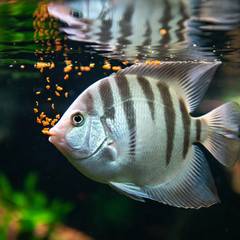
| Discus | 25 to 50 percent weekly, and serious keepers change every 2 to 3 days | A warm, heavily fed tank at 82 to 86°F produces nitrate fast |
| Goldfish | 25 to 50 percent weekly | The heaviest waste producer for its size in the hobby |
| Oscar | 25 to 30 percent weekly, and not optional | Elevated nitrate is tied directly to hole-in-the-head disease |
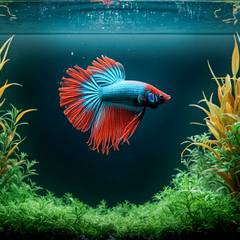
| Betta | 25 to 30 percent weekly on a heated, filtered tank | Small tanks concentrate waste faster than the volume suggests |
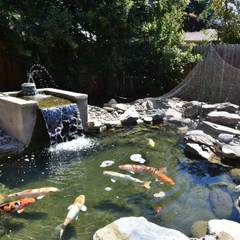
| Koi and other ponds | Governed by the pond's volume and filtration | A 1,000-gallon pond is not changed by the bucket |
The cherry shrimp health guide makes the case for the shrimp figure in full, and the discus tank setup guide for the other end of the range. Neither contradicts this page; they are the two ends of the same principle, that the change size follows what the water can tolerate and what the stock produces.
Rescuing a Tank That Has Gone Months Without One
The dangerous water change is the one done out of guilt. A tank left for months has drifted: nitrate past 40, buffering gone, pH down near or below 6.0. Those are the readings that define old tank syndrome, and the trap inside them is that the low pH protects the fish from the nitrogen, because ammonia at low pH sits in its less toxic ionized form. The old fish have adapted to the drift week by week. A new fish dropped into that water dies, which is usually how the problem is discovered. And a large water change does the same thing to the old fish: it lifts the pH in an hour, the ammonia flips back to its toxic form, and the fish that were coping are not coping anymore.
The correction is small and slow. Ten to 15 percent a day for the first week, every other day in the second, then 20 to 25 percent twice a week for the following two, testing as you go. That is a month to bring a tank back instead of an afternoon, and it is the only version that keeps the fish. The cycling guide covers what to do if ammonia or nitrite appears during that month, since a filter that has sat in acidic water may need time to recover its colony. Once the readings are back inside the table above, the weekly routine starts and the tank never gets to that state again.
The old fish in a neglected tank are not tougher than the new one that died. They were exposed to the same water, one small step at a time over months, and adapted to each step. The new fish met all of the steps at once. A large water change asks the old fish to do the same thing in reverse.
What Goes Wrong
The three failures a new keeper hits, in order of how often the sick fish guide sees them arrive as an illness:
- Changing by the calendar and never testing. The schedule was set for a lightly stocked tank, the tank filled up over a year, and the nitrate crept past 40 while the routine stayed the same. A test before each change catches this in the first month it happens.
- Refilling from a hose with no conditioner. Chlorine damage to gills shows as fish gasping at the surface within the hour, and the fish that survive it have burned gills that take weeks to heal. Dose the conditioner as the water goes in, every time, including the quick top-up.
- The big catch-up change. A neglected tank gets 75 percent of its water swapped in an afternoon and loses half its fish that night. Small daily changes would have saved every one of them.
The Takeaway
Change 25 to 30 percent of the water every week, from the substrate, with conditioned water at the tank's temperature. Test nitrate before the change and let the reading set the size: under 20 ppm the routine is right, past 40 it is not. Follow the species article where it gives its own figure, and on a tank that has gone months without a change, go small and daily.

Want this as a printable reference? The Goldfish Care Package turns this guide into a 40-page PDF you can keep by the enclosure, $8.99.
Sources & Further Reading
6 sources
- Nitrate toxicity to aquatic animals: a review with new data for freshwater invertebrates (Camargo, Alonso and Salamanca, Chemosphere, 2005)
- Simultaneous exposure to nitrate and low pH reduces the blood oxygen-carrying capacity and functional performance of a freshwater fish (Gomez Isaza, Cramp and Franklin, Conservation Physiology, 2020)
- PetMD: Nitrate Poisoning in Fish (Jessie Sanders, DVM, DABVP Fish Practice)
- Fish Vet: Old Tank Syndrome (Jessie Sanders, DVM, DABVP Fish Practice)
- Fish Vet: Dechlorinator for Fish Systems (Jessie Sanders, DVM, DABVP Fish Practice)
- Aquarium Co-Op: How Often Do You Have to Clean or Change Water in a Fish Tank?
❓ Frequently Asked Questions
How much water should I change and how often?
For a filtered, moderately stocked freshwater tank, 25 to 30 percent once a week. Test nitrate before the change: past 40 ppm between changes means take out more or change more often, under 20 ppm means the schedule is working. Shrimp tanks and a few fish carry their own figure, and their articles override this one.
Why does the water still need changing if my filter is working?
The filter's bacteria turn ammonia into nitrite and nitrite into nitrate, and then stop. Nothing in an ordinary freshwater filter removes nitrate, so it accumulates until water carrying it leaves the tank. A clear tank with a healthy filter can still sit at a nitrate level that is slowly damaging the fish in it.
Is it safe to do a 50 percent or larger water change?
On a tank that gets regular changes, a one-off 50 percent change with matched, dechlorinated water is the standard response to nitrate past the safe line. On a tank that has gone months without one, a large change is the dangerous move: the tank has drifted far from the tap, and swapping most of the water at once shocks fish that were coping. That tank gets small daily changes.
Do I have to match the temperature of the new water?
Yes, close enough that the tank does not swing. Fill from a mix of hot and cold, check it against the tank with a thermometer, and dose the conditioner as the water goes in rather than after. Chlorine damages gills within minutes and there is no treatment once it has, so the conditioner is not the step to skip on a quick refill.
🛒 Recommended Gear
As an Amazon Associate, we earn from qualifying purchases through the links above - at no extra cost to you.
Written by Michael Ryan
Mike keeps two rescued bearded dragons, Dex and Cera, and writes the care guides on BeastlyFacts from his own research and mistakes. He is not a veterinarian.
More about Michael Ryan →Comments
No comments yet - be the first!