Common Rummy-Nose Tetra Health Issues (and What a Fading Red Nose Is Telling You)
On This Page▾

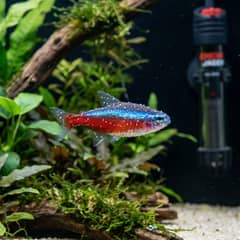
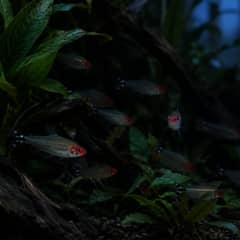
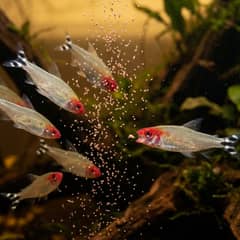
The rummy-nose tetra (Petitella bleheri, formerly Hemigrammus bleheri) is a schooling fish of about 2 inches from the soft, acidic, tea-colored blackwater rivers of the Rio Negro and Rio Meta basins. Nothing that sickens it is peculiar to the species, but it reacts to stress more readily than most small tetras, and it has an unusual way of showing it: the deep red of its head and snout drains toward pink when the fish is unwell. That color, a ceiling temperature well short of the usual ich cure, and a marked sensitivity to copper shape how its health gets handled.
Signs That Need Action Today
A count of the school at feeding time, with a look at every nose, is the daily check. These are the signs that cannot wait until tomorrow.
Test the water first:
- A red nose gone pale, on one fish or across the school.
- Fish gasping at the surface or breathing fast.
- Several fish showing the same sign together.
- A dead fish. Lift the body out before doing anything else.
Start treatment today:
- White specks like grains of salt on the body or fins: treat for ich.
- Rapid breathing that keeps going after the water tests clean, since ich can settle in the gills.
Watch and check again tomorrow:
- Flashing: darting at glass, wood or sand to scrape the body.
- A slimy look from extra mucus on the skin.
- A fish that turns sluggish or skips its food.
- Clamped fins, or a fish losing weight while it still eats.
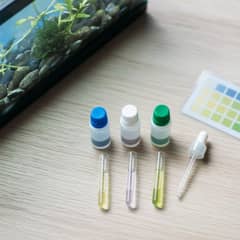
The first three in that last group are how ich usually starts, and the white specks often show only well after the infection took hold, so a fish with any of them gets checked for spots every day until it looks normal again. A fish thinning on a full appetite points instead toward the internal parasites further down. A struggling fish and a struggling tank look much alike from outside the glass, and sorting a water problem from a disease begins with the test kit before it turns to the fish.
What a Healthy Rummy-Nose Looks Like
| Check | Healthy | Worth a closer look |
|---|---|---|
| Nose and head | Deep red | Pale or pinkish once the fish has settled |
| Belly | Slightly rounded | Pinched, or swollen |
| Skin and fins | Smooth and whole, no white spots | White specks, a slimy film, frayed or bloody fins |
| Eyes | Bright, not cloudy | Cloudy or bulging |
| Activity | Busy, swimming steadily | Sluggish, circling or drifting |
| Place in the school | Packed tight in the shoal: it is one of the more tightly shoaling small tetras | Hanging apart from the rest |
Water Quality Comes First
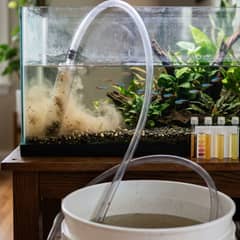
Rummy-noses do best in soft, acidic water: 73 to 79°F, pH 5.5 to 7.0 and 2 to 12 dGH. Stability inside that window counts for more than chasing one exact figure. The species loses color in poor conditions, which makes a weekly partial water change part of its routine, and testing before each change catches a slide early. Soft water carries little buffering, so the KH reading is the one to understand before trying to move pH in either direction, and it is also the number that decides whether copper can go anywhere near the tank.
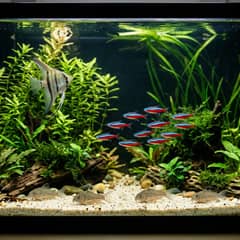
A school goes in only once the nitrogen cycle has finished, the single most important step when a tank is first set up, so that ammonia and nitrite both read zero for a fish this sensitive to stress. A school of 10 or more is part of keeping each fish well.
The species name of the true rummy-nose, rhodostoma, means rose-mouthed, after the red that covers its snout and mouth.
Source: ETYFish Project
Ich: Warm to 79°F, Then Treat Without Copper
Ich, also called white spot disease, most often enters a tank in infected water or on a newly added fish. Its early signs are the ones in the watch group above, with the spots arriving later. A fish with infected gills breathes quickly or hangs at the surface, and a heavy infestation can kill, above all in a fish already weakened by poor water.
Most ich strains die in water above 86°F, and fish that tolerate that heat can be cured by holding the tank there. The rummy-nose is kept at 73 to 79°F, so the top of its range sits seven degrees below that 86°F mark. Breeders do warm a spawning pair to 82 to 86°F for a short stay, but nothing shows that a school can be held at 86°F for the days an ich cure takes, so heat is not the plan for this fish.
Warmth still helps up to the ceiling. The parasite reproduces faster in warmer water, and between 75 and 79°F it completes its life cycle in about three to six days, so each new generation reaches the free-swimming stage, the only one treatment kills, sooner. Bring the tank up slowly to 79°F with a dependable aquarium heater, run an air stone for the extra oxygen this treatment needs, and dose daily, at least three to five times, using one of these:
- Not aquarium salt. Salt kills ich only at 4 to 5 grams per liter, a bath given only to species known to tolerate it, and no salt tolerance has been measured for the rummy-nose. Live plants may not tolerate raised salt either. Use a copper-free ich medication instead.
- An ich medication without copper, dosed to the label or a vet's instructions. Vets usually treat the water with formalin or copper sulfate over several rounds, and in a rummy-nose tank copper is the one to leave out, for the reasons set out under copper below.
Carry on until the deaths have stopped and no fish shows any sign of illness. The same warm-then-treat route serves every species whose ceiling sits below 86°F, and in a mixed tank the treatment stops at the lowest ceiling among the fish. Survivors of an outbreak can harbor the parasite, and a secondary bacterial infection sometimes follows, so the school stays under a close eye for a while after the last spot clears.
Fin Rot and Fungus: Damage First, Then Infection
Both usually arrive behind something else. Fin rot is bacterial, most often Aeromonas, Pseudomonas or Flavobacterium: the fin tip turns gray and then wears away, and poor conditions and fighting set it up. New rummy-noses sometimes come home from the store already carrying a bacterial infection, one more reason for the quarantine tank described below.
Saprolegnia and the other water molds behind cottony growths are fungus-like organisms and not true fungi. They colonize tissue already damaged by an injury, a parasite or poor water, and low temperature is one of the named triggers, a reason to keep the heater reliable even when no ich is in sight. Correct the water first, then move the fish to the hospital tank, and fix the injury, parasite or water problem that let the mold in.
Internal Parasites
Most rummy-noses in shops are tank bred, but the wild fishery still runs: Brazil's Amazonas state exported more than 7 million of them between 2006 and 2015. Wild fish that look healthy often carry heavy parasite loads, so a wild batch brings that risk with it.
Worms or protozoa are the likely reason a rummy-nose loses condition on a full appetite. Camallanus shows itself, as red worms protruding from the vent, and its intermediate hosts are Cyclops and Daphnia, which makes live crustacean foods one way it gets into a tank. Spironucleus is treated with metronidazole, and tapeworms with praziquantel, the drug of choice for them. Organophosphates are the class to avoid, since they are flagged as unsafe for some characins, the group the rummy-nose belongs to. Telling these apart takes a microscope, so the vet picks the drug once the parasite has a name.
Neon Tetra Disease and Its Lookalikes
Neon tetra disease comes from a microsporidian parasite, Pleistophora hyphessobryconis, whose primary host is the neon tetra. It has turned up in around 20 species of freshwater fish across four orders, and characins as a group are among its hosts, so the name gives a rummy-nose school no protection, though no report yet names a rummy-nose among them.
Mycobacteriosis is the lookalike that matters most in this species. Tetras belong to the fish families at higher risk of it, and the bacteria do well in acidic water high in humic and fulvic acids, a fair description of a blackwater rummy-nose tank. Its signs vary from fish to fish: wasting, a swollen belly, skin ulcers and bleeding, bulging eyes, paleness and a bent spine can all appear. It thrives where oxygen runs short and organic waste builds up, no treatment clears it from a fish, and it can infect people as well.
Paleness is the trap, since a rummy-nose already fades under ordinary stress. A pale fish that is also wasting, ulcerated or bent goes to the hospital tank, and a lab is what tells mycobacteriosis apart from anything treatable.
The Red Nose: A Prompt to Test the Water
The red on a rummy-nose fades when the fish is stressed or its conditions are poor, and in a healthy, settled school it stays strong. That makes the nose a useful early prompt, and it earned the species its hobby nickname, the canary in the coal mine. It is not a precise gauge: it does not say which reading is off, or by how much, and a pale nose alone is not a diagnosis. What it does say is that something has changed, and the list of possible causes runs from bad water and a cold tank to disease and bullying. The first response is always the same. Test ammonia, nitrite and pH with a liquid test kit, read the thermometer, then look further.
Water that has drifted alkaline is one known cause of a dulled head, and in harder, higher-pH water nitrate takes a bigger toll on this fish, with lost color often the first thing a keeper sees. When the water reads clean, the other suspects are the tank's company and the diet. Bullying is one of the stresses that drains the red, and a calm community matters for this fish, which is why settling a new group in before any boisterous tankmates arrive is part of keeping it healthy. Color also depends on what goes in at the bowl: the best red comes from a varied mix of small dried, frozen and live foods sized for a small mouth.
A pale nose is not always a warning. Fish shipped in the last couple of days, or just chased around with a net, often show washed-out heads that color up again within half an hour or by the next day, so a newly moved fish gets that time before its nose is read.
Copper, Soft Water and Shrimp
Copper is the common ich and parasite treatment a rummy-nose tank should not see. When 10 wild Rio Negro fish species were tested for copper sensitivity in ion-poor water, all four characins proved more sensitive than the catfish and the cichlids, and the rummy-nose was the most sensitive of all, with half the fish killed at 12.8 micrograms of copper per liter. The test used plain copper salt in clean lab water, not a medication in a home tank.
Soft water raises the risk further. Copper sulfate is extremely toxic to fish in water of low alkalinity, and it is not to be used at all once total alkalinity falls below 50 mg/L, about 2.8 dKH, a line a soft rummy-nose tank often sits under.
Copper is toxic to invertebrates as well, and adult dwarf shrimp often share these tanks, since rummy-noses tend to leave adult shrimp and snails alone and eat only the babies. No label makes a medication safe around invertebrates, so every shrimp and snail is moved out before treatment begins, and dosing in the hospital tank spares the display, its plants and everything else in it.
Quarantine Every New Fish
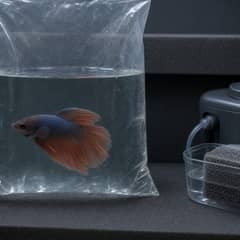
Rummy-noses sometimes arrive from the store already carrying ich, and a newcomer added straight to the display tank brings it to every fish there. In warm aquarium water, disease in shipped fish often becomes visible one to three weeks after arrival, so each new fish is kept apart for at least 30 days in quarantine, and longer if anything shows, before it meets the school. Quarantine is the single most important step for every fish added.
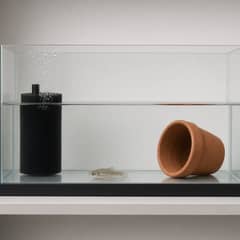
A small separate tank running a sponge filter, heated to the same range as the main tank, covers it, and the same setup serves as the hospital tank whenever a fish falls ill. Its nets, siphon and other gear stay with it unless they are disinfected before use on the main tank.
When a Fish Vet Is Worth It, and How to Find One
Several of the problems above can only be named under a microscope or at a necropsy. Guessing with store medications is common, and a run of products, each tried when the last one fails, usually leaves the fish worse off than before.
Some deaths leave nothing to see from outside. Endocardiosis, a disease of the heart valves, has been found in tetras including a rummy-nose, showed up in 4.3% and 5.7% of the tetra hearts examined at two diagnostic labs, and was judged the main cause of death in four of the cases. A sudden loss with no outward sign is exactly the kind of death a necropsy can explain.
A vet's license stops at the state line, but consulting does not: the clinic down the road can call in an aquatic vet from any state, which makes a local exotic or small-animal practice a fair place to start. To reach a fish vet directly, the American Association of Fish Veterinarians keeps a directory sorted by state or country. Outside North America, the World Aquatic Veterinary Medical Association is the place to look. Advice given online without an exam cannot legally serve as a treatment plan.
What to bring:
- Tank water. About a quart in a clean container, drawn the moment the fish start behaving oddly, before any water is changed, then chilled. Water from the travel bag does not count, because its pH falls and its ammonia climbs on the way.
- The fish. The sickest one still alive. A fish that has already died is rarely usable, and a frozen one never is.
- The history. How big and how old the tank is, what lives in it and how many, what was added lately, when the trouble began, what food goes in and how much, when the water was last changed, and the last medication with its dose.
A rummy-nose school that eats eagerly, swims as one and holds a deep red head in steady, soft water is a healthy school. When the red starts to fade, the water is the first place to look.
Sources & Further Reading
Last reviewed 31 Oct 2026 · 8 sources
- Fish White Spot Disease (Ich) - VCA Animal Hospitals
- University of Florida IFAS Extension: Francis-Floyd R, Yanong RP, Pouder DB. Ichthyophthirius multifiliis (White Spot) Infections in Fish. UF/IFAS Extension CIR920; Use of Copper in Freshwater Aquaculture and Farm Ponds (Watson and Yanong), UF/IFAS Extension FA-13; Submission of Fish for Diagnostic Evaluation (Klinger and Francis-Floyd), UF/IFAS FA55
- Seriously Fish: Petitella bleheri
- PubMed (U.S. National Library of Medicine): Pleistophora hyphessobryconis (Microsporidia) Infecting Zebrafish (Danio rerio) in Research Facilities (Sanders, Lawrence, Nichols, Brubaker, Peterson, Murray and Kent, 2010), Diseases of Aquatic Organisms; Duarte RM, Menezes AC, da Silveira Rodrigues L, de Almeida-Val VM, Val AL (2009). Copper sensitivity of wild ornamental fish of the Amazon. Ecotoxicology and Environmental Safety 72(3):693-698; LaDouceur EEB, Cartoceti AN, St Leger J, Holder K, Yanong RP, Kim R (2019). Endocardiosis in Tetras (Family Characiformes). Journal of Comparative Pathology 171:19-23
- Merck Veterinary Manual: Parasitic Diseases of Fish; Bacterial Diseases of Fish; Mycotic Diseases of Fish; Selection of Fish
- Francis-Floyd R (2011). Mycobacterial Infections of Fish. SRAC Publication 4706 (PDF, downloads)
- Tribuzy-Neto IA, Beltrão H, Benzaken ZS, Yamamoto KC (2020). Analysis of the ornamental fish exports from the Amazon State, Brazil. Boletim do Instituto de Pesca 46(4):e554
- How To Find A Fish Vet To Help Your Fish (Jessie Sanders, DVM, Fish Practice)
Frequently Asked Questions
Why is my rummy-nose tetra's red nose fading?
A paler nose means the fish is under stress or its conditions have slipped, so run ammonia, nitrite and pH tests before anything else. Alkaline water alone can dull the red, and a nose that stays pale once the water tests clean points to tankmates, diet or early illness.
Can you treat ich in rummy-nose tetras with heat?
Not with heat alone. Ich strains mostly die above 86°F, seven degrees past the rummy-nose's 79°F ceiling. Warm the tank slowly to 79°F with extra aeration and let a copper-free ich medication clear the parasite. Salt is unproven for this species at the 4 to 5 grams per liter that kills ich.
How long should new rummy-nose tetras be quarantined?
A full 30 days in their own tank before they meet the main school. New rummy-noses sometimes come home already carrying ich, and a month gives it time to surface where only the newcomers need treating.
Are rummy-nose tetras hard to keep healthy?
They react to stress more than most tetras, which is why many keepers steer beginners toward hardier fish. A cycled tank held steady at 73 to 79°F, pH 5.5 to 7.0 and 2 to 12 dGH, with a school of 10 or more, prevents most of their problems.
What does it mean when several rummy-nose tetras look sick at once?
Two or more fish showing the same sign together usually means the water, so test ammonia and nitrite straight away. If the readings are clean and white specks appear, start ich treatment that day.
Can I use a copper medication on rummy-nose tetras?
It is the worst choice for this fish. Rummy-noses came out as the most copper-sensitive of 10 wild Amazon species in testing, and copper turns more dangerous still in soft, low-alkalinity water. Pick an ich treatment without copper, and move any shrimp or snails out first.
My new rummy-noses have pale noses. Are they sick?
Not necessarily. Fish that were shipped in the last few days, or just chased with a net, often come back to full red within half an hour or by the next day. A nose that stays pale after they have settled is the one to act on.
How do I find a vet for a sick rummy-nose tetra?
Start with a local exotic or small-animal vet, who can bring an aquatic vet from any state in to consult. The American Association of Fish Veterinarians lists fish vets by state or country. A quart of tank water taken before any water change goes along with the fish.
More on the Rummy Nose Tetra

Recommended Gear
As an Amazon Associate I earn from qualifying purchases through the links above, at no extra cost to you.
Written by Michael Ryan
Mike keeps two rescued bearded dragons, Dex and Cera, and writes the care guides on BeastlyFacts from his own research and mistakes. He is not a veterinarian.
More about Michael Ryan →You May Also Like
Subscribe - it's free
An occasional email when something new is worth your time. No spam.
Deep Dive
Health and More