Aquarium Substrate: Sand, Gravel and Planted Floors
On This Page▾

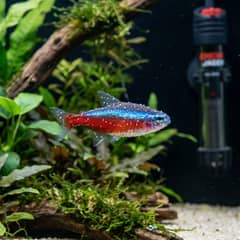
A goldfish forages by sucking up mouthfuls of the tank floor and spitting out what is not food, and a corydoras hunts with its barbels pushed into the same layer. For fish like these the substrate is a feeding ground. For every fish it is part of the water chemistry, since some floors leach calcium for years, and even a midwater neon tetra changes color with it.
Sand or Gravel
Both work, and they differ in where the dirt goes. Very fine sand lets little dirt sink in, so waste sits on top for the filter or a siphon. The larger the grain, the more gets trapped, though gravel stands up to a vacuum that would lift sand. Coarse gravel is a poor medium for roots; fine sand suits roots but is more prone to going anaerobic, starved of oxygen, when laid deep.
Some fish sift fine gravel through their gills and others swallow it, so the grain depends on the species, and the wrong size and texture can damage barbels and skin. For a first planted tank, start with an inert substrate that carries no nutrients of its own, either aquarium gravel or sand.
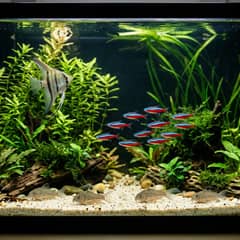
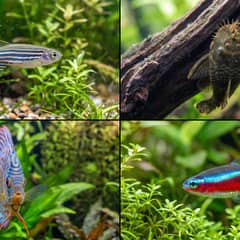
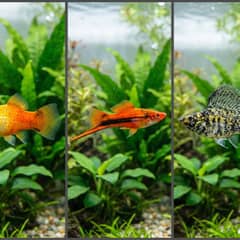
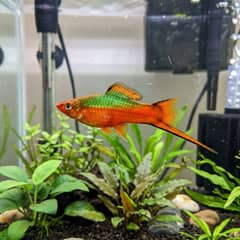
Color. Dark substrates make tetras' colors stand out, and embers, zebra danios and swordtails look best over one. A black sand or a dark, small-grained gravel meets it. Neon and cardinal tetras turn lighter over a pale substrate or background in bright, clear water. That is a color effect only: in farmed food fish, a black tank made fish more sensitive to stress, and a dark floor has not been shown to calm an aquarium fish. Given the choice, zebrafish picked gravel over sand, and any substrate over a barren tank.
How Deep and How Much
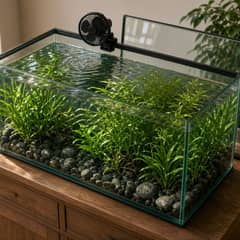
An unplanted community tank needs only a shallow bed, a thin layer of sand or a couple of inches of gravel, because deeper beds hold more waste and are likelier to turn anaerobic. Where waste builds up in a deep, unstirred layer and the oxygen runs out, hydrogen sulfide can form, which is toxic to fish and escapes into the water when the layer is disturbed. Pond gravel deeper than 3 inches carries that risk, but an ordinary 1 to 2 inch aquarium bed that is cleaned on schedule has not been shown to produce it. Deep beds of porous planting soil are the exception to the depth limit. A tank planted into the floor needs at least 2 to 3 inches, while a thin layer of sand is enough where little is rooted. Sloping the bed deeper toward the back also makes the tank look deeper.
How much to buy. Rules of thumb run from 1 to 1.5 pounds per gallon; at 1.5 pounds, a 10 gallon tank takes about 15 pounds for a 1 to 2 inch layer. Gallons do not measure the floor, though: a tall tank holds more water over the same footprint, so a per-gallon rule gives it a deeper bed. A substrate calculator asks for depth, length and width instead, and returns a number of bags. Work from the floor.
What the Floor Does to the Water
Inert sand, gravel and rock leave the water alone. Calcareous substrates carry calcium and other minerals that raise hardness and pH. Inert floors matter most for soft-water fish such as tetras and discus, because whatever goes into a soft-water tank has to leave the water soft.
Several floors are less inert than they look. Even standard pea gravel contains enough calcium to raise pH and hardness. Rough, angular colored gravel with a powdery coating is often white dolomite, rich in calcium and magnesium, under paint or resin, so it raises both figures too and has no place in a soft-water tank. Beach shells, coral and sand can shift pH. Coral sand belongs only in a tank meant to stay hard and alkaline, where it can push pH past 8.0. Seachem says its Flourite and Flourite Black Sand will not alter pH.
Buffering on purpose. For hard-water fish on soft tap water, that chemistry is a tool. Crushed coral is calcium carbonate: it raises KH strongly and GH somewhat, adding calcium without the magnesium dolomite carries. The usual rate is 1 pound per 10 gallons, mixed into the gravel. It dissolves faster at lower pH, lasting 1 to 2 years in the substrate and 1 to 3 months in a filter, so test pH and KH to know when to add more.
Floors that pull the other way. Aquasoil lowers pH, toward the soft, acidic range embers and other soft-water tetras are kept in. A mild acid source moves pH far more in soft water than in hard, because carbonate hardness neutralizes acid first, the buffer at the center of how pH, GH and KH work together.
Rock follows the same rule. Limestone and other calcareous rocks, and seashells, leach calcium carbonate into the water. Put a few drops of vinegar on a stone: fizzing means calcium carbonate. Dragon stone passes, and rock with visible veins is best left out of a soft-water tank.
Planted Floors: Root Tabs, Capped Soil, Aquasoil
An inert bed feeds nothing, so a planted tank adds nutrients one of three ways.
| Planted floor | How it works | What to watch |
|---|---|---|
| Inert gravel or sand with root tabs | Root tab fertilizers are pushed into the bed beside root-feeding plants such as Cryptocoryne | The simplest start, and it leaves pH and hardness where the water put them. A liquid fertilizer in place of tabs also grows plants in inert gravel |
| Capped soil | A thin layer of soil, just covering the glass, under a deeper cap of gravel | Cap with gravel, since gas escapes through it; under sand, escaping gas erupts and muddies the water. Moving plants or digging bottom dwellers make a cloudy mess, and soil can cause ammonia spikes or algae |
| Aquasoil | Natural soil granules that lower pH and keep the water slightly acidic | It releases ammonium and nitrite at first, so fish go in only once both read zero, with 25 to 50% water changes at least twice a week for the first four weeks; the bed lasts about two to three years |
Digging into a planting substrate can release its stored nutrients and set off algae.
Leaves and wood on top. Dried leaves and driftwood are an optional top layer. Leaves such as catappa grow a biofilm fry graze on. Leaves, bogwood and mopani all release tannins, thought to be beneficial, that bring pH down a little in soft water, usually short of blackwater. High KH buffers most of that away, nothing on the floor softens hard tap water, and old leaves are swapped for fresh every few weeks, before they rot. Catappa's reputation against disease comes from leaf extract injected into farmed catfish, which says nothing about a leaf on a tank floor.
Bare Bottoms, and the Koi Pond
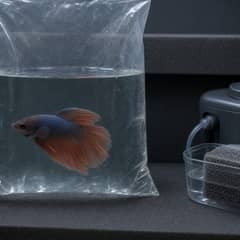
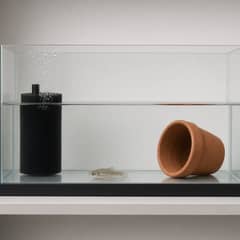
A bare floor shows every bit of waste, and in an outbreak dormant pathogens are easier to clear off it. Substrate can hide feces and uneaten food and harbor parasites and pathogens. The quarantine and hospital tank is built bare for those reasons: an inexpensive 10 gallon tank, sponge filter, small air pump and heater, broken down and disinfected between uses. Breeding tanks for egg scatterers such as zebra danios and black skirt and rummy-nose tetras use a mesh base.
Many discus keepers choose a bare tank, the easiest floor to clean, and breeding discus calls for one. Sand keeps uneaten food in plain view, small gravel works with regular vacuuming, and many keepers go heavily planted over an inert floor. Bare has a cost: substrate gives beneficial bacteria more surface, though in zebrafish tanks it also held more waste and bacteria, so a bed needs keeping clean.
A koi pond makes the same choice at scale. A bare liner is the easiest pond floor to clean and works well with a bottom drain, which carries waste out. Gravel and small rocks must be stirred often or they cement together, and they collect debris that is hard to clean, since a pond vacuum keeps sucking up the small stones. Deeper than 3 inches, pond gravel risks anaerobic bacteria and pockets of hydrogen sulfide that can kill fish if mixed into the water. Rock laid on a liner, sheet plastic or sprayed, wears through it faster. Where a pond does get a floor, a shallow layer of smooth-sided pebbles, rocks or gravel suits it.
Fish That Work the Floor
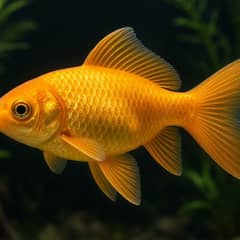
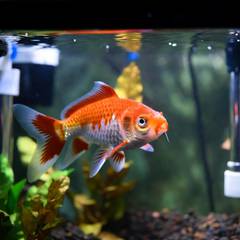
Goldfish and oscars. Goldfish evolved to take in mouthfuls of sand, silt and mud. A stone usually comes back out within minutes, but a large piece lodged in the mouth takes sedation and forceps at a fish vet, and swallowed pea gravel can block the esophagus. Fine grit, very small rounded gravel or sand all suit, and a goldfish tank can also run bare, on sand, or on gravel too big to fit in the mouth. An oscar digs into the substrate, so it gets soft sand or gravel too large to swallow, with a few flat rocks for spawning.
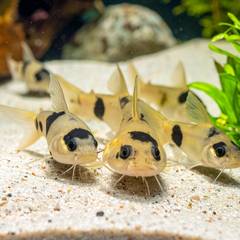
Corydoras and plecos. Cories feed with their barbels in the bed, and the consensus floor is smooth, fine sand or fine, smooth gravel, kept scrupulously clean, and no deeper than about 0.6 inch so the fish can reach the glass. Damaged and infected barbels get blamed on sharp grain and on dirty beds alike, so the bed has to be smooth and clean. Breeding cories appear less prone to disease over thin sand than in a bare tank. Undergravel filters, which use the gravel as the filter medium, do not belong under cories. A bristlenose with plenty of cover, caves included, is unfussy about decor. Its floor has no species-specific rule; the general advice that coarse grains can affect catfish points to a smooth one.
Cleaning
Before it goes in. Rinse new substrate thoroughly: most is dusty enough to cloud the tank, powder-coated colored gravel worst of all. Rinse sand in a bucket 2 to 3 inches at a time, stirring hard under cold water.
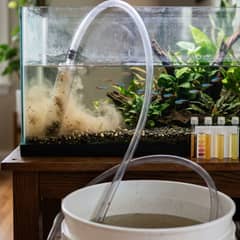
Gravel. Vacuum at least every two weeks, weekly for preference, since a neglected bed brings nitrate spikes. A careful pass reaches most of the floor while drawing off only about 20 to 30% of the water. A gravel vacuum with a squeeze bulb starts the siphon without mouth suction. Crimp the hose to slow the flow, and work in rows like mowing a lawn.
Sand. A gravel cleaner pushed into sand lifts the sand out. Rake your fingers through the surface weekly, then skim the siphon just above it. Limit each cleaning to about a quarter of the bed. Top up the sand that leaves with each pass.
Planted beds. A gravel cleaner can suck a planting substrate out, so the cleaner works the open patches and the rooted areas are left alone. Dig plants out instead of pulling them, and take every root: roots left behind decompose and add nitrate.
Which Floor for Which Tank
| Tank | Fish | Floor | What decides it |
|---|---|---|---|
| Midwater fish, mostly soft water | Neon, cardinal, ember, rummy-nose and glowlight tetras; zebra danio; angelfish; planted discus; betta; black skirt tetra | Inert sand or fine gravel, dark for embers and zebra danios, river sand for rummy-nose and glowlights; betta, angelfish and black skirt have no floor requirement | Soft water has to stay soft; neons and cardinals pale over a pale bed |
| Hard-water livebearers | Guppy (about 8 to 30 dGH), platy (10 to 30), molly (15 to 30), swordtail (10 to 25) | No species-specific need for grain; dark suits swordtails | Soft tap water needs lifting, and crushed coral mixed into the gravel does it |
The Takeaway
A tank floor is chosen for the fish that touch it and the water it sits in. Goldfish need a bed they cannot swallow, cories one that is smooth, shallow and clean, and soft-water fish one that leaves the water soft. Keep the bed shallow enough to stay clean, vacuum it on schedule, and leave the glass bare for quarantine and breeding.
Sources & Further Reading
Last reviewed 1 Nov 2026 · 5 sources
- Frequently asked questions on aquarium substrates, Matt Clarke, Practical Fishkeeping
- Providing a Home for Fish, Ruth Francis-Floyd and Barbara D. Petty - Merck Veterinary Manual
- Goldfish Care Sheet, Melissa Witherell, DVM - PetMD
- Best Pond Substrate for Outdoor Fish Ponds, Jessie Sanders, DVM, DABVP (Fish Practice)
- Aquarium Soil, Tropica
Frequently Asked Questions
Is sand or gravel better for a freshwater aquarium?
Neither wins outright. Sand keeps waste on its surface and suits roots, but it goes anaerobic when laid deep. Gravel hides more debris between its pieces yet stands up to a vacuum. Choose by the fish: sifters and diggers want sand, and many midwater species have no need either way.
How many pounds of substrate does my tank need?
Per-gallon rules of 1 to 1.5 pounds get you close, but they ignore the tank's shape. Multiply the floor's length by its width by the depth you want, or use a manufacturer's calculator that asks for those three figures. A tall tank needs less than its gallons suggest.
Will gravel change my water's pH?
Inert gravel will not, but plenty of gravel sold for aquariums is not inert. Pea gravel carries enough calcium to lift pH and hardness, and rough, powder-coated colored gravel is often dolomite underneath. For a soft-water tank, buy a substrate sold as inert.
Can goldfish choke on aquarium gravel?
A stone caught in the mouth usually comes back out within minutes, though a large one can need sedation at a fish vet. Swallowed pea gravel can block the esophagus. Gravel bigger than the mouth, fine sand, or a bare floor avoids both problems.
How do I clean sand without sucking it up?
Keep the vacuum's tube out of the sand. Rake your fingers through the surface to lift the dirt, then skim the siphon just above it, crimping the hose to slow the flow. Clean about a quarter of the bed at a time, and top up the sand that leaves.
Do quarantine tanks need substrate?
No. A hospital or quarantine tank stays bare so waste shows up at once and the whole setup can be broken down and disinfected after each use. A sponge filter, an air pump and a heater are all it carries.
What substrate is best for corydoras?
Smooth, fine sand or fine, rounded gravel, in a layer shallow enough for the fish to dig through to the glass, and kept clean. Barbel damage gets blamed both on sharp grains and on dirty beds, so a cory floor should be neither.
Do I need aquasoil to grow aquarium plants?
No. Plain inert gravel or sand fed with root tabs or a liquid fertilizer grows plenty of plants. Aquasoil feeds roots and acidifies the water, which suits soft-water tetras, but it releases ammonium for the first weeks and is usable for about two to three years.
Recommended Gear
As an Amazon Associate I earn from qualifying purchases through the links above, at no extra cost to you.
Written by Michael Ryan
Mike keeps two rescued bearded dragons, Dex and Cera, and writes the care guides on BeastlyFacts from his own research and mistakes. He is not a veterinarian.
More about Michael Ryan →You May Also Like
Subscribe - it's free
An occasional email when something new is worth your time. No spam.
Health and More