Rummy-Nose Tetra Tank Setup: A 36-Inch Run, Soft Acidic Water, and Dim Light
On This Page▾

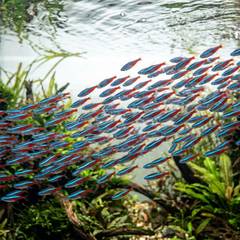
The rummy-nose tetra (Petitella bleheri, formerly Hemigrammus bleheri) is a South American tetra from tannin-stained blackwater rivers, where the water runs brown and very acidic. Adults reach about 2 inches (5 cm), and they move in a way that shapes the whole tank: a sudden burst of speed, a glide, then another burst, with the rest of the school matching each move.
Tank Size: 36 Inches of Swimming Room
A school of 10 needs a tank at least 36 inches (90 cm) long. In volume that is a 30 to 40 gallon tank, and an Aqueon 40-gallon breeder sits right on the minimum at 36 x 18 inches. Buy by the measurement along the front glass: a 20-gallon long, at 30 inches, comes up short.
Length matters because this is one of the tighter schooling tetras and an active one. The group works back and forth along the tank in bursts, and a short tank cuts every run off early. Ten is the smallest school to plan for, a number set by how the fish behave in a group, and a larger school is better still.
Temperature: 73 to 79°F, With 79 as the Ceiling
Hold the water at 73 to 79°F (23 to 26°C) with a submersible heater set inside that band, so a warm room has somewhere to go. 79°F is the ceiling.
That band sits wholly inside the 73 to 81°F a cardinal tetra tank is kept at, and it shares 73 to 77°F with a neon tetra tank. A shared tank runs inside the overlap.
Water Chemistry: Soft and Acidic
The target is pH 5.5 to 7.0 with a general hardness of 2 to 12 dGH, and the soft, acidic end suits the species best. The firehead rummy-nose is kept at up to 15 dGH, so 12 leaves a margin under its limit. That pH range falls inside the 5.0 to 7.0 that cardinal and ember tetra tanks are kept at, though rummy-noses take a little more hardness than an ember's 10 dGH limit. Water that drifts alkaline washes out their color.
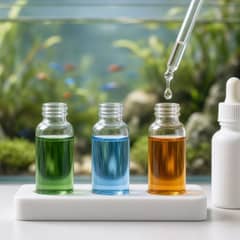
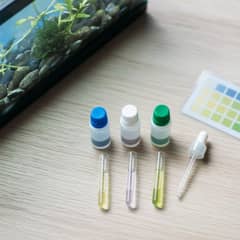
Test the tap before the tank is filled. Hard source water is fixed at the source, by bringing GH and KH down, and that decides how the tank is first mixed and how every change after it is made up.
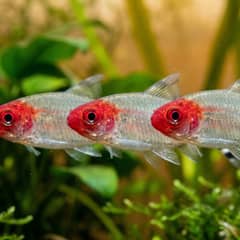
The red head is the quickest visual check in the tank. It fades when the fish is stressed or kept in poor water, so a school that has gone pale is the signal to run the test kit. It does not tell you which reading is off.
Filtration: Sized to the Tank, Gentle Where There Are Fry
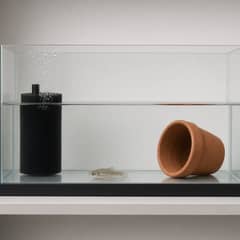
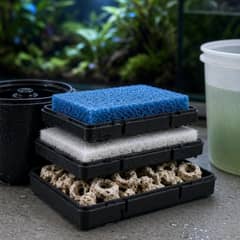
Size the filter to the tank's volume, using the turnover figures for a real tank, not the number on the box. In a breeding tank flow becomes the deciding factor: a sponge filter moves water gently enough that the intake cannot swallow the fry.
Substrate: River Sand Under Wood and Leaves
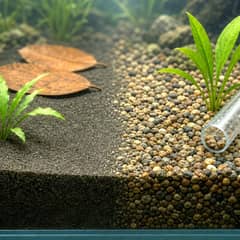
River sand is the floor for this species, with a few driftwood branches laid across it. Whatever goes down has to leave soft water soft, so the bed must be inert. Inert substrates leave the water's chemistry alone, while calcareous ones carry calcium and other minerals that raise hardness and pH. Even standard pea gravel holds enough calcium to do it, and coral sand pushes the pH past 8.0, far above the 7.0 top of this fish's range and into the alkaline water that fades its color.
About 1 inch (2.5 cm) of sand is plenty, since sand this fine tends to stagnate in a deep layer. A bed that plants root into runs 2 inches (5 cm) or more of gravel, with root tabs pushed in beside the rooted plants. A few handfuls of dried beech or oak leaves finish the floor, and they are the same leaves that tint the water in a blackwater layout.
Plants: Optional, With an Open Lane
Aquatic plants are not a feature of the rummy-nose's home rivers, so a planted tank is a choice and not a requirement. The species does well in a standard, well-planted tank too, and the red heads look striking against plenty of green. Whichever layout is chosen, keep a long open lane through the middle of the tank for the school to run.
Lighting: Fairly Dim, 8 to 10 Hours
Keep the light fairly dim, on for roughly 8 to 10 hours a day, and the fish show their best color under it. Dim for an aquarium is still far above the level a school needs to work. In lab trials, groups of five held together only above 1.5 lux, and in schools of about 50, very low light broke the group into fish that could not move as one. As the light rose, the same fish lined up and then settled into a steady, circling mill. A dimmed fixture gives the shade this fish prefers without taking the tank anywhere near that threshold.
Sight alone can hold a rummy-nose school together. When researchers disabled the lateral line, the fish kept schooling by eye, though they swam about 79% farther from their neighbors.
Source: McKee, Soto, Chen and McHenry (2020), Proceedings of the Royal Society B
Tankmates: Calm Fish of a Similar Size
Rummy-noses are very peaceful and lose out to boisterous or much larger tankmates, so the tank should be a calm one. Every companion also has to pass the four checks any pairing faces: an overlapping temperature, overlapping water chemistry, no mouth big enough for the other fish, and no nipping. In a tank held at 73 to 79°F, that rules out fish kept cooler.
The species that fit:
- Other small tetras of the Hemigrammus and Hyphessobrycon groups, and pencilfish.
- Apistogramma and other dwarf cichlids. A confident rummy-nose school makes a good dither fish for these shy, territorial cichlids.
- Corydoras and small loricariid catfish on the bottom.
- In a general community, smaller rasboras, barbs and anabantoids, and West African dwarf cichlids such as Pelvicachromis.
Shrimp are a split answer. Like most fish, rummy-noses snack on baby shrimp and fry when they find them, but they leave adult dwarf shrimp and snails alone.
Blackwater or Clear Water
Both work. The firehead comes from blackwater, and it also does well in a standard, well-planted tank of clear water.
For the stained look, the layout copies the rivers: a river-sand bottom, driftwood and roots, and a few handfuls of dried beech or oak leaves. The wood and leaves color the water like weak tea, with old leaves pulled every few weeks before they rot and foul the water. A small net bag of aquarium-safe peat in the filter is the older way to the same blackwater effect, and it is not needed: peat collection is unsustainable and environmentally destructive.
Cycle the Tank First, Then Lower the pH
A finished cycle is the single most important step when a rummy-nose tank is first set up. The tank is fully cycled before the school goes in, with ammonia and nitrite both at zero and nitrate starting to rise. This species reacts badly to stress, which is why it is often steered away from beginners, and an unfinished cycle is exactly that kind of stress. Rummy-noses kept in a seasoned aquarium with good husbandry can live 5 years or more.
Cycle the tank at the tap water's own chemistry, and bring the pH down with leaves and wood only after ammonia and nitrite have reached zero, so the water changes in one step once the bacteria are established.
Quarantine is the single most important step for every fish added. New fish sometimes arrive carrying ich, so they spend at least 30 days in a separate quarantine tank before they meet the display.
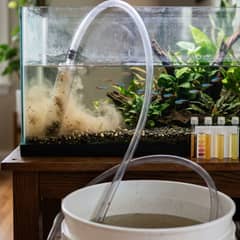
Partial water changes go in every week, whatever the layout. A rummy-nose loses its color when conditions turn against it, so a steady weekly routine is part of keeping the species at all. The size of each change follows the nitrate reading taken before it, and the new water goes in mixed to the same soft chemistry and temperature as the tank, so the school never meets a jump.
Sources & Further Reading
Last reviewed 31 Oct 2026 · 3 sources
- Seriously Fish: Petitella bleheri (Firehead Tetra); Paracheirodon axelrodi (Cardinal Tetra)
- PubMed (U.S. National Library of Medicine): Lafoux, Moscatelli, Godoy-Diana and Thiria (2023), Illuminance-tuned collective motion in fish, Communications Biology; McKee, Soto, Chen and McHenry (2020), The sensory basis of schooling by intermittent swimming in the rummy-nose tetra, Proceedings of the Royal Society B
- Frequently asked questions on aquarium substrates, Matt Clarke, Practical Fishkeeping
Frequently Asked Questions
What size tank do rummy-nose tetras need?
One that is at least 36 inches (90 cm) long for a school of 10, which puts it in the 30 to 40 gallon range. Measure the front glass before reading the gallons on the label.
Is a 20-gallon tank big enough for rummy-nose tetras?
No. A 20-gallon long is only 30 inches from end to end, which leaves a school of 10 six inches short of the 36-inch minimum.
What temperature do rummy-nose tetras need?
73 to 79°F (23 to 26°C). A heater set in the middle of that band keeps the tank clear of 79°F, the top of the range.
What pH and hardness do rummy-nose tetras need?
pH 5.5 to 7.0 with a general hardness of 2 to 12 dGH. Soft, acidic water suits them best, and their color dulls when the water turns alkaline.
Do rummy-nose tetras need a planted tank?
No. A planted tank and a sparse layout of sand, wood and dried leaves both suit them, and plants are scarce in the rivers they come from.
Can rummy-nose tetras go into a new tank?
Not until it has finished cycling, with ammonia and nitrite both at zero. Rummy-noses are sensitive to stress, and a tank still cycling is a steady source of it.
What substrate is best for rummy-nose tetras?
Fine river sand about an inch deep, with driftwood and a few dried leaves on top. It has to be inert, because pea gravel and coral sand push pH and hardness up and the red head fades in alkaline water.
What fish can live with rummy-nose tetras?
Calm fish of a similar size that share 73 to 79°F water: other small tetras, pencilfish, Corydoras, small loricariids and dwarf cichlids such as Apistogramma. Boisterous or much larger fish push them aside.
More on the Rummy Nose Tetra
Recommended Gear
As an Amazon Associate I earn from qualifying purchases through the links above, at no extra cost to you.
Written by Michael Ryan
Mike keeps two rescued bearded dragons, Dex and Cera, and writes the care guides on BeastlyFacts from his own research and mistakes. He is not a veterinarian.
More about Michael Ryan →You May Also Like
Subscribe - it's free
An occasional email when something new is worth your time. No spam.
Deep Dive
Health and More