Rummy-Nose Tetra
Petitella bleheri (formerly Hemigrammus bleheri)
Beastly Facts · Updated
On This Page▾
Overview
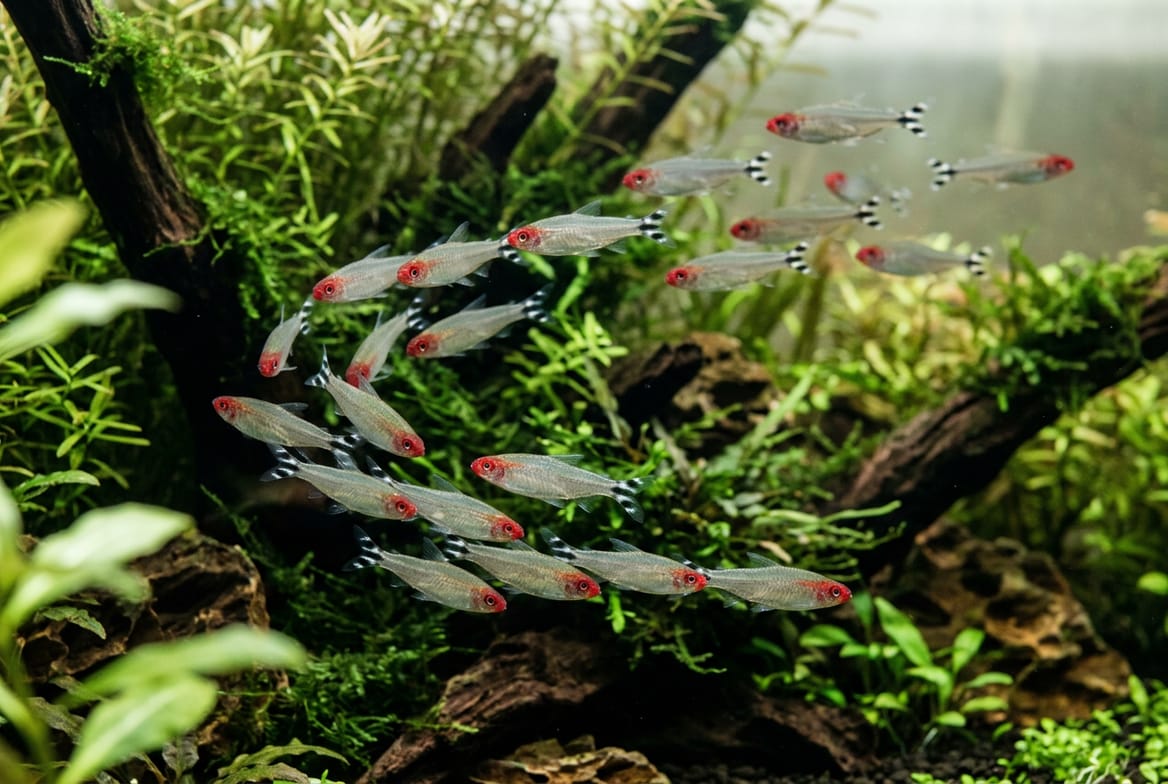
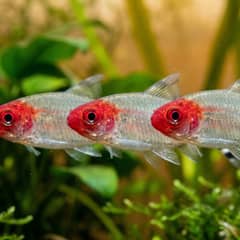
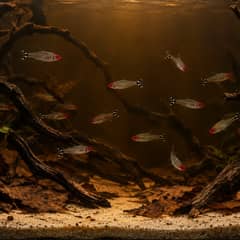
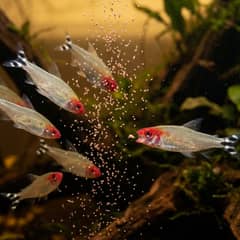
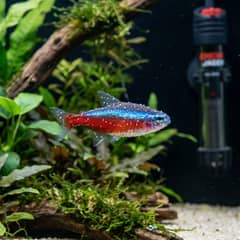
The rummy-nose tetra is a slim schooling fish from the blackwater rivers of the Rio Negro and Rio Meta basins, named for the bright red that covers its head. It schools so tightly that physicists use it to study how groups of animals move together, and the red fades when a fish is stressed or kept in poor conditions. Most fish sold under the name are Petitella bleheri; two close look-alikes, P. rhodostoma and P. georgiae, are sometimes sold under the same label.
Quick Facts
Native Range
Rio Negro and Rio Meta basins (Brazil and Colombia)
Natural Habitat
Tannin-stained, very acidic blackwater rivers and flooded forest streams, with few aquatic plants
Adult Size
About 1.5-2 inches (4-5 cm)
Wild Diet
Omnivorous: microcrustaceans, insect larvae, filamentous algae and plant fragments, shifting with the flood season
Wild Lifespan
Not documented in the wild; about 5 years in captivity
Conservation Status
Least Concern (IUCN)
History
Géry and Mahnert described the species in 1986 from the Rio Negro in Brazil and named it for Heiko Bleher, the explorer and ornamental fish wholesaler who collected specimens there. It sat in the genus Hemigrammus until a 2020 study moved it, along with the original rummy-nose tetra described by Ahl in 1924, into Petitella. In Brazil's Amazonas state it ranks second among exported aquarium fish, behind only the cardinal tetra.
Compare
Rummy-Nose Tetra
Human
Adult Size
About 1.5-2 inches (4-5 cm)
5-6 feet (150-185 cm); ~135-200 lbs
Wild Lifespan
Not documented in the wild; about 5 years in captivity
~73 years (global average)
Wild Diet
Omnivorous: microcrustaceans, insect larvae, filamentous algae and plant fragments, shifting with the flood season
Omnivorous - eats just about anything
Native Range
Rio Negro and Rio Meta basins (Brazil and Colombia)
Global - originated in Africa roughly 300,000 years ago
Natural Habitat
Tannin-stained, very acidic blackwater rivers and flooded forest streams, with few aquatic plants
Everywhere from arctic tundra to tropical megacities
Conservation Status
Least Concern (IUCN)
Least Concern (8+ billion and counting)
Test Yourself
What's the Rummy-Nose Tetra's native range?
Care Guide
Rummy-Nose Tetra Care Guide
The red-nosed schooler that turns laps of a long tank in lockstep!
Subscribe - it's free
New animal facts and care guides straight to your inbox. No spam.
Deep Dive

Health and More







Did You Know?
Rummy-nose tetras school so tightly that physicists use them to study how groups decide where to go: in a ring-shaped tank, the U-turns that reverse the whole school mostly start with the fish at the front.
Explore More