Neon Tetras Aren't Handled, But the School Size Isn't Optional
On This Page▾

A neon tetra is a fish to watch, and the only time a keeper's hands come near one is the minute it moves from a bag or a net into water. The welfare question with this species is group size, and getting that number right changes how these fish behave.
The Number That Matters: Six, Minimum
Neon tetras are obligate schooling fish: they need a group to feel secure and behave normally. Six is the floor, and ten to twelve or more is considerably better if the tank allows it. A group smaller than six produces fish that are pale, stressed, constantly hiding, and more vulnerable to illness. For this species the number works as a welfare requirement.
What a Properly Schooled Group Looks Like
Confident, brightly colored fish swim together in a loose group and work the mid-water of the tank instead of hiding in corners. It is one of the more rewarding things to watch in a community aquarium, and it only happens reliably once the school is big enough.
The Minutes Between the Bag and the Tank
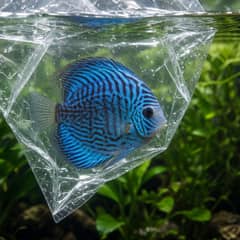
The one real handling job is getting new neons into the tank, and it starts with the same float, net and release every aquarium fish gets. Neons react more to a change in water chemistry than most community fish, so when the shop's water and the home tank differ much in pH or hardness, slow mixing earns its time with this species. Buy the whole school in one trip if the tank is ready for it. A pair of neons added ahead of the rest has no school to hide in.
Two more rules follow from that sensitivity. Put neons into a tank that has run for a while after cycling, never one that finished cycling last week, and keep each water change to a size the fish never notice.
Telling Males From Females
Sexing a neon is hard until the fish are mature. Adult females are rounder-bodied and a little larger than males, and seen from the side, that fuller belly makes the female's blue stripe look slightly bent. A male's body stays slim and its stripe runs straight. In a school of ten, the plumpest few are the females.
Breeding Neons
A community tank almost never produces young neons, and the reason is chemistry and light. Spawning needs very soft, acidic water, hardness around 1 to 5 dGH and a pH of 5.5 to 6.5, in a very dimly lit tank. One successful home spawning ran at 78°F, inside the ordinary temperature range. The eggs and fry are light sensitive, and the adults eat any eggs they find.
That shapes the setup. A small bare tank, a clump of Java moss or a layer of leaf litter for the eggs to fall into, soft water, and the tank kept dark. Add a pair or two of conditioned adults, and take them out once eggs appear. The eggs hatch in 24 to 36 hours, and the fry swim free 3 to 4 days after that. They start on infusoria-sized food and move to microworm or newly hatched brine shrimp once they can take it. Young neons color up at about four weeks.
First-Timer Mistakes
- Buying two or three neons and calling it a school. It's the most common mistake with this species.
- Adding them to a tank that has only just cycled, which stresses an already sensitive fish.
- Mixing them with fin-nipping tankmates, which disrupts schooling even in an adequate group.
How Neon Tetras Compare to the Guppy
The two look interchangeable on a beginner's shopping list: small, colorful, community friendly. Their care diverges. Guppies are hardy livebearers that tolerate harder, more alkaline water and breed without help. Neon tetras are egg scatterers that need soft, acidic, stable water, and they react badly to swings. A keeper who has done well with guppies should check that assumption before buying neons, because guppies put up with a wider range of water than neons do.
Neon tetras are often confused with the closely related cardinal tetra, and the red stripe tells them apart. It runs the full body length on a cardinal, but only the back half on a neon.
The Neon tetra encyclopedia profile covers the species itself.
Sources & Further Reading
Last reviewed 21 Jul 2026 · 5 sources
Frequently Asked Questions
Do you handle neon tetras the way you'd handle a hamster or a bird?
No. Neon tetras are watched, not handled. What decides how well they do is the size of the school they live in.
How many neon tetras should I keep together?
Six at the very least, and ten to twelve if the tank allows. Below six you get pale, stressed fish that hide constantly and fall ill more easily. Treat the number as a welfare requirement.
What does a properly schooled group look like?
Bright fish moving together through the middle of the tank, out in the open instead of tucked into corners. It only looks like that once the school is big enough.
What's the most common neon tetra beginner mistake?
Buying two or three and calling it a school. That's the big one. Adding them to a tank that hasn't finished cycling, and mixing them with fin-nippers, round out the list.
How can you tell a male neon tetra from a female?
Only once they're adults. Females are rounder-bodied and a little larger, and the fuller belly makes the blue stripe look slightly bent. Males stay slim with a straight stripe.
How do neon tetras compare to guppies?
They look interchangeable on a shopping list and aren't. A guppy is a hardy livebearer that tolerates harder, alkaline water and breeds without much intervention. A neon tetra is an egg-scatterer that needs soft, acidic, stable water, and it reacts badly to swings.
More on the Neon Tetra
Neon Tetra care guide
🐠 How Much Does Neon Tetra Ownership Really Cost?
🐠 Common Neon Tetra Health Issues (Including the Disease Named After This Fish)
🐠 Neon Tetra Tank Setup: Soft Water, Dim Light, and a Blackwater Feel
🐠 Neon Tetra Feeding: Schedule, Diet, and the Rule That Prevents an Outbreak
🐠 Neon Tetra Enrichment: Someone Counted, and the Number Is Ten

Written by Michael Ryan
Mike keeps two rescued bearded dragons, Dex and Cera, and writes the care guides on BeastlyFacts from his own research and mistakes. He is not a veterinarian.
More about Michael Ryan →