Glowlight Tetra Feeding: Diet, Live Foods, and How Often to Feed
On This Page▾

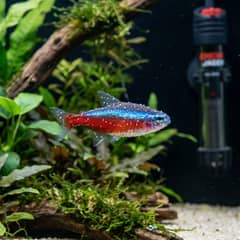
A glowlight tetra is about 1.6 inches (4 cm) long and will take nearly anything small enough to swallow. That makes feeding simple, and it also means the keeper, not the fish, has to set the limit on how much goes in.
Feeding Schedule by Life Stage
Glowlight fry wait out their yolk sacs before eating anything, juveniles take several small meals, and adults need only one or two light ones.
| Stage | What | How often and how much |
|---|---|---|
| Fry | Nothing while the yolk sac lasts; then cultured infusoria, followed by baby brine shrimp or microworm and crushed dry food as they grow | Up to 5% of body weight a day, in portions small enough to be cleared |
| Juvenile | The adult foods at a smaller size: crushed flake, the smallest micro pellets, baby brine shrimp | Three to four small meals a day, tapering to the adult schedule |
| Adult | Micro pellets or small flake, with bloodworm, daphnia and brine shrimp live or frozen in the rotation | Once or twice a day, each feeding light: about 3% of body weight a day in total |
Glowlights scatter their eggs, and the parents will eat them if left in the tank, so fry are raised apart from the adults. The eggs hatch in 24 to 36 hours, and the fry then live on their yolk sacs for several days before they need feeding. Infusoria is the usual first food, though glowlight fry have occasionally taken brine shrimp nauplii as soon as they swim free.
For adults, the portion is what the school clears while it is still feeding hard. If flakes or pellets reach the substrate untouched, the next pinch is smaller. Watching also shows whether every fish is getting a share. Uneaten food rots into ammonia, the waste that the nitrogen cycle in a mature tank has to keep clearing, and a quick drop in water quality is how an easy eater ends up in a fouled tank.
What Glowlights Eat, in the Wild and in the Tank
Wild glowlights are omnivores. Their diet is worms, small crustaceans and plant material, which is the reason a mix of foods suits them better than a single product. The captive menu follows from that: a dried staple, with small live and frozen prey added around it.
Build the daily diet on a quality dried food of a suitable size. A slow-sinking micro pellet or a small flake does the job, and either one is eaten readily by a school this size.
Glowlight tetras eat almost anything, so size and portion are the only rules. Use micro pellets or small flake as the base, add small live and frozen foods for variety, and feed only what the school clears.
Small live and frozen foods are the best way to widen the diet. Bloodworm, daphnia and brine shrimp are the usual choices, and freshly hatched baby brine shrimp make an occasional treat. Offer them as part of the regular rotation instead of the whole meal, so the dried staple still carries the day-to-day nutrition. They are also what brings a glowlight to its best condition and color.
The genus name Hemigrammus joins the Greek words for "half" and "letter". The name points to the lateral line of the genus's type species, which stops partway along the body instead of running to the tail.
Source: The ETYFish Project
Daphnia brings a risk the dried staple does not: it and cyclops are common intermediate hosts of Camallanus, a parasitic worm that reaches the fish through the food.
Dried food loses its value once it is opened. A container kept at room temperature is thrown out 2 months after opening, and one stored in the freezer after 6 months. Frozen bloodworm and brine shrimp keep for a year, and once thawed they are never refrozen.
Foods to Avoid
- Live tubifex. Tubificid worms are the host of the parasite behind whirling disease, and keeping fish away from them is how that disease is prevented.
- Freeze-dried tubifex as a regular food. It is sold as an occasional treat for glowlights, and freeze-drying is not known to remove the parasite risk the live worms carry.
- Flake sized for bigger fish. It can be too large for a small mouth to take easily, and pieces a glowlight cannot get down sink and rot.
- Rich, fatty or starchy diets. Fatty liver disease is a common problem in captive fish, and diets high in carbohydrate or fat, and rancid food, are among its causes.
Why Glowlights Stop Eating
- Bolder tankmates. In a mixed tank, check that faster or pushier fish are not taking most of each feeding. Companions that pass the compatibility checks for sharing a tank keep feeding time fair for a fish this size.
- Too small a school. Glowlights kept in small or lonely groups spend most of their time in hiding, away from the food.
- Internal parasites. Spironucleus, an intestinal flagellate, causes weight loss and a lost appetite.
When to Worry
Body shape in a glowlight depends on sex. Females are more rounded in the belly, and a female in breeding condition looks very full, so a plump female is not overfed. Males are slimmer, with a slightly sunken belly region, so a lean male is not a hungry one. The signs that need action:
- One fish thinning while the rest eat. That fits an internal parasite, one of the glowlight tetra health problems that needs a diagnosis before any medication goes in.
- A red thread at the vent. Camallanus shows as red worms protruding from the vent, most likely in a tank fed live cyclops or daphnia.
When You Go Away
While you are away, the fish need either a person to feed them or an automatic feeder, and an easy eater like this one makes overfeeding the risk with both.
For a sitter, measure each meal out ahead of time, for example into a labeled pill organizer with one compartment per feeding, so nothing extra goes in. Show them once, and leave your number.
For an automatic feeder, set it up and test it for several days before you go, with a food it dispenses well, checking that it is not jamming or overfeeding.
An adult glowlight asks little more than that: a small dried food, a rotation of live and frozen extras, and a keeper who stops before the water suffers.
Sources & Further Reading
Last reviewed 31 Oct 2026 · 4 sources
- Hemigrammus erythrozonus (Glowlight Tetra), Seriously Fish
- Hemigrammus erythrozonus, Glowlight tetra, FishBase
- How to breed the Glowlight tetra, Practical Fishkeeping
- Merck Veterinary Manual: Nutritional Diseases of Fish; Parasitic Diseases of Fish
Frequently Asked Questions
What do glowlight tetras eat?
Micropellets or small flakes day to day, with bloodworm, daphnia and brine shrimp as live or frozen extras. They are omnivores that take almost anything offered.
How often should glowlight tetras be fed?
Once or twice a day, keeping each feeding light. Give only what the school finishes, since uneaten food fouls the water.
Are glowlight tetras picky eaters?
No. They accept nearly every food of a suitable size, so the risk with this species is overfeeding, not refusal.
Do glowlight tetras need live food?
Not as the staple. A good dried food covers the daily diet, and small live or frozen foods are worth adding to the rotation for variety.
Why does my glowlight tetra's stripe look faded?
Look at the water and the light before the food. Glowlights are more colorful in acidic water, show best under fairly dim lighting, and can look washed out in a sparse, bare tank.
What do glowlight tetra fry eat?
Nothing for the first few days, while the yolk sac lasts. After that they take cultured infusoria, then baby brine shrimp and crushed dry food.
Can glowlight tetras eat tubifex worms?
Live tubifex are best left out, because the worms host fish parasites. Freeze-dried tubifex is sold as an occasional treat, but nothing shows that drying makes it safe, so bloodworm and brine shrimp are the easier choice.
How do I feed glowlight tetras while I'm on vacation?
Have a sitter use meals you measured out in advance, for example one compartment of a labeled pill organizer per feeding, or run an automatic feeder for several days before you leave to check it does not jam or overfeed.
More on the Glowlight Tetra
Recommended Gear
As an Amazon Associate I earn from qualifying purchases through the links above, at no extra cost to you.
Written by Michael Ryan
Mike keeps two rescued bearded dragons, Dex and Cera, and writes the care guides on BeastlyFacts from his own research and mistakes. He is not a veterinarian.
More about Michael Ryan →You May Also Like
Subscribe - it's free
An occasional email when something new is worth your time. No spam.
Deep Dive
Health and More