Fish Color and Diet: What Brings It Out, and What No Food Can Change
On This Page▾

A fish wears three kinds of color, and only one of them comes from its food. The black is a pigment the fish makes for itself. The blues, silvers and iridescent greens are light bouncing off crystals in its skin. The reds, oranges and yellows are built partly from carotenoids, pigments no fish can make and every fish has to eat.
Where a Fish's Color Comes From
Fish color sits in special cells in the skin. Some hold melanin, the black and brown pigment the fish makes itself. Some hold the yellows, oranges and reds, which come from two sources: carotenoids from the diet, and a second kind of pigment the cells make on their own. Others hold no pigment at all, just stacks of tiny colorless crystals that reflect light into the silvers, blues and iridescent sheens.
The fish can change how those cells look within seconds to hours, by spreading the pigment out or pulling it into a tight dot. Hormones and nerves run that change, including the stress response, which is why a frightened or unwell fish can look darker or paler than usual.
The Colors a Fish Has to Eat
Most animals cannot make carotenoids from scratch; plants and algae can. A wild fish gets them by eating algae, or by eating the small crustaceans that ate the algae, and astaxanthin is the main carotenoid in crustaceans. Fish farms add carotenoids to feed for the same reason, from sources such as krill and algae, with marigold used for yellow.
Fish do not all handle those pigments the same way. Carp, the family goldfish and koi belong to, can turn zeaxanthin into astaxanthin inside their own bodies. Perch-like fish, a group that by the usual reckoning takes in the cichlids, cannot make astaxanthin from other carotenoids, so the astaxanthin they carry has to come in with the food already made.
Platies fed brine shrimp enriched with beta carotene for eight weeks carried more than four times the skin carotenoid of platies fed plain brine shrimp. Red swordtails fed marigold petal meal at 15% of the feed held about ten times the carotenoid of fish on plain feed after three to four weeks. Oscars fed astaxanthin for 50 days carried about twice the skin carotenoid of fish on a plain diet. Not every fish answers every pigment, though: red female bettas fed annatto oil extract, an orange-red plant pigment, for four weeks showed no change in skin color at all.
What No Food Will Change
A carotenoid food works only on carotenoid color. Black is melanin, made in the fish's own cells, so no diet darkens a black bar or a black molly. Blues, silvers and iridescent greens are reflected light, so no diet brightens a neon's stripe or a danio's sheen. Even the reds are only partly food, since some of the red in fish comes from a pigment the fish makes itself.
Food also deepens a color the fish already carries without adding one. Beta carotene made platies redder and left their yellow where it was. The pattern, the black markings and the variety a fish was bred as come with the fish.
Color Foods: What Is in Them and What to Expect
A color-enhancing flake or pellet is a carotenoid food, and the ingredients doing the work are the ones above plus spirulina and red pepper or paprika, which supplies the carotenoid capsanthin. Brine shrimp carry pigment only after they have eaten it, so enriched brine shrimp work and plain ones carry little.
Expect a month at the least and more likely two: the earliest measured change came at three to four weeks, and most results were read after seven to ten.
More is not better. Overdoing it does not help, and too much may work against the immune response. A feed that is heavy in pigment can cost growth, which is why the color food stays one part of the rotation and the staple still carries the diet.
The pigments do more than color. Oscars fed astaxanthin or a beta carotene alga died less often after a bacterial infection, and platies on enriched brine shrimp carried more protective enzymes and antibodies in their skin mucus.
Light, Background and the Time of Day
Much of what looks like a color change is a fish adjusting its pigment cells to its surroundings. Zebrafish match their background by gathering or spreading their dark pigment. Neon and cardinal tetras turn lighter in bright light over a pale substrate in clear water, and duller, with a violet stripe, at night. The same fish can look different at breakfast and at dinner without anything being wrong.
When Lost Color Means Something Is Wrong
Stress changes color through the same hormones and nerves, so a fish under pressure from bullies, a move or bad water can go darker or paler. Disease shows in color too. Dulled color under a gray-white film of mucus points to skin protozoa, paleness with sores to larger skin parasites, and very pale gills to anemia. Ich goes the other way: white spots with dark coloration, lethargy and clamped fins.
A pale fish that is also clamping its fins, gasping or refusing food is showing a water problem or an infection, and the water gets tested before anything else.
Tetras and Danios
Neon and Cardinal Tetras
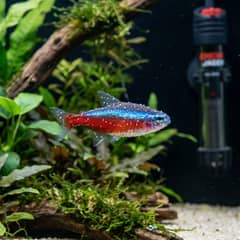
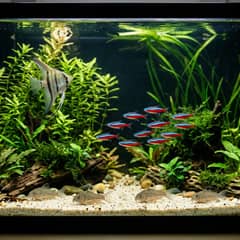
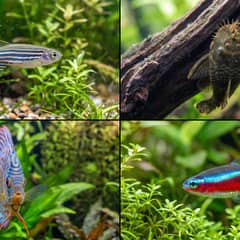
Both carry the same two-part color. The blue stripe is iridophore color: light falling on a tetra's lateral stripe widens the spacing between its reflecting platelets and shifts the color it reflects, and in the neon the platelets tilt like the slats of a Venetian blind. Food cannot reach that color. The red along the lower body is partly carotenoid color, so a varied diet with a carotenoid source keeps it deep.
Glowlight Tetra
The glowlight shows its best color in acidic water under fairly dim lighting, and it can look washed out in a sparse, bare tank. Small live and frozen foods bring out its best condition and color.
Rummy-Nose Tetra
The red head works as a gauge of the whole school. It pales badly when the fish are out of condition or kept in alkaline water, and the red stays deepest on a varied diet, so a nose that fades on every fish at once points to the water before the menu.
Ember Tetra
The ember's orange-red is the carotenoid kind of color, so a staple that lists krill, algae or astaxanthin is worth having. Adult males are the more intensely colored sex, and they are brightest in spawning condition.
Black Skirt Tetra
The black skirt's black is melanin, which no food deepens, and the intense black of a juvenile fades as the fish grows. Its best color comes with dense planting and floating plants dimming the light.
Zebra Danio
A danio's dark stripes are melanin and its silver-blue sheen comes from reflective cells, both made by the fish itself. Background does more for it than food: danios color best in a heavily planted tank over a dark substrate.
Livebearers
Gold and orange mollies carry carotenoid color that a carotenoid-rich food can brighten, while a black molly has none for it to work on.
Platy
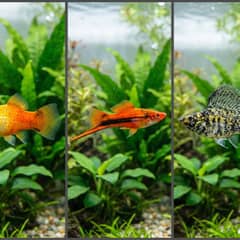
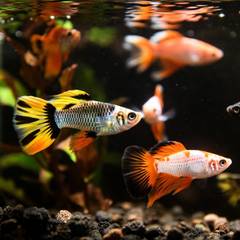
The platy is the clearest case. Its red, orange and yellow are carotenoid color, and enriched brine shrimp deepen the red. A flake or pellet listing spirulina, krill, astaxanthin or marigold, fed a few times a week alongside the platy's usual staple, carries the same pigments.
Swordtail
Red swordtails answer to plant pigment. Marigold, a lutein source, did more for them than hibiscus (China rose) or carrot, so it is the ingredient worth finding on the label.
Guppy
A male guppy's orange spots are partly carotenoid color, so a carotenoid source in the diet feeds part of them. Females are bigger, rounder and plain.
Cichlids
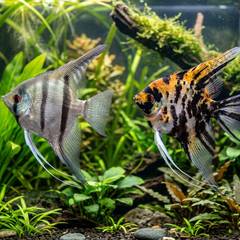
An angelfish's silver and black bars are reflective cells and melanin, so only the orange or red of some varieties answers to food. Discus reds and oranges need astaxanthin that arrives ready-made, from krill, shrimp or a food that lists it.
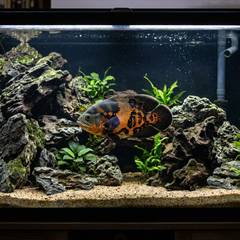
Oscar
The oscar's orange markings respond to food, and a food that lists astaxanthin itself, or krill and shrimp that carry it, is the direct route.
Goldfish and Koi
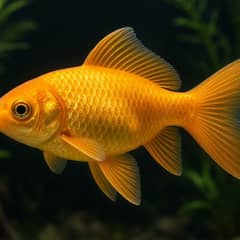
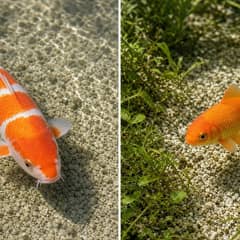
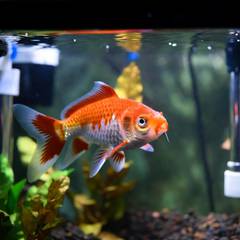
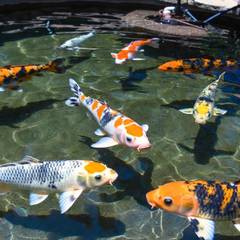
Goldfish and koi have the most flexible chemistry of any common pet fish. As carp they can convert zeaxanthin into astaxanthin themselves, which is why spirulina, a zeaxanthin source, goes into goldfish and koi feed as a red source, alongside the astaxanthin in krill and shrimp meal.
Bettas
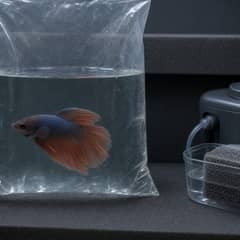
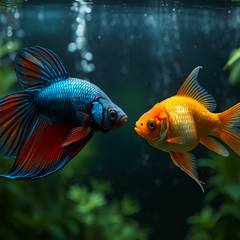
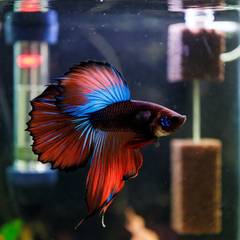
A red betta's red is carotenoid color, and food moves it. When male bettas ranging from blue to red were given extra carotenoids, the redder fish turned redder than unsupplemented fish, while the bluer fish did not redden at all and put the pigment into immune response instead. Not every pigment source works: red females fed annatto oil extract for four weeks showed no change in skin color. The blue, green and metallic sheens of many varieties are reflected light, and a black betta's black is melanin the fish makes for itself, so food does not touch either. A female ready to spawn turns paler and shows dark bars along her flanks, which is breeding dress, not illness.
Bottom Dwellers: Corydoras and Bristlenose Plecos
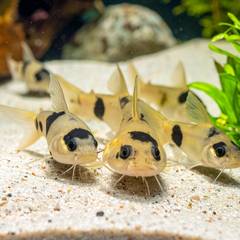
The browns, blacks and bronze sheen of corydoras are melanin and reflective cells, so a color food has almost nothing to work on. Bristlenose plecos are built the same way, and what changes in them is shade, not hue.
Dyed and Injected Fish
Some fish reach stores in colors they were never bred to carry, because dye has been injected under the skin; skirt tetras are among the fish it is done to. The injection stresses the fish badly and such fish often die young, so a dyed fish is best left in the store.
The red a platy carries home from the store is where its color starts. A couple of months of a carotenoid food can deepen it, and clean water, a calm tank and the right light let it show.
Sources & Further Reading
Last reviewed 5 Nov 2026 · 7 sources
- Ligon RA, McCartney KL (2016). Biochemical regulation of pigment motility in vertebrate chromatophores: a review of physiological color change mechanisms. Current Zoology 62(3):237-252
- Marine Drugs: Nakano T, Wiegertjes G (2020), Properties of Carotenoids in Fish Fitness: A Review, 18(11):568; Maoka T (2011), Carotenoids in Marine Animals, 9(2):278-293
- Aquaculture International: Abdollahi Y et al. (2019), β-Carotene-enriched Artemia as a natural carotenoid improved skin pigmentation and enhanced the mucus immune responses of platyfish Xiphophorus maculatus, 27(6):1847-1858; Alishahi M, Karamifar M, Mesbah M (2015), Effects of astaxanthin and Dunaliella salina on skin carotenoids, growth performance and immune response of Astronotus ocellatus, 23(5):1239-1248; Dorce LS et al. (2025), Mitigation of cold stress in red female betta (Betta splendens) through dietary supplementation with annatto (Bixa orellana L.) oil extract, 33(2):100
- Ezhil J, Jeyanthi C, Narayanan M (2008). Marigold as a Carotenoid Source on Pigmentation and Growth of Red Swordtail, Xiphophorus helleri. Turkish Journal of Fisheries and Aquatic Sciences 8:99-102
- Seriously Fish: Paracheirodon innesi (Neon Tetra); Paracheirodon axelrodi (Cardinal Tetra); Hemigrammus erythrozonus (Glowlight Tetra); Petitella bleheri (Firehead Tetra); Hyphessobrycon amandae (Ember Tetra); Gymnocorymbus ternetzi (Black Widow Tetra); Danio rerio; Poecilia reticulata (Guppy); Betta splendens
- Merck Veterinary Manual: Disorders and Diseases of Fish; Parasitic Diseases of Fish
- Clotfelter ED, Ardia DR, McGraw KJ (2007). Red fish, blue fish: trade-offs between pigmentation and immunity in Betta splendens. Behavioral Ecology 18(6):1139-1145
Frequently Asked Questions
Is a color-enhancing food safe for fish?
At the amounts tested, yes, and the same pigments have helped fish fight off infection. The catch is balance: a pigment-heavy feed can cost growth, so a color food is one part of the rotation, never the whole diet.
Can a color food change a blue or black fish, or its pattern?
No. Blue, silver and iridescent green are light thrown back by crystals in the skin, black is a pigment the fish makes for itself, and the pattern and variety are bred in. A color food deepens only the reds, oranges and yellows a fish already carries.
How long does a color food take to work?
Weeks, not days. The earliest change shows at around a month, and two months of steady feeding is a fairer test before judging it.
Why did my new fish lose its color after I brought it home?
A move is stressful, and stress shifts color through hormones within hours, so a new fish often looks washed out at first. One that stays pale while refusing food or clamping its fins needs a water test.
Do I need enriched brine shrimp to bring out color?
No. Brine shrimp pass pigment on only when they have eaten it first, and plain brine shrimp put less pigment into platies than an ordinary commercial food did. A staple flake or pellet with astaxanthin, krill or spirulina on the label carries the same pigments with less work.
Written by Michael Ryan
Mike keeps two rescued bearded dragons, Dex and Cera, and writes the care guides on BeastlyFacts from his own research and mistakes. He is not a veterinarian.
More about Michael Ryan →You May Also Like
Subscribe - it's free
An occasional email when something new is worth your time. No spam.
Health and More