Gargoyle Gecko Enclosure Setup: A Low Ceiling, Not No Heat at All
On This Page▾

Gargoyle geckos run cooler than most reptiles people keep, and that fact gets repeated until it turns into something else: that they need no heat at all. It is a misconception, and a common one.
Enclosure Size
Minimum for a single adult is an 18x18x24 inch enclosure, with 24x24x24 inches as the ideal. Vertical space matters more than floor space, this is an arboreal, climbing species. Hatchlings and juveniles under about 12 grams do better in a smaller grow-out enclosure temporarily. House one gecko per enclosure, they're territorial.
Temperature: A Gradient With a Low Ceiling
Give the enclosure a gradient: a cool end around 70 to 75°F and a basking spot around 82 to 85°F, with ambient temperature sitting at or below about 82°F. Nights can drop into the low 70s or even the mid-60s without issue, and 65°F is the floor. The ceiling is the part worth memorizing: air above 86°F is dangerous, which is a lower limit than almost any other lizard in the hobby.
The "no heat needed" claim is worth addressing directly, because it is everywhere and it is wrong. A gecko is ectothermic and relies on its surroundings for warmth, and a room that suits people gives it no gradient to use. A low-wattage bulb or ceramic heat emitter on a thermostat, over one side of a screen top so the basking branches reach range, is the normal setup. What is genuinely different about this species is how little headroom you have above the basking spot.
Humidity: The Daily Cycle That Prevents Most Health Problems
Target 50 to 70%. Mist heavily in the evening, and let it dry back down toward 50% before misting again. Constant, unbroken moisture causes respiratory infection, one of the most common preventable problems in this species. A thermometer and hygrometer combo makes it easy to confirm the cycle is actually happening rather than guessing.
Gargoyle geckos mostly drink water droplets off leaves and walls rather than from a dish, though a shallow dish is still worth providing. A fine mist spray bottle is all you need to run the daily cycle.
Substrate
Coconut fiber (like Zoo Med Eco Earth) works well for humidity retention, and paper towel is a solid budget option, especially for hatchlings or a sick gecko. A bioactive soil mix with a drainage layer and a cleanup crew is another good option. Avoid sand, wood chips, and gravel, which are the substrates that carry a real impaction risk. Soil and coconut fiber are a different case: this is an arboreal species that spends most of its time off the floor, and soil-based and bioactive substrates are the standard recommendation for it.
Lighting
Gargoyle geckos can survive without UVB since a complete powdered diet supplies vitamin D3. Low-level UVB, a 12-inch low-output T5 HO tube in the 5.0 (5%) strength, positioned for a basking-area UVI of roughly 1.0 to 2.0 with the basking spot 6 to 12 inches below the tube, offers real digestive and immune benefits. Run a 12-hour light cycle, with no light overnight. UVB doesn't pass through glass or plastic, so the bulb needs to sit directly over open mesh.
What Makes a Gargoyle Setup Different
Heavy clutter, not sparse decor, is the right instinct here. Branches, vines, and cork bark genuinely help prevent floppy tail syndrome by giving your gecko somewhere other than bare glass to rest. Gargoyle geckos climb glass poorly compared to crested geckos, so grippable branches matter more here than in a typical crested gecko setup.
Ventilation matters just as much as clutter: a screen top and real airflow let the enclosure dry out within about 24 hours after misting. Keep the enclosure away from sunny windows too, since ambient room heat is the thing most likely to push a gargoyle past its ceiling, and a summer heatwave is a real risk in a way a cold snap is not.
Crested geckos stick to glass with ease. Gargoyle geckos, a close relative, are noticeably worse climbers on smooth surfaces and lean on branches and cork bark instead. It's a small anatomical difference with a real practical consequence: a sparsely decorated gargoyle enclosure just pushes the gecko toward sleeping flat against the glass, which is exactly what causes floppy tail syndrome.
If you're comparing setups across other easy-care geckos, the mourning gecko and the African fat-tailed gecko have noticeably different temperature needs.
The complete UVB lighting guide has the reasoning behind these UVB numbers, and why a low-output bulb is the right one for a gecko that spends its days in leaf shade.
Sources & Further Reading
Last reviewed 14 Sep 2026 · 3 sources
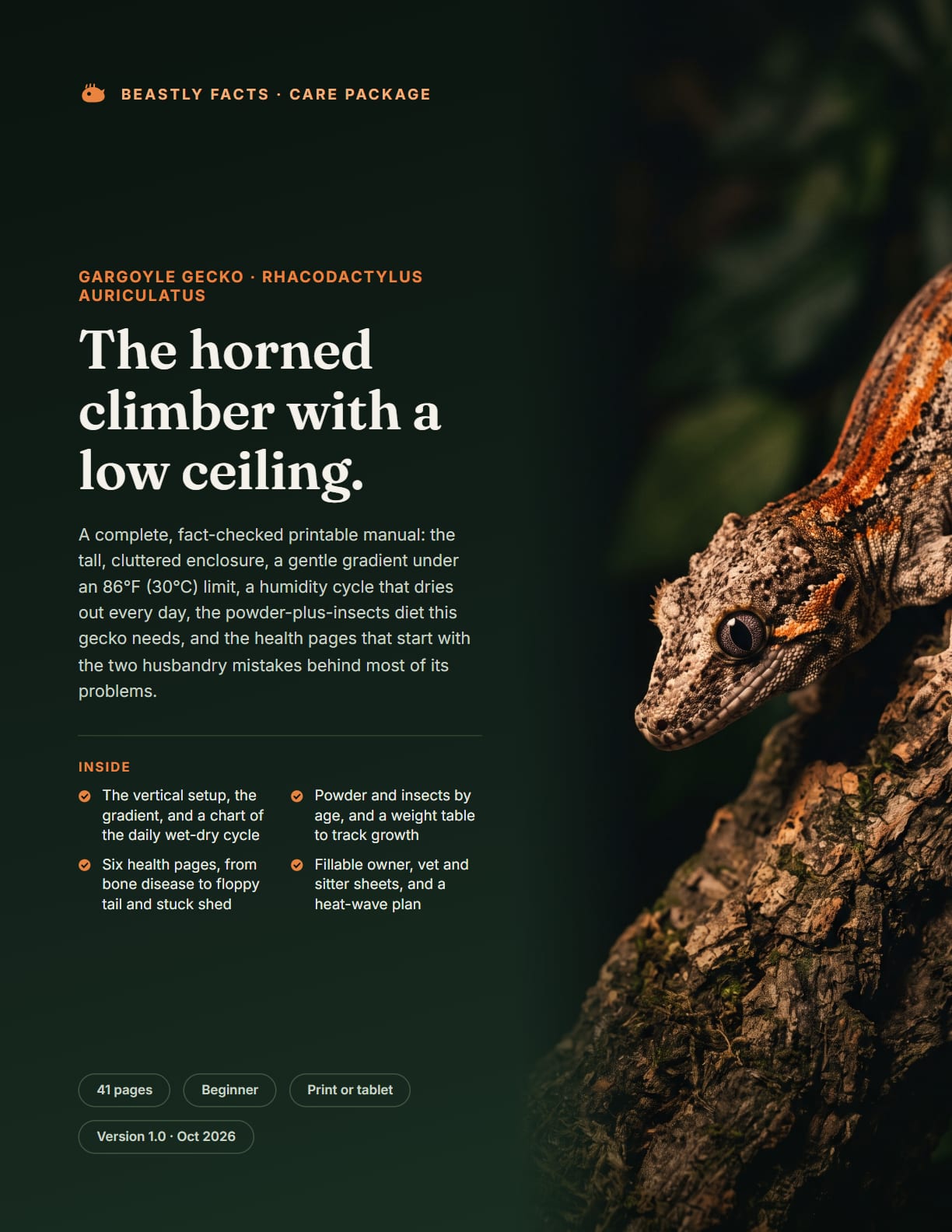
The Gargoyle Gecko Care Package carries this setup as a checklist with the targets to hit, in a 42-page PDF you can keep by the enclosure, $8.99.
Frequently Asked Questions
What size enclosure does a gargoyle gecko need?
18x18x24 inches is the minimum for a single adult, with 24x24x24 inches as the ideal. Vertical space matters more than floor space. Hatchlings and juveniles under about 12 grams do better in a smaller grow-out enclosure temporarily, and gargoyle geckos should always be housed one per enclosure, they're territorial.
Does a gargoyle gecko need a heat lamp?
Usually yes, and the belief that it doesn't is the most repeated mistake about this species. A low-wattage bulb on a thermostat gives a cool end around 70 to 75°F and a basking spot around 82 to 85°F. The ceiling is what's unusual: air above 86°F is dangerous.
How should I manage humidity for a gargoyle gecko?
Target 50 to 70%. Mist heavily in the evening, then let it dry back down toward 50% before misting again. Constant, unbroken moisture causes respiratory infection, so the daily wet-and-dry cycle matters more than hitting an exact number.
Does a gargoyle gecko need UVB lighting?
It can survive without, since a complete powdered diet supplies vitamin D3, but low-level UVB brings real digestive and immune benefits: a 12-inch low-output 5.0 (5%) T5 HO set for a basking-area UVI near 1.0 to 2.0, with the basking spot 6 to 12 inches below the tube. Run 12 hours on, none overnight, and mount it over open mesh, since glass and plastic block UVB.
Why does a gargoyle gecko setup need so much clutter?
Because gargoyle geckos climb glass poorly compared to crested geckos and need grippable branches instead, and because heavy clutter helps prevent floppy tail syndrome, a condition linked to sleeping flat against bare glass. Sparse decor is the wrong instinct for this species.
More on the Gargoyle Gecko
Gargoyle Gecko care guide
🦎 How Much Does a Gargoyle Gecko Really Cost?
🦎 How to Handle a Gargoyle Gecko (And How It Differs From a Crested Gecko)
🦎 Common Gargoyle Gecko Health Issues and What Causes Them
🦎 Gargoyle Gecko Feeding: Schedule, Diet, and Why They Stop Eating
🦎 Gargoyle Gecko Enrichment: Build Up, and Fill What You Build
Recommended Gear
As an Amazon Associate I earn from qualifying purchases through the links above, at no extra cost to you.

Written by Michael Ryan
Mike keeps two rescued bearded dragons, Dex and Cera, and writes the care guides on BeastlyFacts from his own research and mistakes. He is not a veterinarian.
More about Michael Ryan →