Gargoyle Gecko
Geckos
Beastly Facts · Updated
The bumpy-headed climber that drops its tail and simply grows another!
On This Page▾
Did you know? Gargoyle geckos are named for the horn-like bumps on their heads, and unlike their crested gecko cousins they can regrow a dropped tail. A 2024 genome study confirmed the difference: same family, one very different superpower.

The first week
The numbers a new owner needs in the first week, each from the article it links to. Rows with no link come from the encyclopedia.
- Day one
- A new gecko is quarantined 3 to 6 months away from any reptile you already keep, on paper towel, with its own tools and a fecal exam inside that window.Quarantine guide →
- Enclosure
- 18x18x24 inches minimum for an adult, 24x24x24 ideal, vertical over floor, one gecko per enclosure. Hatchlings under about 12 grams do better in a smaller grow-out.Setup guide →
- Temperature
- A cool end of 70 to 75°F and a basking spot of 82 to 85°F, from a low-wattage bulb or ceramic emitter on a thermostat. Nights to the mid-60s are fine and 65°F is the floor. The belief that it needs no heat is the most repeated mistake.Setup guide →
- The ceiling
- Air above 86°F is dangerous, lower than almost any lizard in the hobby. Away from sunny windows: room heat is what pushes a gargoyle past it.Setup guide →
- Humidity
- 50 to 70%: mist heavily in the evening and let it dry back toward 50% before misting again. They drink the droplets; a shallow dish is a backup. Constant wet causes respiratory infection.Setup guide →
- Substrate and clutter
- Coconut fiber, or paper towel for hatchlings and sick geckos; no sand, wood chips, or gravel. Heavy clutter of branches, vines, and cork, since resting on bare glass is how floppy tail starts.Setup guide →
- UVB
- Survivable without, since a complete powdered diet supplies D3, but a 12-inch low-output 5.0 (5%) T5 HO at a basking UVI of 1.0 to 2.0 over open mesh, 6 to 12 inches above the basking spot, 12 hours a day, has real benefits.Setup guide →
- Staple diet
- A powdered crested gecko diet at 2 to 3 parts water to 1 part powder in a cup or on a ledge, rotating 3 or more brands. Hatchlings and juveniles daily, adults every 2 to 3 days.Feeding guide →
- Insects are required
- Unlike a crested gecko: 1 to 2 times a week for juveniles and adults, by body condition, gut-loaded 24 to 48 hours and dusted with calcium without D3 most times, with D3 periodically.Feeding guide →
- Foods to avoid
- Citrus, starfruit, rhubarb, garlic, onion, eggplant, dairy, and avocado.Feeding guide →
- Not eating
- A healthy adult goes up to 2 to 3 weeks; a juvenile not past 4 to 5 days. Water is the time-critical one: no more than 2 to 3 days without access. Weigh regularly; a thinning tail is the early sign.Feeding guide →
- Handling, week one
- Wait two weeks after it comes home, then 5-minute sessions every other day, working toward 15 and a daily total near 20. Adults are calm; juveniles are jumpy.Handling guide →
- Tail and teeth
- Never hold the tail. It regrows, unlike a crested gecko's. A bite is rare and provoked, and can break skin: soap and water.Handling guide →
- Budget
- $50 to $300 for a common animal, $500 to $1,000 or more for a premium morph. $335 to $630 to set up, $385 to $780 with the first vet exam. $320 to $565 a year after that, and $50 to $150 for a routine exam.Cost guide →
- Lifespan
- 15 to 20 years, some breeding well past 20.Cost guide →
- Adult size
- 7 to 9 inches (18 to 23 cm) including tail.
- Hygiene
- Wash hands with soap after any contact, keep the gecko out of the kitchen, and never clean the enclosure in a kitchen sink or a bathtub people use.Hygiene guide →
Emergency card
Call the vet now if you see any of these.
- Any kinked tail, soft jaw, or tremor (possible MBD)
- Open-mouth breathing or mucus (possible respiratory infection)
- A tail that stays deformed despite adding hides (possible FTS)
- Any sign of parasites or impaction
Retained shed wraps a toe like a tourniquet until it dies, so early stuck shed gets a warm soak, and a tight band or a darkened toe goes to a vet. New geckos are quarantined and given a fecal exam before joining a collection.
Where to go next
How Much Does a Gargoyle Gecko Really Cost?
$50 to $300 for a common animal and past $1,000 for a morph, $335 to $630 to set up, $320 to $565 a year, and what a 15-to-20-year lifespan costs.
Gargoyle Gecko Enclosure Setup: A Low Ceiling, Not No Heat at All
The gradient this species needs, the 86°F ceiling it cannot cross, the daily wet-dry humidity cycle, and the clutter that prevents floppy tail syndrome.
Gargoyle Gecko Feeding: Schedule, Diet, and Why They Stop Eating
Powdered diet versus live insects, the schedule by age, why pinky mice are the real obesity risk, and how to read appetite loss.
How to Handle a Gargoyle Gecko (And How It Differs From a Crested Gecko)
Two weeks before the first session, the two defense mechanisms, the bite that breaks skin, and the tail that grows back.
Common Gargoyle Gecko Health Issues and What Causes Them
Metabolic bone disease, floppy tail syndrome, respiratory infection, parasites, and the vet-today list.
Gargoyle Gecko Enrichment: Build Up, and Fill What You Build
No gargoyle study exists, so this is the crested and leopard gecko evidence, labeled as borrowed, on height, novelty and feeding.
What to buy
As an Amazon Associate I earn from qualifying purchases. Underlined items are paid Amazon links, at no extra cost to you.
Prices and the reasoning behind each item are in How Much Does a Gargoyle Gecko Really Cost?.
Full Gargoyle Gecko gear listFrequently Asked Questions
Can a gargoyle gecko regrow its tail, unlike a crested gecko?
Yes, and this is one of the biggest differences between the two species. Gargoyle geckos regenerate a dropped tail, confirmed by peer-reviewed genome research, while crested geckos cannot. The regrown tail is prehensile and cartilage-based rather than bone, with somewhat asymmetrical scales, but it's fully functional.
Do gargoyle geckos need live insects, or is powder enough?
Unlike crested geckos, insects are described as a required supplement here, not optional enrichment. Gargoyle geckos are unusually carnivorous for their gecko family, wild individuals are documented preying on other lizards, even young crested geckos, alongside insects.
Why does a gargoyle gecko setup need so much clutter?
Because gargoyle geckos climb glass poorly compared to crested geckos and need grippable branches instead, and because heavy clutter helps prevent floppy tail syndrome, a condition linked to sleeping flat against bare glass. Sparse decor is the wrong instinct for this species.
Subscribe - it's free
New care guides straight to your inbox. No spam.
Printable Guide
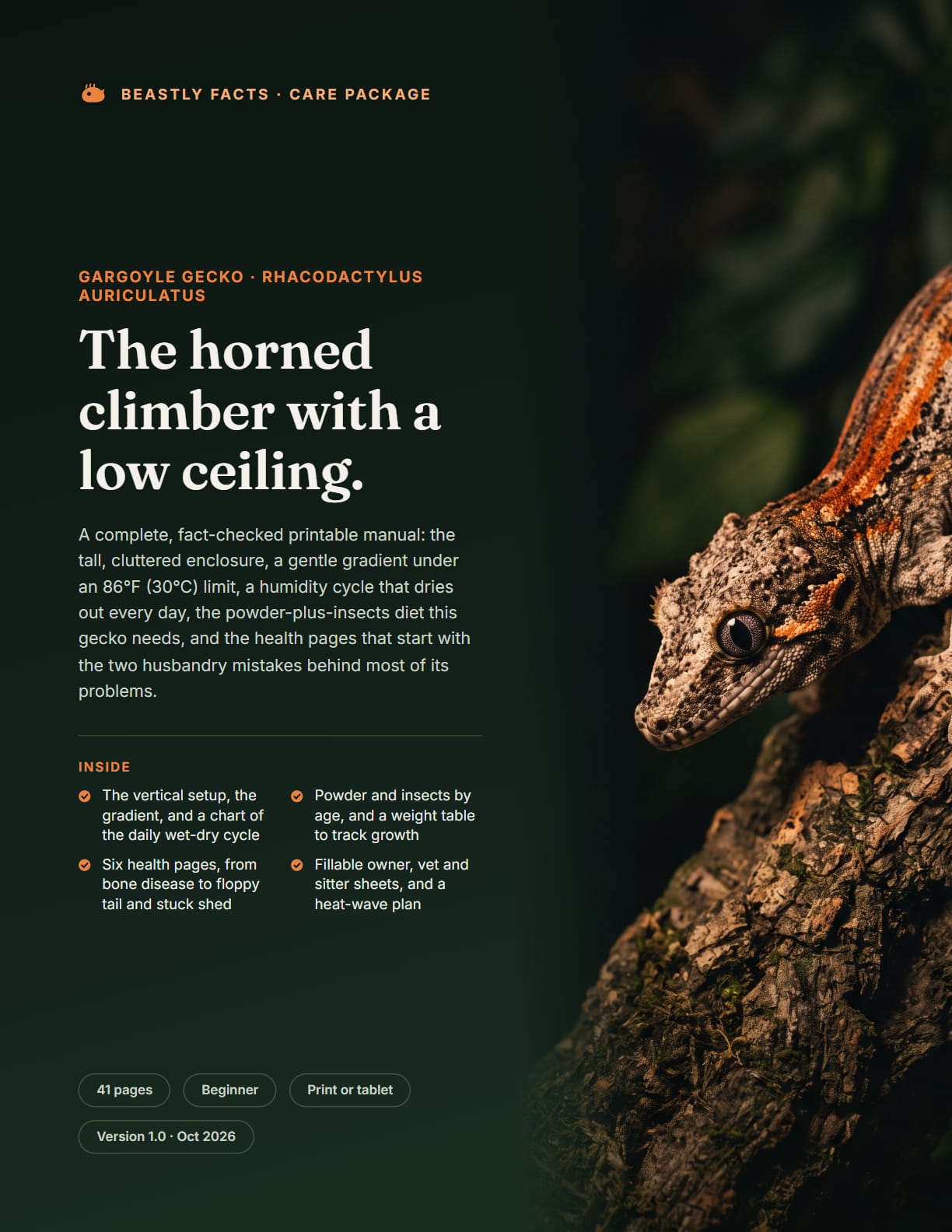
Gargoyle Gecko Care Package
42 pages · PDF · $8.99
Deep Dive
🦎 How Much Does a Gargoyle Gecko Really Cost?
🦎 How to Handle a Gargoyle Gecko (And How It Differs From a Crested Gecko)
🦎 Common Gargoyle Gecko Health Issues and What Causes Them
🦎 Gargoyle Gecko Enclosure Setup: A Low Ceiling, Not No Heat at All
🦎 Gargoyle Gecko Feeding: Schedule, Diet, and Why They Stop Eating
🦎 Gargoyle Gecko Enrichment: Build Up, and Fill What You Build
Health and More
🔌 Reptile Emergency Plan: Power Outages, Travel, and Pet Sitters
💧 Reading Reptile Stool, Urates, and Hydration: A Daily Health Check
🧼 Salmonella and Reptile Hygiene: The Rules That Actually Matter
🌡️ Reptile Heating and Thermostats: Preventing Burns
🧫 Reptile Quarantine: Why New Snakes and Lizards Need Months, Not Weeks
🦎 Understanding Reptile Shedding (Ecdysis)
Fun Facts
🦎 Gecko Toe Magic
Geckos can walk on walls thanks to millions of tiny hair-like structures on their toes called setae. Each foot has about 500,000 of them, using molecular forces to stick to surfaces!
🦎 Climbing the Walls
Geckos have millions of microscopic hairs on their feet that allow them to stick to even molecularly smooth surfaces! This amazing ability comes from van der Waals forces, making them one of nature's great climbers.
Explore More