Bearded Dragon Enclosure Setup: Temperature, UVB, and Everything Else
On This Page▾

Bearded dragon husbandry has moved on from what a lot of old care sheets still say. Bigger enclosures, stronger UVB, and more careful temperature gradients are now the standard.
Enclosure Size
4x2x2 ft (roughly 120 gallons) is the adult minimum, not an upgrade you'll get around to eventually. As a rule of thumb, the enclosure length should be at least three times your dragon's total body length. A front-opening enclosure makes daily handling and cleaning much easier than a top-opening one.
Temperature Gradient
Set up a clear warm side and cool side, and check both with an infrared thermometer aimed at the actual surface, not just the air.
| Zone | Target Temperature |
|---|---|
| Basking surface (adults) | 95 - 110°F |
| Basking surface (juveniles) | 105 - 115°F |
| Warm side (ambient air, not the basking surface) | ~90°F |
| Cool side | 75 - 85°F |
| Nighttime | 65 - 75°F |
UVB and heat are two separate jobs, and mixing them up is one of the most common setup mistakes. A T5 HO UVB tube supplies the UV your dragon needs but produces little to no usable heat on its own, it will not get the basking spot to temperature by itself. Pair it with a separate basking bulb (halogen or incandescent) positioned over the same basking platform, and confirm the actual surface temperature with an infrared thermometer rather than trusting the bulb's wattage.
Only add supplemental heat overnight if your room regularly falls below about 65°F, and use a ceramic heat emitter rather than a light so it doesn't disrupt sleep.
UVB Is Not Optional
This is the one piece of equipment worth spending real money on. Bearded dragons need strong UVB, specifically a linear T5 HO tube (ReptiSun 10.0, or Arcadia's 12% Desert or 14% Dragon, are commonly recommended), spanning about two-thirds of the enclosure length.
Target a UVI gradient from 0 up to 4.0-4.5 at the basking spot, measured with a Solarmeter 6.5 if you want to be precise about it. If you keep a hypomelanistic, silkback, or translucent morph, dial this back to a UVI of 3.0 or lower, those morphs are more UVB-sensitive and can be burned by standard output.
For a 12% tube in its reflector, mount the fixture about 16 to 18 inches above the basking surface with nothing in between, or about 11 to 12 inches when it shines through a mesh lid, and never behind glass or plastic, both block UVB almost entirely. These distances are for a 12% tube: tubes rated 10 to 14% UVB are each mounted to their own maker's distance chart. Run it 10 to 14 hours a day, and replace the bulb every 6 to 12 months, whether it is a T5, a T8 or a mercury vapor bulb, following the maker's own schedule. UVB output drops off well before the bulb visibly dims, so replace on schedule rather than waiting for it to look old.
Measure from the tube to the highest point the dragon can reach, not just the basking slab. Every perch, branch and hide top must sit at or below the chart's distance from the tube, or the dragon can climb into too much UVB.
A bright daylight LED around 6500K alongside the UVB helps with activity and appetite. If you want the biology behind why this is the one bulb you cannot cut corners on, our guide to why bearded dragons need UVB lighting covers what actually happens inside a dragon without it.
UVI, or UV Index, is the same measurement scale used to describe how strong sunlight is outdoors. A bearded dragon's basking spot at a UVI of 4.0-4.5 is roughly equivalent to the UV intensity of full, direct desert sun, which tracks with where the species evolved.
Humidity
Keep it low, 30 to 40%. Bearded dragons are an arid species, and excess humidity is a direct path to respiratory and skin infections. A basic hygrometer is worth the few dollars it costs.
Substrate
Paper towel, newspaper, or tile are the safest options, especially for anyone new to keeping dragons. Avoid loose sand, including calcium sand, along with wood chips and gravel, all of which carry a real impaction risk if ingested.
Experienced keepers sometimes go the other direction and run a bioactive substrate, a deep naturalistic mix with live plants and a cleanup crew of isopods and springtails that processes waste for you. It's a bigger commitment than paper towel and it isn't where most people should start, but our guide to bioactive setups for bearded dragons walks through what it actually takes.
Furnishings
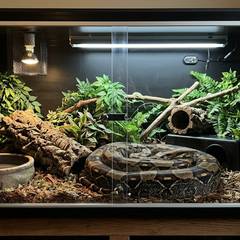
- A basking platform (rock, slate, or sturdy wood) positioned directly under the lamp
- At least two hides, one on the warm side, one on the cool side
- Sturdy, well-anchored climbing branches
- A shallow water dish
Cover three sides of the enclosure to cut down on reflections, which can stress a dragon that mistakes its own reflection for a rival. Skip hot rocks entirely, they're a common cause of thermal burns.
Diet, Briefly
Bearded dragons are omnivores, and the ratio shifts with age: juveniles eat roughly 80% insects and 20% greens, while adults flip to about 80% greens and 20% insects. Gut-loading, dusting, and the calcium schedule by age are in the bearded dragon feeding guide.
If the lighting side of this is new to you, our complete guide to UVB lighting covers Ferguson Zones and the mistakes that cause metabolic bone disease.
Sources & Further Reading
Last reviewed 18 Aug 2026 · 4 sources
- ReptiFiles: Bearded Dragon Temperatures & UVB Requirements
- UC Davis School of Veterinary Medicine: Bearded Dragon Care
- VCA Animal Hospitals: Feeding Bearded Dragons; Bearded Dragon Housing
- NC State College of Veterinary Medicine: Bearded Dragon Care

The Bearded Dragon Care Package carries this setup as a checklist with the targets to hit, in a 50-page PDF you can keep by the enclosure, $8.99.
Frequently Asked Questions
What size enclosure does an adult bearded dragon need?
4x2x2 ft, about 120 gallons, and that is the adult minimum, not an upgrade for later. Quick check: the enclosure should be at least three times your dragon's total body length.
How hot does the basking spot need to be?
95 to 110°F on the basking surface for adults, and 105 to 115°F for juveniles, measured with an infrared thermometer aimed at the actual surface rather than the air. That heat comes from a separate basking bulb, not the UVB tube, which supplies UV but little usable heat on its own.
Do bearded dragons need UVB?
Yes, and it's the one piece of equipment worth spending real money on. They need a linear T5 HO tube spanning about two-thirds of the enclosure, mounted about 16 to 18 inches above the basking surface, or 11 to 12 inches through a mesh lid, and never behind glass or plastic, which block UVB almost entirely.
What substrate is safest for a bearded dragon?
Paper towel, newspaper, or tile, especially for a first dragon. Loose sand, calcium sand included, wood chips, and gravel all carry an impaction risk if swallowed.
More on the Bearded Dragon
Bearded Dragon care guide
🦎 How Much Does a Bearded Dragon Really Cost?
🦎 How to Handle a Bearded Dragon Without Stressing It Out
🦎 Common Bearded Dragon Health Issues and What Causes Them
🦎 Bearded Dragon Feeding: Schedule, Diet, and Why They Stop Eating
🦎 10 Surprising Bearded Dragon Facts
🦎 Bearded Dragon Brumation: Triggers, the Routine, and When to Worry
🦎 Female Bearded Dragons: Eggs, Lay Boxes, and Egg Binding
🦎 Bearded Dragon Growth, Weight, and At-Home Health Checks
🥬 Bearded Dragon Safe Foods List: Staple, Occasional, and Never Foods
🦎 The Bearded Dragon Starter Shopping List (Buy Once, Cry Once)
🦎 Bioactive Setups for Bearded Dragons
🦎 Bearded Dragon Enrichment: Climbing, Digging, and Safe Free-Roam
🦎 Is It Legal to Own a Bearded Dragon? State-by-State Guide
Recommended Gear
As an Amazon Associate I earn from qualifying purchases through the links above, at no extra cost to you.

Written by Michael Ryan
Written from Mike’s own two dragons, Dex and Cera.
Mike keeps two rescued bearded dragons, Dex and Cera, and writes the care guides on BeastlyFacts from his own research and mistakes. He is not a veterinarian.
More about Michael Ryan →