Reptile Heating and Thermostats: Preventing Burns
On This Page▾

A pet reptile can't regulate its own body temperature the way a mammal does, so every enclosure depends on an external heat source running for weeks and months at a time. That's exactly why a thermostat matters more here than for almost any other piece of pet equipment. Heaters should be thermostat controlled, screened from the animal, and positioned toward one end of the enclosure to create a gradient. "Hot rocks" and "sizzle rocks" are the classic exception to avoid outright: they frequently burn larger animals and do a poor job of heating anything.
This guide focuses on the heat sources most commonly used for pet snakes, ball pythons, corn snakes, kingsnakes, hognoses, garter snakes, boas, milk snakes, and rosy boas, since that's where thermostats, probes, and wattage guesses cause the most confusion. The mechanics apply to other reptiles too. The ball python enclosure setup guide and the corn snake enclosure setup guide put this equipment into a full enclosure.
Why This Is the Device That Prevents Burns
Every reptile has a preferred optimal temperature zone, or POTZ: the range where it can reach the body temperature each metabolic job needs, a target that shifts by time of day, season, age and sex. A reptile holds itself inside that zone by moving around its environment. A heat source's job is to put part of the enclosure inside that range. A thermostat's job is narrower and more mechanical: it measures temperature at one point and cuts power to the heat source once that point reaches a set value, then restores power once it drops. On a heat mat, that is what keeps the pad from getting hot enough to burn the lizard or damage the tank.
Skip the thermostat and a heat mat or bulb keeps drawing full power indefinitely, with no ceiling. A basking surface under an unregulated heat source can climb well past what a reptile can tolerate against its skin, and because a reptile can't always move away from a source it's pressed against, especially while brumating or unwell, sustained contact with an overheated surface is how a thermal burn happens. "Hot rocks" are the textbook case of this failure mode: no thermostat, direct skin contact, no automatic cutoff.
Running an enclosure too cold carries its own documented cost. A reptile with a respiratory infection is kept at the mid to upper range of its preferred optimal temperature zone as part of treatment, because raising the temperature within that zone stimulates the immune system, helps mobilize respiratory secretions, and supports proper drug metabolism. The reading for everyday husbandry is narrower than it looks: where a reptile sits inside its POTZ has real consequences for how it handles infection, which is a reason not to run an enclosure at the bottom of the range by default.
The Three Controller Types
Not every thermostat regulates heat the same way, and the type matters more with some heat sources than others.
| Controller type | How it regulates heat | Best matched to |
|---|---|---|
| On/off | Cuts power fully at the set temperature, restores it fully once the reading drops back below that point | Under-tank heat mats, which change temperature slowly enough that a full on/off cycle doesn't create a harsh swing |
| Pulse proportional | Reads temperature continuously and sends short pulses of power rather than switching fully on or off, holding a steadier average output | Ceramic heat emitters and other radiant sources that respond faster than a mat and can overshoot on a simple on/off cycle |
| Dimming | Reduces or increases voltage to the heat source the way a light dimmer does, rather than pulsing power on and off | Halogen and incandescent basking bulbs, since dimming avoids the visible flicker a pulse cycle can cause on a light-emitting bulb |
One caveat on that table: veterinary husbandry guidance says "thermostat controlled" and stops there. The on/off, pulse and dimming split is a manufacturer distinction about how the device delivers power, not a veterinary classification. What matters is that the heat source has a controller at all. An on/off thermostat can technically be wired to any of these heat sources, and it's the type most commonly sold with basic heat mat kits. The distinction matters most on a heat source that changes temperature quickly: a bulb or ceramic emitter can overshoot the set point in the brief window before an on/off unit cuts power, where a pulse proportional or dimming unit is already easing output down before it gets there.
Heat Source Types: What Each One Actually Does
| Heat source | What it is | What it's good for | What it's not good for |
|---|---|---|---|
| Under-tank heat mat | A thin adhesive or standalone pad placed under part of the enclosure floor | Belly heat for burrowing and ground-dwelling snakes, works well through glass or thin PVC | Heating thick substrate or large enclosures on its own, and no light output for a basking species |
| Ceramic heat emitter (CHE) | A screw-in bulb that produces infrared heat with no visible light | Daytime or nighttime ambient and basking heat without disrupting the light cycle | Precise, low-wattage heating in a small enclosure, output is harder to fine-tune than a dimmable bulb |
| Deep heat projector (DHP) | A ceramic-style emitter designed to project heat downward in a more focused beam than a standard CHE | Overhead basking heat with a more defined warm spot, used with larger or taller enclosures | Small enclosures, where the more focused beam can create too small or too hot a basking area |
| Halogen or incandescent basking bulb | A conventional light bulb used for both light and heat during the day | Daytime basking heat paired with visible light, works well on a dimming thermostat | Nighttime heat, since light-emitting bulbs aren't suited to providing nocturnal heat |
| Radiant heat panel | A flat panel, usually mounted on or near the enclosure ceiling, that radiates heat downward over a broad area | Even ambient warmth across a larger enclosure without a visible hot bulb | A single, sharply defined basking spot the way a bulb or DHP produces |
None of these are interchangeable. For snakes, the recommended heat sources are incandescent bulbs with a protected reflector hood, dedicated heat lamps, ceramic heat emitters, and under-tank heat pads, with "hot rocks" and "sizzle rocks" the ones to avoid. The clearance has a figure rather than a judgment call: a heat source sits at least 4 to 6 inches away from the highest spot the snake can reach, behind a screened top that stops the animal escaping or touching the hot bulb. The same rule applies in general terms to every reptile: heaters screened from the animal and positioned toward one end of the enclosure to give a thermal gradient.
Where the Probe Actually Goes
A thermostat only regulates what its probe measures. Put the probe against the back of the heat mat instead of the surface the animal contacts, and the thermostat reads the mat's own temperature, not the basking surface, numbers that can diverge widely depending on substrate thickness and enclosure material. The same problem happens in reverse with an overhead bulb: a probe left dangling in open air measures ambient temperature, not the surface directly under the bulb where the animal actually basks.
For an under-tank mat the answer is settled: the probe goes on the floor of the warm hide, directly over the mat, the surface the animal actually lies on. Hold it there with a probe clip or a suction cup, not tape: thermostat makers warn that aluminum tape over the probe throws off its reading, and an animal can stick to exposed adhesive and tear scales. Check that it hasn't drifted at every spot clean. For an overhead source it is not settled. Thermostat manufacturers disagree, some specifying the probe on the basking surface directly under the lamp and others specifying it suspended in the air a few inches below the bulb, and a dimming controller behaves differently depending on which you follow. What every source agrees on is the part worth taking away: the probe reads at the animal's level, not up in the airspace near the fixture, the same principle that applies to thermometers. Beyond that, follow your controller's own instruction rather than a general rule, and confirm the result with the two independent checks below.
A thermostat with a correctly set target temperature can still produce a burn if its probe has slipped off the basking surface onto bare glass or substrate, since the display keeps showing an accurate reading for the wrong spot. The setting isn't the failure. The probe's location is.
Wattage Is a Starting Guess, Not a Target
A wattage figure printed on a heat mat or bulb box is sized for a specific enclosure volume and material under average conditions, not for your room, enclosure, or climate. A glass enclosure in an air-conditioned room and a PVC enclosure in an unheated garage lose heat at very different rates on the same listed wattage, so that number is a reasonable starting point for shopping, not a figure you dial in once and stop checking.
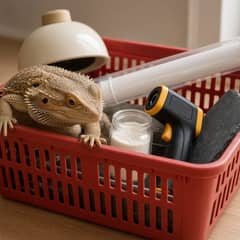
The way to confirm it worked is with two separate tools, not one thermostat display. A digital probe thermometer left at the basking spot and the cool end gives a continuous read on both ends of the gradient over a day or more. An infrared temperature gun spot-checks the actual surface at multiple points, the basking spot, the substrate, the wall near the heat source, catching a hot spot the fixed probe isn't sitting on. Run both checks before an animal goes into a new enclosure, and again whenever the setup changes.
The Maximum to Check Against
No single number is the safe ceiling for every reptile, because basking needs run from a ball python's warm end to a desert lizard's hot rock. The ceiling is the top of your species' own published basking range, read on the surface with the infrared gun, and the thermostat target sits at or just under it. Two anchors give a sense of scale. For most pet snakes the warm end runs 90 to 95°F, so a surface reading well above that under a snake's heat source is a fault, not a feature. At the other end, even a bearded dragon, one of the hottest-basking reptiles commonly kept, never needs a basking surface above 122°F (50°C); past that the enclosure is overheating, and the bearded dragon's own basking range sits well below it.
Surface temperature is only half the ceiling. The other half is contact. An overhead heat source should sit at least 4 to 6 inches from the highest point the animal can reach, behind a screen or guard, because a lamp or emitter the animal can touch will burn it at any setting.
Failure Modes Worth Planning Around
A thermostat's whole job is being the single point of control for a heat source that has no other safety limit, which also makes it a single point of failure. Plan for that failure, don't just trust the setting.
The probe shifting off its target surface is the single most common failure, and it fails silently, the thermostat keeps regulating accurately, just for the wrong spot. Check the probe's position visually at every water change or spot clean, not only when something already looks wrong.
A thermostat failing with the heat source stuck on is rarer but more dangerous, since there's no automatic ceiling at all. An independent digital thermometer, positioned apart from the thermostat's own probe, catches this: a reading that disagrees sharply with the display is the first sign something in the chain has failed. Treat any backup heat source you keep for an outage, covered in our reptile emergency plan guide, the same way, wrapped and never in direct contact with the animal.
Night Heat Is a Different Setup, Not Just a Lower Number
Daytime heat and nighttime heat aren't the same problem with a lower target. Light bulbs cannot be used to provide nocturnal heat, which rules out leaving a basking bulb on after dark just to hold the temperature up.
The practical fix is a heat source with no visible light: a heat mat, a ceramic heat emitter, or a deep heat projector, any of which can run around the clock without lighting the enclosure. It is also worth checking whether night heat is needed at all before buying it. A snake needs no night heat as long as the room stays at 65°F to 70°F (18°C to 21°C). A room that holds that overnight needs no night heat source, which is a cheaper and simpler answer than any of the above. A room that drops below it does, and then the no-light rule decides which one.
Thermal burns and a chronically under-heated enclosure sit at opposite ends of the same equipment chain, and the fix for both is the same short list: a thermostat matched to the heat source, a probe at the level that matters and mounted the way its controller specifies, and a wattage guess you verify. Get those three right and most of what goes wrong with reptile heating stops being possible. The ball python health issues guide covers the health consequences at either extreme.
Sources & Further Reading
Last reviewed 14 Sep 2026 · 4 sources
- Merck Veterinary Manual: Management and Husbandry of Reptiles; Overview of Reptiles; Bacterial Diseases of Reptiles
- VCA Animal Hospitals: Snakes, Housing; Bearded Dragons, Housing
- ReptiFiles: Bearded Dragon Temperatures and UVB Requirements
- Spyder Robotics: Herpstat Manual, Probe Placement
Frequently Asked Questions
What does a reptile thermostat actually do?
It cuts power to a heat source at a set temperature and restores it once the reading drops, so the heat source never runs unchecked. Without one, a heat mat or bulb just keeps drawing full power indefinitely, which is why 'hot rocks' and heat sources with no thermostat are a documented cause of thermal burns in pet reptiles.
What kind of thermostat should I use with a heat mat versus a heat bulb?
A basic on/off thermostat suits an under-tank heat mat, since a mat's temperature swings slowly enough that a full on/off cycle stays gentle. A ceramic heat emitter, deep heat projector, or basking bulb benefits more from a pulse proportional or dimming thermostat, since those hold a steadier output instead of swinging fully on and off, which matters more for a heat source that reacts faster than a mat.
Where does the temperature probe actually go?
At the animal's level, never against the back of the heat mat and never left up near the fixture reading room air. For an under-tank mat that means the floor of the warm hide, held with a probe clip or suction cup rather than tape. For an overhead lamp, thermostat manufacturers disagree between the basking surface itself and the air a few inches below the bulb, so follow your controller's instruction and verify the result with a separate thermometer. A probe reading the heat source itself, rather than the level the reptile occupies, can let the basking surface run far hotter than the thermostat's display shows, which is how a correctly set thermostat still produces a burn.
How do I know what wattage heat source to buy?
Treat the wattage listed for your enclosure size as a starting guess, not a target. Buy for your enclosure's volume and material, wire it through a thermostat, then verify the actual temperatures with a digital probe thermometer and an infrared temperature gun before trusting the setup with an animal in it.
What happens if a reptile thermostat fails?
Most fail obviously, the heat source stops and the enclosure cools. The dangerous failure is rarer but real: a thermostat stuck with the heat source on, or a probe that slips off its mounting point and reads room air instead of the basking surface. A second, independent thermometer checked daily is what catches either failure before it becomes a burn or a cold snap.
Do reptiles need heat at night?
Most still need to stay within their nighttime range, but the heat source has to change. Light-emitting bulbs aren't suitable for nocturnal heat, since light at night disrupts a reptile's day-night cycle, so night heat comes from a heat mat, a ceramic heat emitter, or a deep heat projector, none of which put out visible light.
Recommended Gear
As an Amazon Associate I earn from qualifying purchases through the links above, at no extra cost to you.

Written by Michael Ryan
Mike keeps two rescued bearded dragons, Dex and Cera, and writes the care guides on BeastlyFacts from his own research and mistakes. He is not a veterinarian.
More about Michael Ryan →