White's Tree Frog
Amphibians
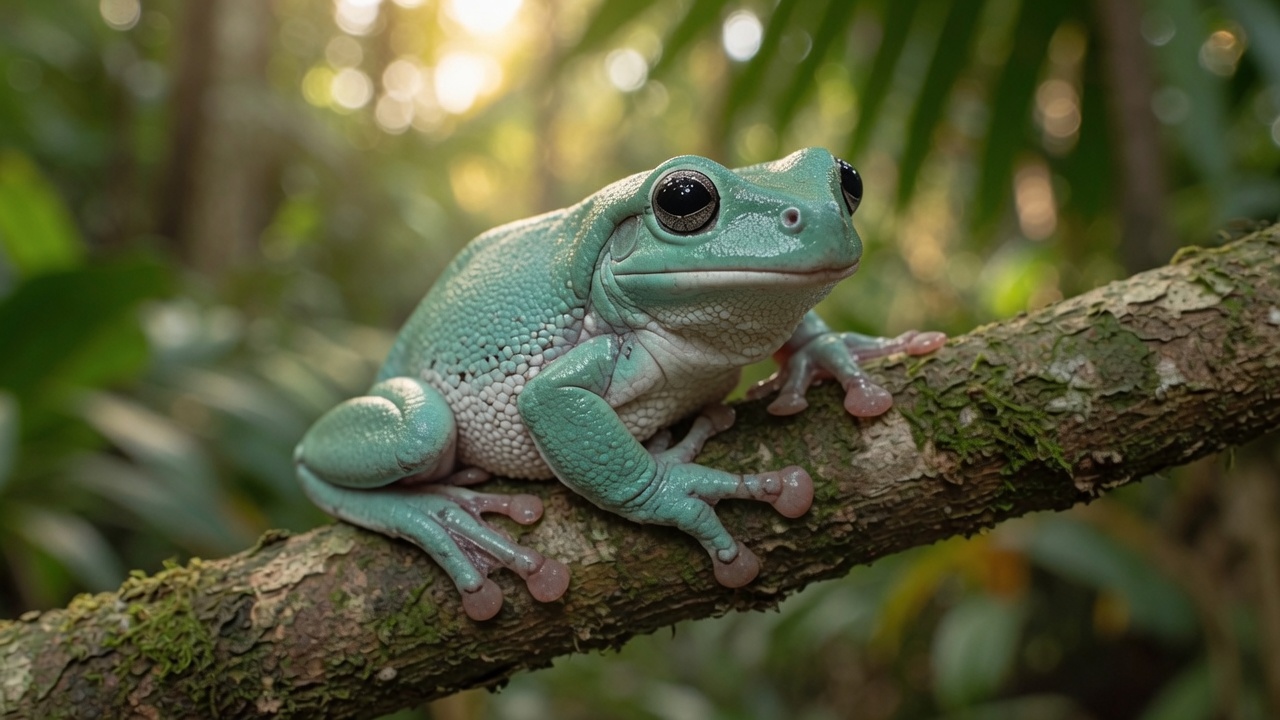
The chubby, chilled-out tree frog with a permanent smile and incredible tolerability!
On This Page▾
🤓 Did you know? White's tree frogs are also called 'dumpy tree frogs' because they develop adorable fat rolls (parotoid glands and lipid ridges) as adults. These rolly features are a sign of a well-fed, healthy frog, not obesity!

🗓️ The first week
The numbers a new owner needs in the first week, each taken from the article that explains it.
- Enclosure size
- 18 inches long by 18 inches wide by 24 inches tall is the standard minimum for one adult, sized for a vertical, arboreal species. A 20-gallon-equivalent enclosure is comfortable for a single frog, and 24x18x24 inches works well for a small group of two to four.Setup guide →
- Temperature
- Keep a gradient: cool side around 70 to 75°F, a basking area around 80 to 85°F, dropping into the mid-70s at night. This species doesn't need intense heat, just a gentle, reliable gradient.Setup guide →
- Humidity
- A baseline around 50 to 60% with misting spikes up to 70 to 80% once or twice daily, then letting it drop back down between mistings. Constant, unbroken high humidity is directly linked to bacterial and red-leg issues.Setup guide →
- Water
- Use only dechlorinated tap water or spring water for misting and drinking, never distilled or reverse-osmosis water.Setup guide →
- Why not RO or distilled
- Distilled and RO water are usually not electrolyte-balanced and can be fatal to an amphibian without rebalancing with buffers, electrolytes, and pH adjustment. Dechlorinated tap water, checked with a test kit, is the more practical starting point for most home keepers.Quarantine guide →
- Substrate
- Coarse orchid bark, coco fiber or coco husk, or a bioactive soil mix, kept lightly moist rather than soggy. Avoid fine, loose substrate that's easy to accidentally ingest during feeding.Setup guide →
- UVB
- Low-level UVB is recommended, this species survives without it but genuinely does better with it. A low-output T5 bulb in the 5 to 7% range works well, positioned so the basking branch sits at least 6 inches below the fixture, and the bulb gets replaced every 9 to 12 months on a schedule, regardless of whether it still looks like it's working.Setup guide →
- Feeding
- Keep adult feeding to roughly 3 to 4 appropriately sized insects, 2 to 3 times a week, rather than free-feeding, and limit high-fat feeders like waxworms and superworms to once a week at most.Health guide →
- Obesity check
- Fat deposits build up visibly over the tympanum (the external eardrum) and in the armpit area. The line between the breed's natural "dumpy" look and genuine obesity comes down to fat visibly bulging over the tympanum and armpits, not the frog's general roundness.Health guide →
- Handling
- Keep sessions short, roughly 5 to 15 minutes, and don't handle more than about twice a week. Wash your hands thoroughly with plain water only, no soap, immediately before handling, or wear powder-free nitrile gloves lightly wetted with dechlorinated water.Handling guide →
- Cover
- Live planting with broad leaves at several heights, so a frog can sit supported and out of sight at any level. If the frog is always immediately visible, there is not enough in there.Enrichment guide →
- Group housing
- They tolerate company well and can be kept in groups, provided every animal is a similar size. A White's tree frog will swallow anything that fits, including a smaller frog, and a mixed-size group is a feeding accident waiting to happen.Enrichment guide →
- Budget
- $20 to $60 for a standard animal, most complete setups landing in the $200 to $400 range, and roughly $13 to $24 a month in consumables after that, before substrate and power.Cost guide →
- Vet costs
- An exotic or amphibian-experienced vet exam commonly runs $50 to $150. A dedicated exotic emergency visit fee alone often starts around $250 at specialty hospitals, before any treatment.Cost guide →
- Lifespan
- The average lifespan is about 16 years, with one individual recorded living 21 years in human care. More conservative figures put it at 10 to 15-plus years with excellent care.Cost guide →
- Adult size
- 3 to 4.5 inches (7 to 11 cm).
- Quarantine
- Six to eight weeks is typically adequate for a new amphibian. Zoo and aquarium practice runs a 30-day minimum with 60 days preferred before release from quarantine. The clock should reset, not just pause, if the animal shows any illness partway through.Quarantine guide →
- Moving a new arrival
- A container, not a net. Move the animal with some of its own tank water into a small, clear, water-tight container, which lets you view it from any angle without ever needing to touch it directly or force it through mesh.Quarantine guide →
- Hygiene
- A completely healthy-looking reptile or amphibian can carry and shed Salmonella with no outward sign of illness at all, and the route is hands and surfaces to mouth rather than bites. Children younger than 5 years old should not handle or touch reptiles or amphibians or their environments.Hygiene guide →
🚨 Emergency card
Call the vet now if you see any of these.
- Lethargy and weight loss, especially in a new or suspect animal (chytridiomycosis). This is a genuine emergency, quarantine any new or suspect animal immediately and get to a vet right away
- Redness on the belly and legs, lethargy, and loss of appetite (red-leg syndrome). This needs a vet
- Signs of a bacterial or skin infection, which enclosures kept too humid without adequate ventilation invite. Always see a vet if signs appear
- Inadequate calcium supplementation or missing UVB catching up with the frog (metabolic bone disease). This needs a vet
- Advanced obesity with liver involvement. Advanced cases with liver involvement need a vet
An exotic or amphibian-experienced vet, found before you need one. Amphibian veterinary care has real limitations, and prevention through correct husbandry does more work here than treatment ever will.
📰 Where to go next
How Much Does a White's Tree Frog Really Cost?
The frog at $20 to $60, a $200 to $400 setup, the recurring lines that add up to $13 to $24 a month, and what a 16-year average lifespan does to the budget.
White's Tree Frog Tank Setup: What Your Frog Actually Needs
The 18x18x24 minimum, the temperature gradient, the humidity that dips instead of sitting high, substrate, UVB, and the water that is safe to mist with.
How to Handle a White's Tree Frog
Why plain water beats soap, when gloves are the safer option, how long a session runs, and why the risk points at the frog rather than at you.
Common White's Tree Frog Health Issues (Obesity Is the Signature Risk)
Obesity as the signature risk, chytridiomycosis, red-leg syndrome, bacterial and skin infections, metabolic bone disease, and the husbandry pattern behind all of them.
White's Tree Frog Feeding: Reading the Ridges Above the Eardrum
The insects worth offering, how often by size and age, gut loading and dusting, and the ridge test that says whether the frog is too heavy.
White's Tree Frog Enrichment: Plants Changed the Frogs, Not Just the Tank
The red-eyed tree frog plant study and what it actually measured, dense layered planting, broad perches near the top, prey released into cover, and the one rule for group housing.
🛒 What to buy
Prices and the reasoning behind each item are in How Much Does a White's Tree Frog Really Cost?.
❓ Frequently Asked Questions
What humidity level is correct for a White's tree frog?
Hold a baseline of 50 to 60% and let misting push it to 70 to 80% once or twice a day, then let it fall. Humidity that never drops is linked to bacterial and red-leg issues, so damp around the clock is the thing to avoid.
How long do White's tree frogs live, and how does that affect budgeting?
The average is about 16 years, and one individual reached 21 in human care. More conservative figures run 10 to 15-plus years. Either way, plan on well over a decade of ongoing care.
Is it safe to handle a White's tree frog?
Yes, more so than the great majority of frog and toad species kept as pets. They're docile, slow-moving, and tolerate handling well once they're used to it. The risk isn't the frog hurting you, it's accidentally harming the frog through chemical exposure on your hands.
Subscribe - it's free
New care guides straight to your inbox. No spam. 🐾
🖨️ Printable Guide
White's Tree Frog Care Package
undefined pages · PDF · $8.99 · listing soon
📰 Deep Dive
🐸 How Much Does a White's Tree Frog Really Cost?
🐸 How to Handle a White's Tree Frog
🐸 Common White's Tree Frog Health Issues (Obesity Is the Signature Risk)
🐸 White's Tree Frog Tank Setup: What Your Frog Actually Needs
🐸 White's Tree Frog Feeding: Reading the Ridges Above the Eardrum
🐸 White's Tree Frog Enrichment: Plants Changed the Frogs, Not Just the Tank
🩺 Health and More