Hognose Snake Feeding: Prey Size, Schedules, and the Picky Hatchling
On This Page▾

A western hognose hatchling can weigh three grams. At that size the question is not which mouse to buy but which part of one, and the sizing charts start exactly there: for a hog of 3 grams and under, a small pinky head.
Prey Size
The chart runs by weight, which is more useful than by age for an animal that arrives at wildly different sizes.
- 3 grams and under: a small pinky head
- 4 to 6 grams: extra small pinks
- 7 to 9 grams: small to medium pinks
- Larger juveniles: large pinks to peach fuzzy, then peach fuzzy to fuzzy
Past the hatchling stage, sizing goes by proportion instead: a prey item slightly thicker than the snake's center mass. The progression runs from pinky mice at hatching up through fuzzies and hoppers. Where it ends depends on the animal: a 70 gram male may settle on a hopper or a couple of fuzzies, while a large adult female works up to considerably bigger prey.
Mice are the staple and the best diet for this species, with larger individuals sometimes taking smaller rats. Gerbils, hamsters, multimammate mice and chicks are fallbacks for a snake that will not take anything else.
How Often, and Why Adults Eat Less
Young snakes eat every 5 to 7 days. Adult males of 70 grams and up take a hopper or a couple of fuzzies as their metabolism slows, and mature females move to every 10 to 14 days, with some large females going 14 to 21. The simpler version of the same schedule is hatchlings weekly and adults once every two weeks, because an adult fed weekly gets fat.
Every two weeks works on either. The reason they slow down is the most common husbandry mistake with this species, an adult kept on a hatchling's schedule getting fat, and the general reptile version of the point is that diets high in protein may predispose them to uric acid accumulation, which can cause gout.
Frozen Thawed
Thawed prey over live, without exception.
The reason is straightforward: a live rodent can injure a snake that does not immediately subdue it, and a three gram hatchling taking a pinky head has no margin for that. Thawed prey also lets the keeper control temperature and size precisely.
The Refusing Hatchling
This species has a reputation for it, and a hatchling that turns down a meal is not automatically in trouble.
One practical threshold: start scenting if a snake refuses its first three meal offerings. The scents that work are fish (sardine, tuna, salmon), chicken bone broth, and frog, toad, lizard or gecko, with commercial scent strips as a packaged option. The amphibian scents map onto what the species evolved eating, which is why they work on an animal ignoring a plain pinky.
Two other causes are seasonal. A male ready to breed may refuse, and seasonal change heading toward brumation can put a snake off food on its own. Neither is fixed by offering more food. A pet hognose kept at steady temperatures needs no deliberate brumation, which is a breeding tool, but one that slows down on its own is fine while it holds its weight. Weight loss, wheezing or open-mouth breathing, or lethargy well past the season's usual quiet end the wait and start a vet visit.
A refusal that continues past that, or comes with weight loss, is a vet question, no longer a feeding one.
Feed Off the Substrate
Feed in a separate container, away from the loose, dry, diggable substrate this species needs. A snake that takes a mouse with a mouthful of substrate attached is the impaction case, and the enclosure setup guide explains why the substrate has to be deep and loose in the first place.
That is also the one place where the display enclosure and the feeding setup should look nothing alike. Plain, lined, boring, easy to clean.
Sources & Further Reading
Last reviewed 24 Sep 2026 · 3 sources
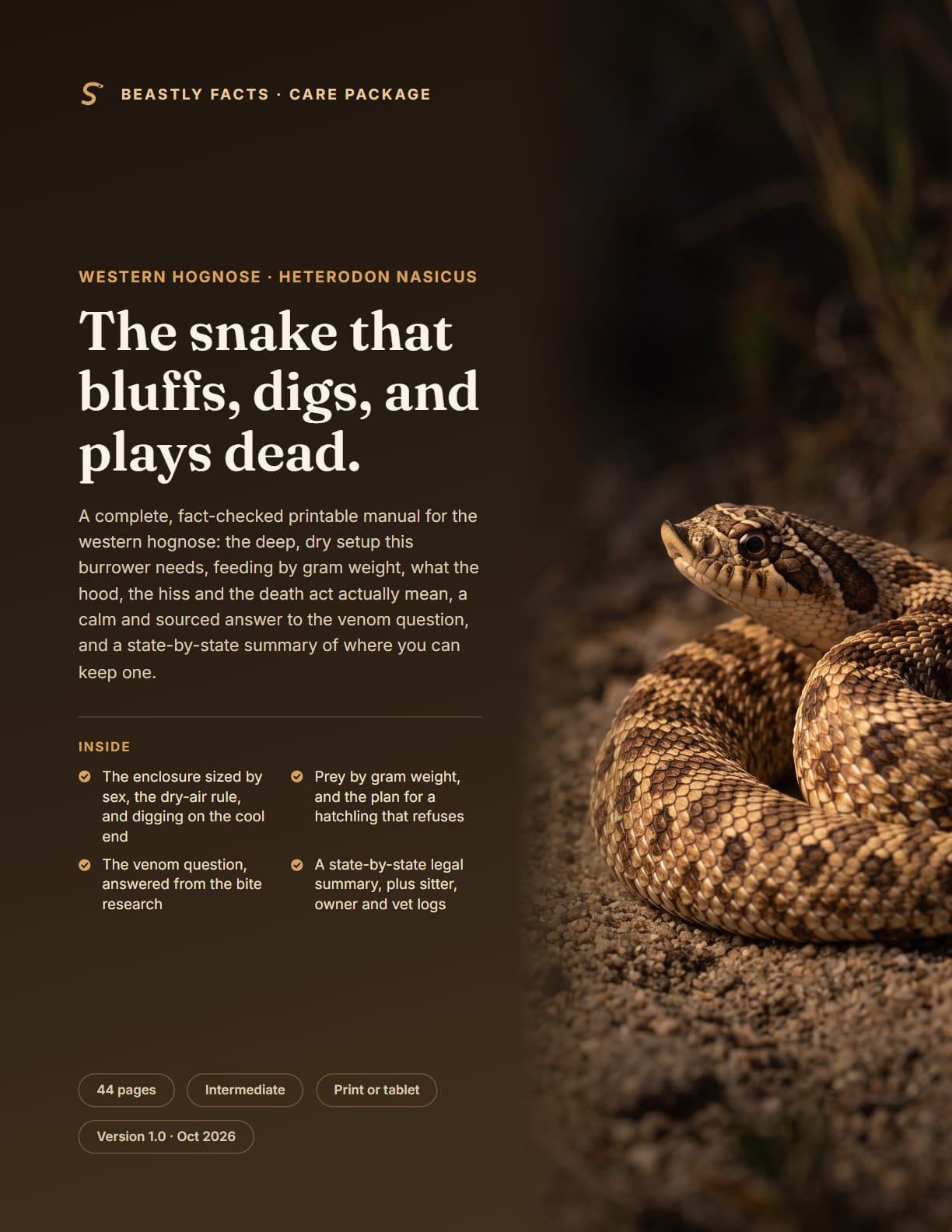
The Hognose Snake Care Package puts the feeding section, an owner log and a pet-sitter sheet on paper, in a 47-page PDF you can keep by the enclosure, $8.99.
Frequently Asked Questions
What size prey does a hognose snake need?
Sized to the snake, and for hatchlings that means by gram weight: a small pinky head for hogs 3 grams and under, extra small pinks at 4 to 6 grams, small to medium pinks at 7 to 9 grams, then large pinks, peach fuzzies and fuzzies. The general rule at any age is a prey item slightly thicker than the snake's center mass.
How often should a hognose snake be fed?
Often as a hatchling, much less as an adult. Young snakes eat every 5 to 7 days, mature females every 10 to 14, and some large females every 14 to 21. Adults on the simpler schedule eat once every two weeks, which is the interval to default to, since an adult fed weekly gets fat.
Should hognose snakes be fed frozen thawed or live?
Frozen thawed. It removes the risk of a live rodent injuring the snake, and it is standard practice for pet colubrids.
What do I do if my hognose refuses to eat?
Refusal is common in this species and usually not an emergency. Try scenting the prey if a snake refuses its first three offerings, using sardine, tuna, salmon, chicken bone broth, or frog, toad, lizard or gecko scent. A male ready to breed, or seasonal change heading toward brumation, can also put a snake off food on its own.
More on the Hognose Snake
Hognose Snake care guide
🐍 How Much Does a Western Hognose Snake Really Cost?
🐍 How to Handle a Western Hognose Snake (And Why the Drama Is Mostly Bluff)
🐍 Common Western Hognose Snake Health Issues
🐍 Western Hognose Snake Enclosure Setup: Dry, Deep, and Built for Burrowing
🐍 Hognose Enrichment: They Were Asked, and They Chose

Written by Michael Ryan
Mike keeps two rescued bearded dragons, Dex and Cera, and writes the care guides on BeastlyFacts from his own research and mistakes. He is not a veterinarian.
More about Michael Ryan →