How Snakes Actually Shed, and Why Humidity Is Not the Engine
On This Page▾

There is a belief that circulates in keeping circles almost unchallenged: that a snake cannot shed without a lot of humidity, and that a stuck shed means the enclosure was too dry. The second half is often true. The first half is not, and the gap between them is responsible for a lot of unnecessarily damp enclosures and a lot of sick desert snakes. The separation between old skin and new is not driven by moisture in the air at all. It is driven by something the snake releases under its own skin, days before anything visible happens. Our complete guide to reptile shedding walks through the practical stages, and this article covers the mechanism underneath them.
Two Skins at Once
Before a snake sheds anything, it grows a replacement underneath. Squamate skin runs on the idea of epidermal generations: an outer generation and an inner one, stacked. Work on the snake epidermal differentiation complex by Holthaus and colleagues, published in Scientific Reports in 2017, describes the outer epidermis as a stack of clear, lacunar, alpha, mesos, beta and oberhautchen layers, and notes that the outer generation protects the resting and newly forming inner generation beneath it.
So for a good part of the cycle, your snake is wearing two complete skins. The one you can see is already obsolete. The question the animal has to solve is not how to soften the old skin, but how to detach it cleanly from the new one without damaging what is underneath.
The Fluid That Does the Work
It solves that problem chemically, from the inside.
Lymph diffuses into the space between the old and new skin, and enzymes form a cleavage zone there. Two enzymatic processes do the actual separating, with anaerobic glycolysis assisting in separating the outer layer and acid phosphatase breaking down the cementing material holding the layers together.
That is the whole trick. A fluid diffuses into the space between the two skins, enzymes dissolve the bonds cementing them, and the old skin ends up sitting loose on top of the new one like a suit that no longer fits. None of that requires water in the air. It is an internal process running on the snake's own biochemistry, and it proceeds whether the enclosure reads 35 percent or 75 percent.
Worth a small correction to how this usually gets described in hobby conversation, because it comes up constantly: this is generally written up as a lymph-like fluid carrying enzymes, not as a secreted oil. Snake skin does contain lipids, and they matter enormously, but their documented job is forming the permeability barrier that keeps water in. The lubricating and separating during a shed is the lymph and the enzymes.
The Blue Eyes Are the Fluid
This is the part that makes the mechanism visible, and most keepers have watched it happen without knowing what they were looking at.
A snake has no eyelids. Each eye is covered by a transparent scale called the spectacle, and the spectacle sheds along with everything else. When the fluid diffuses in, it diffuses in there too: lymph-like fluid collects between the old eye covering and the newly formed layer, separating them, and the normally clear spectacle turns opaque and bluish-white.
The blue phase is not dryness, dullness, or a warning sign. It is the separation fluid, seen through a window. And when the eyes clear again in the days before the shed, that is the fluid being reabsorbed, with the old skin now fully detached and ready to come off.
The eyes clearing is often mistaken for the shed being canceled or delayed. It is the opposite. By the time a snake's eyes go transparent again, the hard part is already finished and the skin is sitting loose, waiting for the animal to find something to rub against.
Where Humidity Genuinely Comes In
None of this means humidity is irrelevant, and overcorrecting into "humidity doesn't matter" would just replace one myth with another.
Humidity matters at the last stage. Once the skin is detached, the snake has to physically get out of it, and ecdysis happens as the snake rubs itself against objects in its environment to loosen the old skin. Skin that has dried and shrunk onto the body is harder to work free in one piece, and it is at this specific point, not at the separation stage, that a dry enclosure causes trouble. Veterinary husbandry guidance reflects that timing: humidity requirements are substantially greater during ecdysis.
Humidity is still one factor among several. Low humidity, skin parasites, nutritional deficiencies, infectious diseases, a lack of suitable abrasive surfaces, and decreased thyroid function all contribute to an abnormal shed. A snake in a correctly humid enclosure with nothing rough to rub against can still fail to start the peel. So can a snake with mites, or one on a poor diet.
One more detail cuts against the ambient-humidity habit specifically: high humidity microclimates are often critical for many arid species, tortoises and leopard geckos among them, to reduce shell pyramiding and dysecdysis. The operative word is microclimate. A humid pocket the animal can enter and leave is doing a different job from a permanently damp enclosure, and it is the pocket, not the whole box, that the evidence supports.
The Rosy Boa Settles It
If ambient humidity really drove shedding, desert snakes would not be able to shed, and they shed perfectly well.
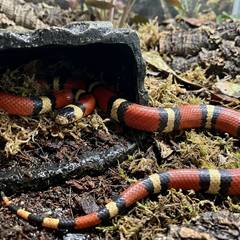
The rosy boa is the clearest case. It is kept at a dry baseline well under 60 percent for most of the year, roughly half what a boa constrictor needs, and it completes normal sheds on that. The correct approach is a temporary bump using a damp sphagnum moss hide during the shed cycle, then a return to the dry baseline. Our rosy boa enclosure setup guide covers those numbers in full.
Get this wrong in the direction the myth pushes you and the consequences are not theoretical. Keeping a rosy boa permanently damp to help it shed is the leading route to respiratory infection and scale rot in the species, which our rosy boa health issues guide covers in detail. The myth tells you to solve a shedding problem by creating a far more serious husbandry one.
What To Do Instead
The practical version of all this is short.
- Give the snake something to rub on. This is the step people skip. The peel has to be started mechanically, and cork bark, slate, or rough branches provide the friction to start it. A lack of suitable abrasive surfaces causes abnormal sheds in its own right.
- Raise humidity temporarily, not permanently. Offer a humid hide during the shed cycle and let the enclosure return to its species-appropriate baseline afterward.
- Match the baseline to the species, not to the shed. A tropical boa and a desert rosy boa need different enclosures year round, and the shed cycle does not change that.
- If shed is retained, soak rather than pull. Soak the snake in chin-deep water at enclosure temperature for about 30 minutes, supervised the whole time, then gently work the loosened skin free with a gauze sponge. If it still won't come, repeat on another day or use a humidity chamber, a warm tub lined with damp towels, and never stretch the soak into hours.
- Never pick at retained eye caps. The treatment is ophthalmic ointment applied for several days until the spectacle either falls off or can be carefully removed with fine forceps, which is a veterinary procedure, not a keeper one. The eye underneath is not replaceable.
- Look past humidity when sheds keep going wrong. Repeated bad sheds in a correctly set up enclosure point at parasites, nutrition, or an underlying condition, and that is a vet conversation.
The Real Takeaway
A snake sheds because it built a new skin underneath the old one and then chemically dissolved the join between them. That process belongs to the animal. What the enclosure contributes is much smaller and much more specific: enough moisture at the right moment that the detached skin comes away in one piece, and enough texture that the snake can start the peel at all.
The reason the myth is worth correcting is not pedantry. It is that "snakes need humidity to shed" gets applied as a blanket rule to animals that evolved in deserts, and the resulting enclosures make them sick. Understanding what the fluid does, and when humidity actually matters, is what lets you keep an arid species dry with confidence. The complete guide to reptile shedding is the practical stage-by-stage version.
Sources & Further Reading
Last reviewed 14 Sep 2026 · 5 sources
- WikiVet: Snake Shedding
- Purdue University College of Veterinary Medicine: Shedding in Reptiles
- Merck Veterinary Manual: the disorders and diseases of reptiles and management and husbandry of reptiles pages
- Kevin Wright, DVM, DABVP: Diagnosing and Treating Dysecdysis aka Retained Shed, Reptiles Magazine
- Holthaus KB, Mlitz V, Strasser B, Tschachler E, Alibardi L, Eckhart L. Identification and comparative analysis of the epidermal differentiation complex in snakes. Scientific Reports, 2017
Frequently Asked Questions
Do snakes need high humidity to shed?
Not to start the process. The separation between old and new skin is done internally by a lymph-like fluid and enzymes that form a cleavage zone, and that happens regardless of how damp the room is. Humidity matters at the final stage, when the loosened skin has to come away in one piece, and for that a humid hide is usually enough.
Why do my snake's eyes turn blue before a shed?
That cloudy blue-white color is the fluid itself. It accumulates between the old spectacle covering the eye and the newly formed layer beneath it, which scatters light and turns a normally transparent scale opaque. The eyes clear again in the days before the shed because the fluid gets reabsorbed, not because anything dried out.
Is it the snake's natural oils that lubricate the shed?
Close, but the veterinary literature describes it as a lymph-like fluid carrying enzymes rather than an oil. Lipids do exist in snake skin and form its water barrier, but the thing doing the separating during a shed is diffused lymph plus enzymes that break down the material cementing the two layers together.
My snake had a bad shed even though humidity was correct. Why?
Humidity is one cause among several. Skin parasites, nutritional deficiencies, infectious disease, a lack of suitable abrasive surfaces, and reduced thyroid function all cause it alongside low humidity. A snake with nothing rough to rub against can fail to start the peel in a perfectly humid enclosure.
Can a desert snake shed properly in a dry enclosure?
Yes, and rosy boas are the standing proof. They are kept at a dry baseline year round and shed normally, with a temporary humid hide offered only during the shed cycle itself. Keeping an arid species permanently damp to help it shed trades a minor problem for respiratory infection and scale rot.
Recommended Gear
As an Amazon Associate I earn from qualifying purchases through the links above, at no extra cost to you.

Written by Michael Ryan
Mike keeps two rescued bearded dragons, Dex and Cera, and writes the care guides on BeastlyFacts from his own research and mistakes. He is not a veterinarian.
More about Michael Ryan →