Western Hognose Snake Enclosure Setup: Dry, Deep, and Built for Burrowing
On This Page▾

Western hognose care comes down to a fairly short list of priorities: keep it dry, keep the substrate deep enough to burrow in, and get the heat source right. Nail those and this is a genuinely easy species to house well.
Enclosure Size
A useful rule of thumb is roughly one square foot of floor space per foot of snake length. For adult males, a 20-gallon-equivalent enclosure (around 30x13x13 inches) works as a minimum. Females grow noticeably larger, and a 40-gallon-equivalent setup (36x18x16 inches) is a more appropriate minimum for them. A 2x2x2 foot or similarly sized front-opening PVC enclosure makes a solid adult setup for either sex.
Hatchlings and juveniles
A hatchling under 6 inches long can live in a 5 gallon enclosure, about 16 by 8 by 10 inches, and a juvenile can move up to a 10 gallon until it is about a year old. Starting a young hognose in the adult enclosure also works, as long as it has enough hides and cover to feel secure in the bigger space. Whatever the size, the lid on a baby's enclosure needs clamps or latches. Never use tape, which is notorious for injuring snakes.
Floor space matters more than height here, this is a ground-dwelling, burrowing species, not a climber. If you're using glass, cover three sides to reduce stress, and make sure the lid is genuinely secure, hognoses will push at any gap they find.
Temperature
Basking area around 90 to 95°F on one end and cool side 70 to 75°F. At night the heat goes off and the enclosure can fall to room temperature, as long as it stays no colder than about 60°F. A hognose needs no night bulb, and needs night heat only if the room drops below that. A daytime heat source is required, and the commonly recommended choice is a low-wattage halogen basking bulb positioned over the substrate, on a dimming thermostat, rather than relying on a heat mat or ceramic heat emitter as the primary source.
You may see some general care sheets recommend an under-tank heat mat and thermostat kit instead, this is a genuine point of disagreement in the hobby, but halogen basking bulbs are the more current, specialist-endorsed choice. Whichever heat source you choose, the thermostat itself is not optional.
Humidity: Keep It Low
30 to 50% ambient humidity, genuinely on the dry side compared to many other pet snakes. Don't mist the whole enclosure to raise humidity, instead provide one dedicated humid hide for shedding, and only add moisture there as needed. Running the whole enclosure damp is a direct path to respiratory infection and scale rot.
A digital thermometer and hygrometer is worth treating as core equipment here, not an optional extra, since this species' whole husbandry pattern hinges on keeping humidity confirmed low rather than guessed at.
Substrate: Deep Enough to Burrow In
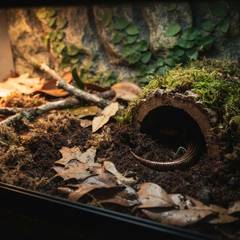
This is a fossorial species that uses substrate depth, not just decoration, and where you put that depth matters as much as how much of it there is: the cool end is where a hognose digs. Provide 3 to 6 inches of loose, dry, diggable substrate, a soil and sand mix works well, roughly 70% soil-based substrate to 30% reptile-safe sand is a common ratio. Aspen or coconut fiber substrate also works well as the soil-based component. Keep it dry, damp substrate combined with this species' preference for arid conditions is a fast route to skin and respiratory problems.
Feed your snake off the substrate, in a separate container, to prevent impaction.
Cleaning is simple on a dry setup. Pull droppings and urates as soon as you see them. Replace the whole substrate about every three months even if it looks clean, because urine soaks into it, and use that empty enclosure as the time to disinfect every surface and hide. That is a longer interval than the once or twice a month the general schedule sets for loose sand or soil, and it holds only for a bed kept dry with every dropping pulled the day it appears. A bed that has gone damp, smells, or hid a dropping for days gets the monthly change instead. A bioactive setup is the exception: once its cleanup crew is established it can run for years without a full substrate change. The water dish, the disinfectant and its contact time follow the general reptile enclosure cleaning schedule.
Hognoses are one of the few pet snake species that are genuinely diurnal, active during the day rather than at night or dusk. That's part of why a low-output UVB bulb and a normal 12-hour light and dark cycle are increasingly recommended for this species, even though care sheets for nocturnal snakes like ball pythons rarely bother with lighting at all.
Lighting
Hognoses are active during the day, unlike many pet snakes, and benefit from a normal 12-hour light and dark cycle. UVB isn't strictly required by every source, but a low-output linear T5 bulb spanning about two-thirds of the enclosure length is increasingly recommended for this diurnal species. For a 5.0 or 6% T5 HO tube, the distance from the tube to the snake's back on the basking spot is 10 to 14 inches through a screen lid, or 14 to 18 inches with no mesh in the way, and a UV index meter is the way to confirm it.
The Non-Obvious Requirement
Deep, dry, burrowable substrate isn't a nice-to-have here, it's close to the core of what this species needs to feel secure and behave normally. Combined with feeding off-substrate to prevent impaction, this is really the whole game with hognose husbandry. It's a drier, more active setup than a corn snake or ball python needs, worth knowing if you're coming to hognoses from either of those species.
The Hognose Snake encyclopedia profile has the wild background.
Sources & Further Reading
Last reviewed 14 Jul 2026 · 2 sources
- ReptiFiles: Western Hognose Snake Care; Hognose Snake Temperatures, Humidity and Lighting; Hognose Snake Enclosure Size; Hognose Substrate Options
- Wildlife Nomads: Hognose Snake Types and Behavior
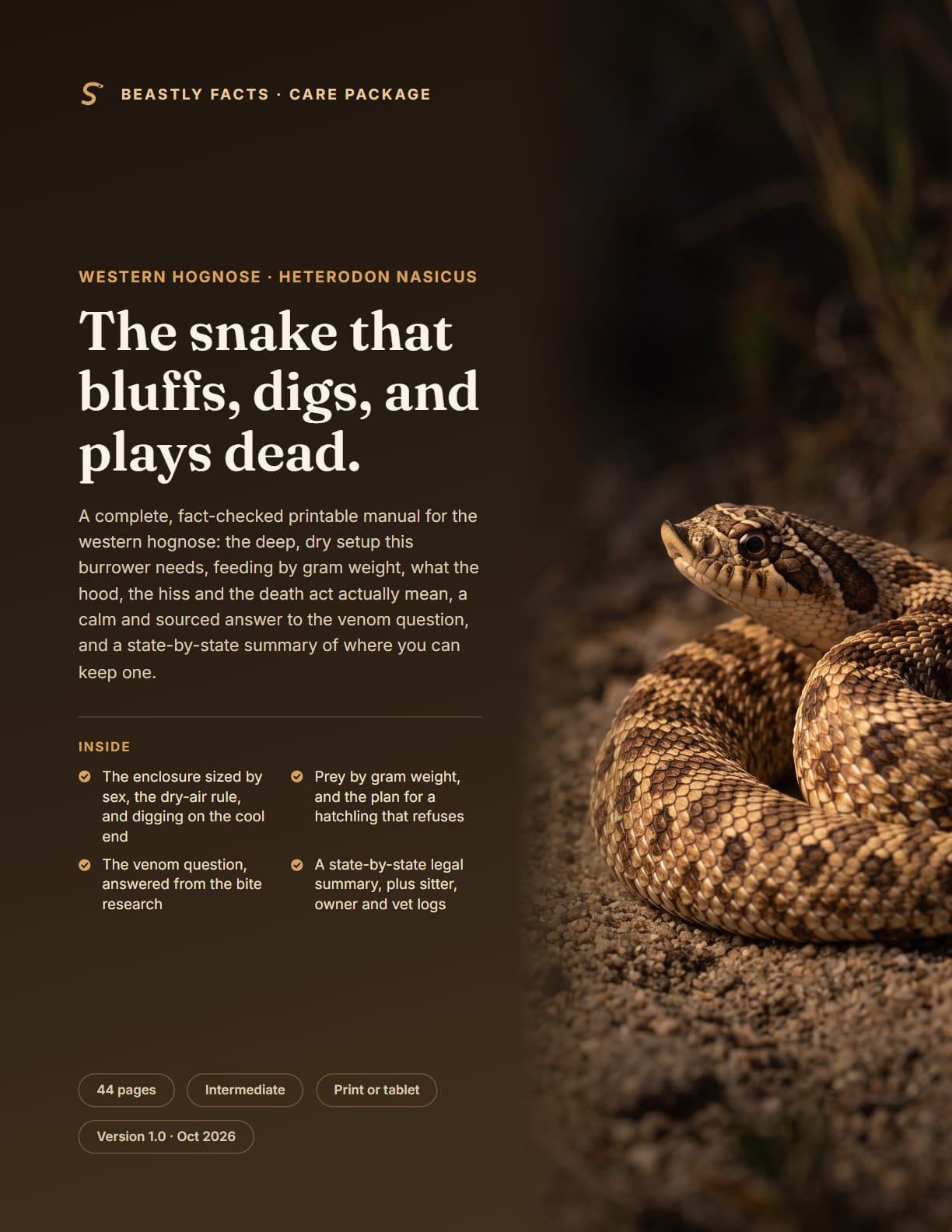
The Hognose Snake Care Package carries this setup as a checklist with the targets to hit, in a 47-page PDF you can keep by the enclosure, $8.99.
Frequently Asked Questions
What size enclosure does a Western hognose snake need?
A useful rule of thumb is roughly one square foot of floor space per foot of snake length. Adult males need a 20-gallon-equivalent minimum (around 30x13x13 inches); females grow noticeably larger and need a 40-gallon-equivalent minimum (36x18x16 inches). A 2x2x2 foot PVC enclosure works well as an adult setup for either sex. Floor space matters more than height, this is a ground-dwelling, burrowing species, not a climber.
What temperature does a hognose snake enclosure need?
A basking area around 90 to 95°F on one end, a cool side at 70 to 75°F, and nights that can fall to room temperature, no colder than about 60°F. The commonly recommended heat source is a low-wattage halogen basking bulb over the substrate on a dimming thermostat, rather than a heat mat or ceramic heat emitter as the primary source.
How humid should a hognose snake enclosure be?
30 to 50% ambient, dry compared with most pet snakes. Rather than misting the whole enclosure, run one dedicated humid hide for shedding and add moisture only there.
What substrate should I use for a hognose snake?
3 to 6 inches of loose, dry, diggable substrate, commonly about 70% soil-based substrate to 30% reptile-safe sand. This is a fossorial species that uses the depth, so keep it deep and keep it dry.
Does a hognose snake need UVB lighting?
Not every source calls it essential. Because hognoses are active by day, keepers increasingly add a low-output linear T5 tube covering about two-thirds of the enclosure length, switched on and off with the lights on a 12-hour cycle.
More on the Hognose Snake
Hognose Snake care guide
🐍 How Much Does a Western Hognose Snake Really Cost?
🐍 How to Handle a Western Hognose Snake (And Why the Drama Is Mostly Bluff)
🐍 Common Western Hognose Snake Health Issues
🐍 Hognose Snake Feeding: Prey Size, Schedules, and the Picky Hatchling
🐍 Hognose Enrichment: They Were Asked, and They Chose
Recommended Gear
As an Amazon Associate I earn from qualifying purchases through the links above, at no extra cost to you.

Written by Michael Ryan
Mike keeps two rescued bearded dragons, Dex and Cera, and writes the care guides on BeastlyFacts from his own research and mistakes. He is not a veterinarian.
More about Michael Ryan →