Veiled Chameleon Enclosure Setup: The Dripper Isn't Optional
On This Page▾

Veiled chameleon husbandry has a reputation for being demanding, and it earns that reputation honestly. Get the enclosure type, misting, and lighting right, and this is a genuinely rewarding species to keep. Skip any one of them, and problems follow fast.
This covers the full setup.
Enclosure Size and Type
2 feet by 2 feet by 4 feet (24x24x48 inches) is the practical minimum for an adult, bigger, 4x2x4 feet, is better if you have the space. Juveniles can start smaller, around 18x18x36 inches, but veiled chameleons reach adult size in just 6 to 8 months, so plan and budget for the adult enclosure from the start rather than treating it as a future upgrade. A screen enclosure is the traditional choice and provides excellent airflow. Hybrid enclosures, with partially solid sides, hold humidity better and are increasingly preferred. Glass terrariums can work but need serious attention to ventilation, most aren't large enough for an adult anyway.
Temperature
Basking spot around 85°F for females and juveniles, up to 90 to 95°F for adult males. Ambient temperature 72 to 80°F, with a beneficial night drop to 55 to 65°F. A basking heat bulb is required, this species needs a genuine thermal gradient to regulate itself properly.
Humidity and the Dripper: The Non-Negotiable Part
Aim for 40 to 50% during the day and 80 to 100% at night, measured with a probe hygrometer in the middle of the enclosure. Raise it through misting sessions morning and evening, plus a dripper or an overnight cool-mist humidifier using distilled water. The settings that get there: mist 3 to 5 minutes, 2 to 4 times a day with the last session in the evening, run the dripper 20 to 30 minutes once or twice a day shortly after lights-on, and let the humidifier carry the overnight 80 to 100%, since it raises the air's humidity but leaves too little on the leaves to count as drinking water. Live plants, pothos, hibiscus, ficus, and parlor palm are all good choices, help maintain humidity naturally and give your chameleon cover.
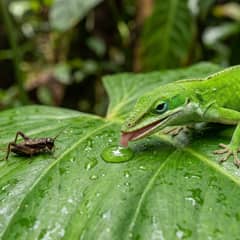
Here's the detail that actually determines success with this species: veiled chameleons do not recognize standing water as something to drink. They only respond to moving droplets on leaves and branches. A water dish alone will not keep your chameleon hydrated, no matter how often you refill it. A dripper or misting system is a genuine essential, not an accessory, and skipping it leads directly to dehydration and kidney problems. The chameleon hydration guide breaks down the differences between drippers, misting systems, and foggers if you're deciding between them.
Drainage and Cleaning
Daily misting and a dripper put a lot of water through the enclosure, and it has to leave. Water left pooling on the floor grows bacteria, which is why the cleanest setup is a bare-bottom enclosure raised on a stand or table with a drainage tray or bucket underneath. A table or shelf with a bucket underneath is the usual DIY version. Empty the tray or bucket before it fills.
The routine that follows from that setup:
- Daily: empty the drainage tray and dripper catch cup, pick droppings and dead feeders off the floor and leaves, and wipe any feces from branches.
- Weekly: rinse plant leaves and wipe the screen and branches where droppings collect, and refill the dripper and misting reservoir with fresh distilled water instead of topping it up.
- Monthly: move the chameleon to a temporary enclosure, then scrub and disinfect the bare floor, branches, and drainage tray on the monthly clock in the reptile enclosure cleaning schedule. Rinse and dry everything before the chameleon goes back.
A bare floor also keeps every dropping in plain view, which is the easiest daily health check this species offers.
Veiled chameleons are drought-adapted enough that they can also drink water condensing on the casque, the helmet-like structure on top of the head. It channels droplets down toward the mouth as an extra natural adaptation, on top of drinking directly from misted leaves and branches.
Substrate
Bare bottom or paper towel is the safest, easiest option. Coco fiber or a soil-based mix works for planted, bioactive setups. Avoid sand, gravel, and wood chips, all carry a real impaction risk if ingested during a feeding strike.
Lighting
A linear T5 HO UVB tube (ReptiSun 5.0 or Arcadia 6% are the commonly recommended options) spanning the enclosure, with the basking branch positioned roughly 6 to 9 inches below it. UVB and daylight lighting both run 12 hours a day, on a 12-hour light and 12-hour dark cycle. Put the UVB, the basking bulb, and any daylight LED on one timer so they switch on and off together, and keep the night dark: no basking bulb or colored night light after lights-out, since the night drop to 55 to 65°F is part of the design. Replace the bulb every 6 to 12 months regardless of whether it still visibly lights up. Skip compact or coil-style UVB bulbs, they're not considered adequate for this species.
The Other Non-Obvious Requirement: A Permanent Egg-Laying Bin for Females
Even a female with no male present will produce eggs, and without somewhere appropriate to lay them, she's at real risk of egg-binding. Keep a moist sand or soil bin, roughly 5 to 10 inches deep, permanently available, not something you set up only once she shows signs of needing it.
The complete UVB lighting guide has the reasoning behind these UVB numbers, bulb distance included.
Sources & Further Reading
Last reviewed 24 Sep 2026 · 3 sources
Frequently Asked Questions
What size enclosure does an adult veiled chameleon need?
24x24x48 inches is the practical floor for an adult, and 4x2x4 feet is better if the space is there. Because they hit adult size in 6 to 8 months, buy the adult enclosure up front rather than planning an upgrade.
Why can't I just use a water dish?
Standing water does not read as drinking water to this species. Only moving droplets on leaves and branches get a response, so refilling a dish more often will not fix hydration. The dripper or misting system is the essential piece, not an accessory.
What temperature and humidity does a veiled chameleon need?
A basking spot around 85°F for females and juveniles, up to 90 to 95°F for adult males, with ambient temperature 72 to 80°F and a beneficial night drop to 55 to 65°F. Humidity runs 40 to 50% by day and 80 to 100% at night, raised through morning and evening misting plus a dripper or overnight cool-mist humidifier using distilled water.
What UVB setup does this species need?
A linear T5 HO tube running the length of the enclosure, ReptiSun 5.0 or Arcadia 6%, with the basking branch about 6 to 9 inches under it. Swap the bulb out every 6 to 12 months even while it still lights up, and leave compact or coil-style UVB alone.
Do I need an egg-laying bin even without a male present?
Yes. Females produce eggs whether or not a male is around, and with nowhere appropriate to lay them, egg-binding becomes a real risk. A moist sand or soil bin 5 to 10 inches deep stays in the enclosure permanently, set up long before she shows signs of needing it.
More on the Veiled Chameleon
Veiled Chameleon care guide
🦎 How Much Does a Veiled Chameleon Really Cost?
🦎 How to Handle a Veiled Chameleon (Carefully, and Not Often)
🦎 Common Veiled Chameleon Health Issues and What Causes Them
🦎 Veiled Chameleon Feeding: Schedule, Diet, and the Supplement Schedule That Actually Matters
🦎 Veiled Chameleon Enrichment: The First Two Months Change the Animal
Recommended Gear
As an Amazon Associate I earn from qualifying purchases through the links above, at no extra cost to you.
Written by Michael Ryan
Mike keeps two rescued bearded dragons, Dex and Cera, and writes the care guides on BeastlyFacts from his own research and mistakes. He is not a veterinarian.
More about Michael Ryan →