Black Skirt Tetra Enrichment: A School That Moves as One
On This Page▾

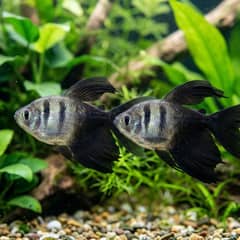
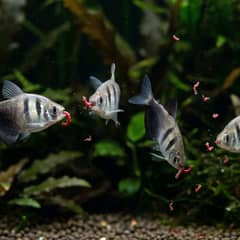
A black skirt tetra is a deep-bodied, black-banded fish about 2 to 2.5 inches long, and it is rarely still: an active, lively fish that lives in a school.
Black skirt tetras come from weedy, slow creeks shared with piranhas, and they react to danger as a school. Enrichment means giving that school its shape: a group of 12, plant thickets to retreat into with open water to swim through, and regular small live or frozen food beside the staple. Clear water suits them; tannins are optional.
Where They Come From
The black skirt tetra (Gymnocorymbus ternetzi, also sold as the black widow tetra) is native to the Rio Paraguay and Guaporé basins of Brazil, Bolivia and Argentina. It lives in small, slow creeks, tributaries and streams, often under thick overhanging plants. In Brazil, young and adult fish have been found together among the water plants of floodplain oxbow lakes, and in larger numbers in the dry season than the wet.
Those waters hold piranhas, wolf fish and golden dorado. A small fish from water like that is a hider by nature, and adults hold the middle and upper layers of the water rather than the bottom.
Every black skirt sold today is captive bred, so the fish in a tank has never seen a piranha. The school still behaves as if one might be close.
A School That Reacts as One
Black tetra schools have been tested with startle stimuli, and the fish did not react one by one. The alarm passed through the group as a wave, and how quickly it crossed the school did not change with how tightly the fish were packed. In large schools the signal outran what each fish could manage by simply copying the neighbor beside it.
That shared reaction is the school's answer to a predator. Give it room to work: a long, open run where the whole group can turn and regroup together.
The black tetra startle study ran in Bioinspiration and Biomimetics, a journal for research that copies designs from living things.
Source: Rahman et al. 2020, Bioinspiration and Biomimetics
Twelve, and Where the Energy Goes
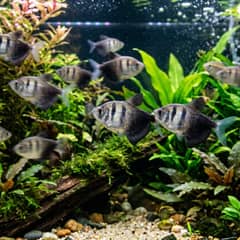
Keep 12 or more of this one species. A school of a dozen or more is also where black skirts look their most dramatic.
The number matters for another reason. Black skirts have a name as fin nippers, and that energy has to land somewhere. In a group of about 12, the chasing and squabbling usually stays within the school, where it does no harm, and tankmates are generally left alone. A bigger school fixes the habit in most tanks, not every one, so the tankmates still matter. Slow fish with long, trailing fins are a poor match, and quick, short-finned companions that keep pace are the safe choice.
Thickets and Open Water
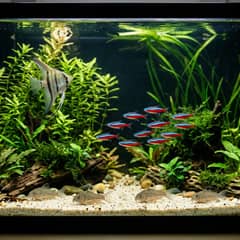
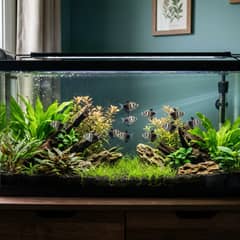
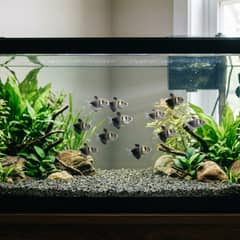
Black skirts want both halves of their habitat: plenty of open swimming room and quieter, planted corners to retreat to when something alarms them. Plant densely at the ends and along the back, and keep the front and middle clear for the school to cross. Some floating plants to soften the light help the fish show their best color.
The fish use that cover when the water turns against them. When the temperature was lowered in a lab test, plain white skirt tetras, young and adult, were 3.8 times more likely to take refuge in shelters than the green fluorescent form of the same species. A thicket is where a chilled or startled black skirt goes, so a tank without one leaves it nowhere to go.
They are easygoing about the details beyond that and will do well in most well-kept setups. Captive-bred stock adapts to a wide range of water, pH 6.0 to 7.5 and 5 to 19 dGH, at 68 to 79°F. A school of 12 needs a 20-gallon long tank, 30 x 12 inches, which gives the length for thickets at both ends and a clear run between them.
Clear Water or Tannin-Stained?
Wood and leaves would tint a black skirt tank brown, and for this fish the case for doing it is indirect.
The wild water has been described as brown but clear and slightly acidic, around pH 5.5 to 6.3. The species carries its own adaptations for ion-poor, acidic water: it takes up sodium at high rates even when the water holds very little. That fits a fish from soft, stained creeks, and it is as far as the evidence goes. No one has tested black skirts in stained against clear water.
The case against needing it is stronger. Every fish in the trade is captive bred and unfussy about water chemistry, and the setup that brings out their color is dense planting with floating plants to dim the light. Pushing the pH down for a blackwater look is a risk for this species: black skirts are not especially tolerant of low pH, they lose sodium heavily at pH 4.0, and they cannot survive at pH 4.0 or below.
So clear water is the plain choice for a black skirt. A light tint from wood is a matter of looks, as long as the pH stays inside the fish's range.
Feeding as Enrichment
In the wild, black skirts eat mostly worms, small crustaceans and insects, picking up a little algae and plant matter along the way. They are small predators at heart and go for live or frozen food with obvious enthusiasm.
Build the diet on flake or granules, such as semi-floating micro pellets, and add small live or frozen foods like daphnia and bloodworm on a regular basis. Live daphnia give the school something to chase through open water.
Priority Order
- A school of 12 or more black skirt tetras, one species
- A long tank with open water through the front and middle
- Dense planting at the ends and back
- Floating plants to soften the light
- Regular small live or frozen food beside a flake or granule staple
- Tankmates that are quick and short-finned
- Clear water inside pH 6.0 to 7.5, with any tint left optional
What Not to Do
Do not buy five and expect the nipping to stay in the group. Do not house them with slow, long-finned fish. Do not fill the whole tank with decor and leave the school nowhere to run, and do not leave it bare with nowhere to hide. Do not push the pH low chasing a blackwater look. Do not add new fish without a quarantine period first.
A black skirt's defense was always the school and the weeds beside it. A tank with a dozen fish, a clear run and a thicket to dive into gives it both.
Sources & Further Reading
Last reviewed 31 Oct 2026 · 4 sources
- PubMed (U.S. National Library of Medicine): Rahman, Sajjad, Mansoor, Belden, Murphy and Truscott (2020). School formation characteristics and stimuli based modeling of tetra fish. Bioinspiration and Biomimetics 15(6); Leggatt RA and Devlin RH (2020). Fluorescent protein transgenesis has varied effects on behaviour and cold tolerance in a tropical fish (Gymnocorymbus ternetzi): implications for risk assessment. Fish Physiology and Biochemistry 46: 395-403; Gonzalez RJ, Dalton VM and Patrick ML (1997). Ion regulation in ion-poor acidic water by the blackskirt tetra (Gymnocorymbus ternetzi), a fish native to the Amazon River. Physiological Zoology 70(4): 428-435
- Gymnocorymbus ternetzi (Black Widow Tetra). Seriously Fish
- Leggatt, Johnson and McGowan (2018). Environmental Risk Assessment of the GloFish Electric Green Tetra and the GloFish Long-Fin Electric Green Tetra. DFO Canadian Science Advisory Secretariat Research Document 2018/049 (PDF, downloads)
- Gymnocorymbus ternetzi, Black tetra. FishBase
Frequently Asked Questions
How many black skirt tetras should be kept together?
Twelve. A school that size usually keeps its own squabbles in house, which is what stops the species from turning on the fins of other fish.
Do black skirt tetras need live plants?
They are not fussy about decor, but yes, they do better with them. Thick clumps plus a few floating plants give them a place to retreat and bring out their best color.
What size tank does a school of black skirt tetras need?
A 20-gallon long, 30 x 12 inches, for a school of 12. That length fits plant thickets at both ends with open water between them.
What live or frozen foods do black skirt tetras like?
Daphnia and bloodworm, offered regularly beside a flake or granule staple. Wild black skirts eat worms, small crustaceans and insects.
Why does a black skirt tetra school scatter all at once?
The fright spreads fish to fish as a wave. In startle tests on this species, the signal crossed large schools faster than copying the nearest neighbor would allow.
Do black skirt tetras need tannin-stained water?
No. Every black skirt in the trade is captive bred and copes with a wide range of water. Wood can tint the water for looks while the pH stays in range, but the cover that brings out their color comes from plants.
More on the Black Skirt Tetra
Recommended Gear
As an Amazon Associate I earn from qualifying purchases through the links above, at no extra cost to you.
Written by Michael Ryan
Mike keeps two rescued bearded dragons, Dex and Cera, and writes the care guides on BeastlyFacts from his own research and mistakes. He is not a veterinarian.
More about Michael Ryan →You May Also Like
Subscribe - it's free
An occasional email when something new is worth your time. No spam.
Deep Dive
Health and More