Black Skirt Tetra Tank Setup: A 20-Gallon Long, Cooler Water, and Room to Swim
On This Page▾

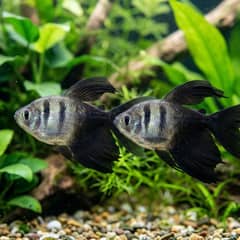
The black skirt tetra (Gymnocorymbus ternetzi), also sold as the black widow tetra, is a rounded South American fish from the Rio Paraguay and Guaporé basins. A home-tank adult measures 2 to 2.5 inches, occasionally 3, and spends its time in the middle and upper layers of the water. Every one in the trade is captive bred, so the species handles a far wider spread of water than the soft-water tetras it often shares a store shelf with. White skirt and long-fin black skirts are the same fish and go in the same tank.
Tank Size: A 20-Gallon Long for a School of Twelve
A 20-gallon long is the tank for a school of 12. Its 30 x 12 inch (75 x 30 cm) base is the footprint to plan around: this is an active swimmer, and length gives a group of 2-inch fish room to move as one. A standard 10-gallon is too short for that school.
Temperature: 68 to 79°F, Cool for a Tetra
68 to 79°F (20 to 26°C) is the range, and it is a cool one for a tetra. Its floor sits 7°F under the 75°F where an ember tetra tank starts, and its ceiling falls short of the 82°F an ember tank reaches and the 81°F top of a cardinal tetra's range. Set the submersible heater inside the band and never above 79°F.
A heater still belongs in the tank, even with a floor that low. Any room that cools below 68°F at night takes the water out of range with it.
What Cold Does to a Black Skirt
White skirt tetras cooled by 1°C (about 2°F) a day from 68°F showed how much margin the species has. They ate less and slowed down at about 63°F (17°C), quit feeding as the water neared 54°F (12°C), stopped moving just above 50°F (10°C), and lost their balance at about 50°F. Below about 45°F (7°C) they cannot survive at all, and they likely cannot survive long under about 49°F (9.5°C).
That margin buys time when a heater fails or the power goes out. It does not make a cool tank a good one. At 63°F the school is already off its food, five degrees under the bottom of its range.
GloFish Skirt Tetras
GloFish Skirt Tetras and Long-Fin Skirt Tetras are this species and use the same setup, with one adjustment. Adult green GloFish tetras tolerated cold far worse than unrelated adult white skirts in a direct comparison, while young GloFish tested against their white siblings showed no such gap, so breeding and age may count for more than the glow gene itself. Either way the adjustment is the same. GloFish lists 76 to 80°F for its fish, so a GloFish school sits at 76 to 79°F, the part of both ranges that agree, with the heater running all year. The GloFish Pristella tetra is a different fish entirely.
Water Chemistry: Wide, and Held Steady
Aim for pH 6.0 to 7.5, with 6.0 to 7.0 the better target, and a general hardness of 5 to 19 dGH. What this fish needs most is a pH that holds steady. Black skirts have been bred for the aquarium trade since at least 1950, and generations of captive stock have made them unfussy about water. That window is far broader than the soft water an ember or cardinal tank has to hold.
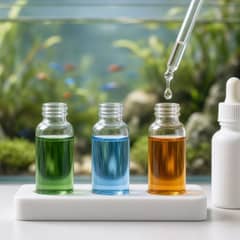
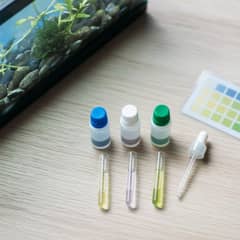
Test the tap before the tank is filled. Water that reads inside both bands needs nothing more than a water conditioner to remove chlorine and chloramine. Water outside them comes into range by shifting GH and KH, which carries the pH along and keeps it there.
Filtration: Turnover Without a Current
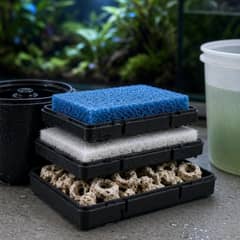
This fish comes from small, slow creeks, so the filter should turn the water over without pushing a current across the tank. A sponge filter sized for 20 gallons fits, and so does a hang-on-back with its output turned down. Either way, the bacteria growing on the media are the part of the filter that keeps fish alive.
Substrate: An Inert Bed Under a Midwater Fish
Black skirts live in the middle and upper water, and the only time the bottom matters to them is spawning, when the adhesive eggs scatter into fine-leaved plants such as java moss. The floor is there for plants and for water chemistry, and sand or fine gravel both suit it.
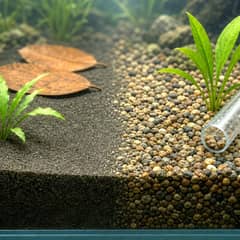
It should be inert. A black skirt does not need the soft water a cardinal does, but a calcareous bed works against the steady pH this fish wants. Crushed coral and coral sand dissolve and raise GH, KH and pH together, coral sand pushes the pH past 8.0, above the range the species is kept at, and even standard pea gravel carries enough calcium to lift pH and hardness.
About 1 inch (2.5 cm) of sand is enough, since a fine sand tends to stagnate in a deep layer. A bed planted into runs 2 inches (5 cm) or more of gravel, with root tabs pushed in beside the rooted plants. Dried leaves on top are optional for this species.
Plants: Open Water in the Middle, Thickets Around It
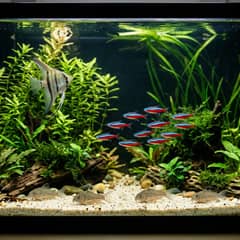
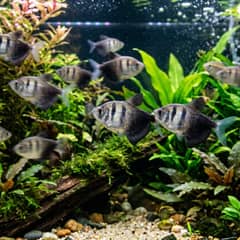
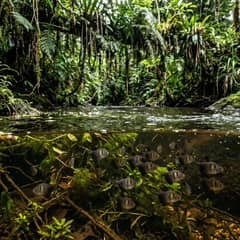
Leave the front and center of the tank clear. Black skirts cruise the middle and upper water and want a long open lane there, so the planting belongs along the back and both ends. Those thickets give the school somewhere quieter to drift into when something in the room startles it. In the wild, young and adult fish turn up together among the water plants of floodplain oxbow lakes.
The cover gets used. As the water cooled, plain white skirts were 3.8 times more likely than green GloFish to take refuge in shelter, so this is a fish that heads for cover under stress. Past that, decor is a free choice: this species settles into most layouts.
Lighting: Dimmed From Above
Black skirts show their best color with dense stands of plants below and some floating plants added on top to dim the light. Run the light for roughly 8 to 10 hours a day.
GloFish Skirt Tetras are the exception on brightness. Their fluorescent color is lit by blue light, and the maker's advice is that the more blue light the tank has, the more the fish shine.
Black skirt tetras released from aquariums have established themselves in Colombia and, for a while, in a Colorado hot spring. In more than 70 years in the trade, no population has been reported taking hold anywhere with a temperate climate.
Source: Fisheries and Oceans Canada, Environmental Risk Assessment of the GloFish Electric Green Tetra (2018)
Tankmates: Fin Nipping Decides the List
The black skirt is generally peaceful and lively, one of the better tetras for a general community tank, but it has a reputation as a fin nipper. A school of at least 12 usually keeps that in check: in those numbers any squabbling is generally contained within the group. Usually is the word to hold on to. The school is the fix that works most of the time, and the tankmates are chosen for the times it does not.
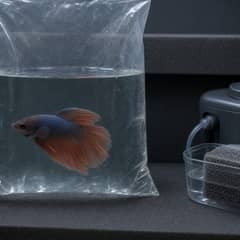
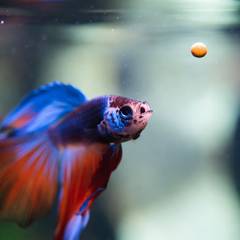
The fish that pay for a lapse are the ones that cannot get away. Slow fish with long, trailing fins make poor tankmates for a black skirt, and a betta is the classic case. Angelfish are the split answer: a black skirt is too round in the body to end up as an angelfish's meal, but the angel's long fins are the kind a nipper goes for, so that pairing needs the full school of 12 and someone watching the fins. Much smaller fish face the opposite risk, since a black skirt may prey on them.
The companions that work:
- Most livebearers, danios, rasboras and other tetras.
- Peaceful bottom dwellers such as Corydoras or smaller loricariid catfish.
- More robust dwarf cichlids such as kribensis.
Blackwater or Clear Water
Clear water is the default, and nothing in this fish's care calls for a tint. The wild water is described as brown but clear and slightly acidic, at pH 5.5 to 6.3, while the captive-bred fish in the trade are kept from pH 6.0 up.
A tint is optional and purely a look. For one, driftwood and dried leaves color the water like weak tea, with old leaves pulled every few weeks before they rot. Low pH is the risk here. Pushing the tank acidic takes it toward 6.0, the bottom of every range given for the species, and away from the steady pH it needs, so let the wood and leaves stain the water without chasing the pH down with them.
Cycle the Tank, Then Hold the Water Steady
A finished cycle is the single most important step when a black skirt tank is first set up. The school goes into a tank that has finished cycling: ammonia and nitrite at zero, with nitrate starting to register.
Quarantine is the single most important step for every fish added. Any new fish first spend 30 days in a separate quarantine tank before joining a display that already has fish in it.
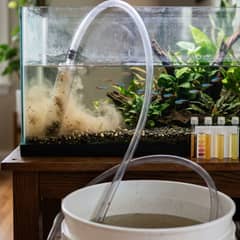
From then on, partial water changes on a weekly routine keep the chemistry where the school settled. Every refill is dechlorinated and brought to tank temperature first, so a fish that tolerates a wide band of water never meets a sudden jump within it.
Sources & Further Reading
Last reviewed 31 Oct 2026 · 5 sources
- Gymnocorymbus ternetzi (Black Widow Tetra), Seriously Fish
- Gymnocorymbus ternetzi, Black tetra, FishBase
- Environmental Risk Assessment of the GloFish Electric Green Tetra and the GloFish Long-Fin Electric Green Tetra (Leggatt, Johnson and McGowan, 2018), Fisheries and Oceans Canada (PDF, downloads)
- Fluorescent protein transgenesis has varied effects on behaviour and cold tolerance in a tropical fish (Gymnocorymbus ternetzi) (Leggatt and Devlin, 2020), Fish Physiology and Biochemistry
- Frequently asked questions on aquarium substrates, Matt Clarke, Practical Fishkeeping
Frequently Asked Questions
What size tank do black skirt tetras need?
A 20-gallon long, 30 x 12 inches (75 x 30 cm) across the base, for a school of 12. The length is the part that counts, because the school uses the open middle of the tank to swim.
What temperature do black skirt tetras need?
68 to 79°F (20 to 26°C). That tops out below an ember or cardinal tank, so the heater should never be set past 79°F.
Do black skirt tetras need a heater?
Yes, in any room that drops below 68°F. Black skirts already eat and move less by about 63°F, so the heater is what keeps a cool house from pulling the tank under its range.
What pH and hardness do black skirt tetras need?
pH 6.0 to 7.5 and 5 to 19 dGH. Captive-bred stock adapts well, so tap water that tests inside both bands only needs dechlorinating.
Can black skirt tetras live in a 10-gallon tank?
No. An adult reaches 2 to 2.5 inches, sometimes 3, and a school of 12 that size needs the 30-inch run of a 20-gallon long.
Do GloFish Skirt Tetras need a different tank?
The same tank, run warmer. They are black skirt tetras, but adult GloFish handled cold far worse than unrelated adult white skirts in one comparison, while young GloFish showed no gap against their siblings. Either way, set the heater between 76 and 79°F and leave it on all year.
Do black skirt tetras nip fins?
They have a reputation for it. A school of at least 12 usually keeps the squabbling inside the group, but slow fish with long, trailing fins, bettas among them, still make poor tankmates.
What substrate is best for black skirt tetras?
Sand or fine gravel that is inert. Black skirts live in the middle and upper water and leave the bottom alone, so the bed only has to hold plants and keep the pH steady, which pea gravel and coral sand would push upward.
More on the Black Skirt Tetra
Recommended Gear
As an Amazon Associate I earn from qualifying purchases through the links above, at no extra cost to you.
Written by Michael Ryan
Mike keeps two rescued bearded dragons, Dex and Cera, and writes the care guides on BeastlyFacts from his own research and mistakes. He is not a veterinarian.
More about Michael Ryan →You May Also Like
Subscribe - it's free
An occasional email when something new is worth your time. No spam.
Deep Dive
Health and More