African Fat-Tailed Gecko Enrichment: The Closest Cousin Was Studied
On This Page▾

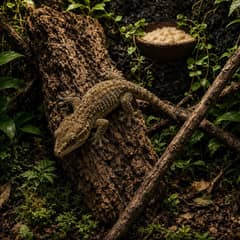
African fat-tailed geckos spend their days asleep under rocks, surface debris and abandoned burrows in the West African savanna, and their nights hunting insects on the ground. No enrichment study has been run on the species itself, so the evidence comes from two places: its closest studied relative, and one thermal-choice study that did use fat-tails.
The leopard gecko study tested five enrichment types and ranked them: thermal and feeding at the top, mirrors and visual novelty at the bottom. Fat-tails are eublepharids, the same family, so that ranking is the best available steer. Where this species differs is humidity, which it needs more of, and heat choice, where its own females pick hotter spots than leopard geckos do. Keep one gecko per enclosure.
What the Leopard Gecko Research Showed
A study tested five types of environmental enrichment on leopard geckos and found thermal and feeding enrichment produced the strongest responses, while mirror-based visual enrichment was the weakest.
A separate study of leopard geckos and crested geckos compared reactions to novel objects with fecal stress-hormone levels. Individuals that approached sooner and investigated longer had lower baseline levels, and no object feature (color, shape or smell) was preferred across animals. Novelty is worth offering, then, but which object a given gecko takes to is individual.
The Humid Hide, Which Is Not Optional Here
Fat-tails need a persistently damp retreat as a standing feature, not a shedding aid set up now and then. A gecko cave packed with damp sphagnum moss stays humid inside while the rest of the enclosure runs drier. Maintain it: a humid hide that has dried out is only a hide.
Thermal Choice, the Top-Ranked Item
Three hides minimum: warm, cool and humid. The point is that the animal can be concealed and at its chosen temperature at the same time, without trading one for the other.
This is the one area with fat-tail data. In a 2000 study, gravid females given a temperature gradient chose nest sites averaging 32.4°C (about 90°F), while leopard geckos in the same study chose 28.7°C (about 84°F). A fat-tail uses the warm end of the range more deliberately than its cousin, so the warm hide has to reach the top of the gradient, not just sit near it.
A Laying Box for Females
The same study is the case for a laying box. Female reptiles can form eggs with no male present, so every adult female needs somewhere to dig and lay, and fat-tail females are selective about temperature when they do it. A covered box of moist substrate deep enough to dig into, set over the warm end, gives her a site that matches what the gradient study says she looks for. Lack of a suitable nesting site is one of the recognized causes of egg-binding.
Feeding as Hunting
Ranked second. Tong feeding with soft-tipped tongs, short supervised insect hunts inside the enclosure, and varying when and where prey appears all beat a static bowl. A fat-tail stalking prey often raises its tail and waves it slowly, which is a good sign that the hunt is doing its job.
Feed in the evening. Fat-tails are nocturnal, and food offered in daylight gets a duller response from an animal that should be asleep.
Floor Space Over Height
This is a ground species that shelters under rocks and in burrows. Cork flats, stacked slate and a deep patch of diggable substrate do more than any branch, and floor area plus a working hide setup is where the enclosure budget goes.
One Gecko or Several
Keep one per enclosure. Both sexes are territorial, males fight over space and females, and two males must never be housed together. Female groups and one male with females are kept by breeders, but only as carefully monitored groups with room to separate, and a pair produces eggs the keeper then has to incubate or discard. A single gecko loses nothing: in the wild this species is solitary and rarely seen in groups, and none of the enrichment above depends on a tankmate.
Priority Order
- A properly maintained humid hide
- Thermal choice with hides at both ends, and a warm end that reaches the top of the range
- Feeding and hunting presentation
- Floor space and diggable substrate
- A laying box for any female
- Novelty objects, last, since visual enrichment ranked bottom
What Not to Do
Do not let the humid hide dry out. Do not raise humidity across the whole enclosure to compensate, since that risks respiratory infection. Do not bother with mirrors, which ranked last in the closest study available. Do not add a second gecko as enrichment, and never a second male.
Sources & Further Reading
Last reviewed 8 Sep 2026 · 6 sources
- Bashaw MJ et al. (2016). Does enrichment improve reptile welfare? Leopard geckos respond to five types of environmental enrichment. Applied Animal Behaviour Science
- Fernández-Lázaro G et al. (2023). Reaction to Novel Objects and Fecal Glucocorticoid Metabolite Levels in Two Species of Nocturnal Geckos. Animals
- Bragg WK, Fawcett JD, Bragg TB, Viets BE (2000). Nest-site selection in two eublepharid gecko species with temperature-dependent sex determination and one with genotypic sex determination. Biological Journal of the Linnean Society
- Animal Diversity Web (University of Michigan): Hemitheconyx caudicinctus
- PetMD: Egg Binding in Reptiles
- Tree of Life Exotic Pet Medical Center: African Fat-Tailed Gecko Care
Frequently Asked Questions
Is there enrichment research on African fat-tailed geckos?
No enrichment study has been published on Hemitheconyx caudicinctus. The nearest evidence is the leopard gecko work, and the two are eublepharids, the same family, which makes this one of the shorter borrows anyone has to make.
What did the leopard gecko study rank?
Bashaw and colleagues tested five types of environmental enrichment. Thermal and feeding enrichment produced the strongest responses and increased behavioral diversity. Mirror-based visual enrichment was the weakest, with geckos largely not engaging with it.
How is a fat-tail different from a leopard gecko for enrichment purposes?
Humidity. Fat-tails come from more humid West African habitats and need noticeably more moisture than leopard geckos, so the humid hide is less of an optional extra and more of a permanent requirement. Everything else transfers closely.
Is the three-hide system enrichment or just husbandry?
Both husbandry and enrichment. A warm hide, a cool hide and a humid hide are what let a gecko choose its temperature and humidity while staying concealed, which is behavioral choice rather than a checklist item. Thermal choice is what the leopard gecko study ranked first.
What is the best feeding enrichment for this species?
Tong feeding, short supervised insect hunts in the enclosure, and varying when and where prey appears. Fat-tails are crepuscular and nocturnal, so evening feeding matches their activity window and gets a better response than daytime offering.
Do fat-tailed geckos need climbing structure?
Some, but it is secondary. They are terrestrial and floor space plus a working hide setup does more for them than height. Low branches, cork flats and stacked slate give somewhere to rest off the ground without making the enclosure a climbing wall.
More on the African Fat-Tailed Gecko
African Fat-Tailed Gecko care guide
🦎 How Much Does an African Fat-Tailed Gecko Really Cost?
🦎 How to Handle an African Fat-Tailed Gecko
🦎 Common African Fat-Tailed Gecko Health Issues
🦎 African Fat-Tailed Gecko Enclosure Setup: Built for the Ground, Not the Branches
🦎 African Fat-Tailed Gecko Feeding: Schedule, Diet, and Why They Stop Eating
Recommended Gear
As an Amazon Associate I earn from qualifying purchases through the links above, at no extra cost to you.

Written by Michael Ryan
Mike keeps two rescued bearded dragons, Dex and Cera, and writes the care guides on BeastlyFacts from his own research and mistakes. He is not a veterinarian.
More about Michael Ryan →