How Much Does Black Skirt Tetra Ownership Cost?
On This Page▾

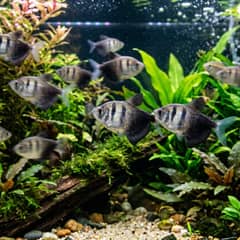
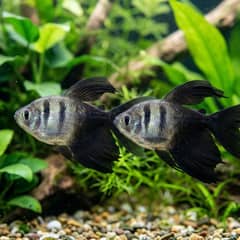
The black skirt tetra (Gymnocorymbus ternetzi), also sold as the black widow tetra, comes from the Rio Paraguay and Guaporé basins of South America and grows to about 2 to 2.5 inches in a home aquarium, 3 inches at most. The trade runs on captive-bred fish, and a whole school costs less than the tank it lives in.
The Fish: $35 to $75 for a School of 12
Pet stores sell plain black skirts for about $3 to $6 a fish. The white skirt and the long-fin are the same species, need the same care, and sell inside that same band. Twelve is the number to price, because a school that size keeps the species' fin nipping inside the group, and 12 fish come to $35 to $75 at the store.
Online sellers often charge less per fish in packs of 12, but live fish travel overnight, and the shipping on one order can cost as much as the fish in it.
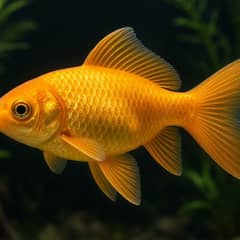
GloFish Skirt Tetras are black skirts too: a genetically engineered line of the white skirt, kept exactly like the plain fish. The color is the whole price difference. Stores charge about $12 to $13 apiece, so a school of 12 lands around $144 to $156, against $35 to $75 for plain fish.
Black or white is settled by two genes working as a pair. A skirt tetra grows the dark body and vertical bars only when it carries a dominant copy at both of them. Lacking that at either one, it develops pale and unbanded: the white skirt.
Source: Frankel (2004), Journal of Heredity
Upfront Setup: $165 to $340 for a 20 Gallon Long
| Item | Cost Range |
|---|---|
| 20 gallon long tank with a 30 x 12 inch footprint | $35 - $80 |
| Aquarium heater | $15 - $35 |
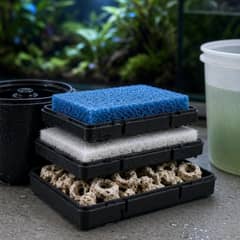
| Gentle filter | $5 - $20 |
| Live plants in dense clumps, with floating plants on top | $15 - $60 |
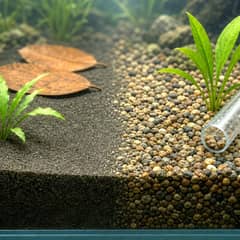
| Two 15.4 lb bags of black sand, or a dark fine gravel, that leaves the pH alone (check the quantity against your tank's floor) | $60 - $80 |
| Liquid water test kit | $25 - $40 |
| Water conditioner that neutralizes chlorine and chloramine | $5 - $15 |
| First supply of micro pellets | $5 - $10 |
| Setup total | $165 - $340 |
Typical price ranges across retailers.
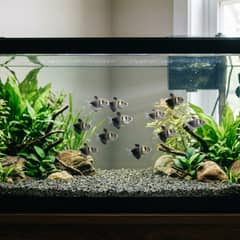
The tank priced for 12 fish is a 20 gallon long, with a 30 x 12 inch (75 x 30 cm) floor. Store tags sometimes list 10 gallons for this fish, and the black skirt tetra tank setup guide explains why the longer tank is the one to buy.
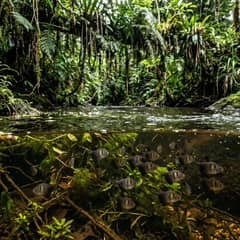
Black skirts are subtropical fish kept at 68 to 79°F (20 to 26°C), so the heater's work is holding the water inside that span when the room cools. A gentle filter suits a fish whose wild home is slow creeks under overhanging plants. Thick clumps of planting with a few floating plants to dim the light show the black at its best, and the middle of the tank stays open for swimming. The table prices two bags of black sand, or a dark fine gravel, for the 30 x 12 inch floor, and a bed that leaves the pH alone helps hold the water chemistry steady, which this fish prefers.
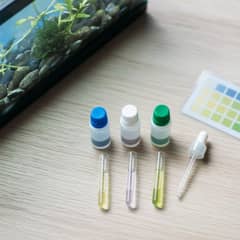
Before any fish go in, the liquid test kit has to show a finished cycle, a result read off the kit and not counted in days. That finished cycle is the single most important step when the tank is first set up. Captive-bred black skirts are unfussy about water chemistry and do well anywhere from pH 6.0 to 7.5, so the budget carries no softening or acidifying products.
The Extras: A Spare Tank for Quarantine
| Extra | Cost Range |
|---|---|
| Bare 20 gallon long tank for quarantine, with no substrate or decor | $35 - $80 |
| Heater for the quarantine tank | $15 - $35 |
| Sponge filter for the quarantine tank | $5 - $20 |
| All the extras together | $55 - $135 |
Typical price ranges across retailers.
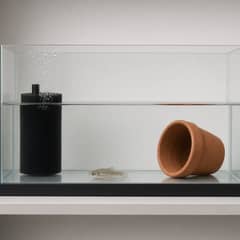
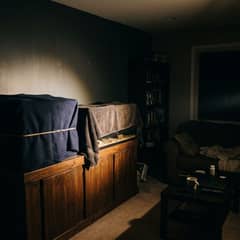
Quarantine is the single most important step for every fish added. New arrivals live apart for 30 days before joining the display, and 30 days is the minimum: at the temperatures tropical fish are kept at, ich often shows up 1 to 3 weeks after shipping. A bare 20 gallon long is priced here because twelve fish of this size need room for a month, and the fish quarantine guide covers running it. The tank keeps its own net and siphon, since equipment shared with the display can carry the parasite across.
Ich gets treated in that tank too, and since heat for this species stops at the 79°F top of its range, the cost of an ich outbreak is a bottle of salt or medication. Salt is a treatment only for fish that can take it, and this species gives a reason for care: its newly hatched fry die at salt levels as low as 1 part per thousand.
Every fish added later restarts the clock. Two replacements or a second dozen each spend their own 30 days apart while the display school waits. GloFish skirts work the same way with one difference: their license rules out breeding, so a GloFish school only grows by purchase, and each purchase is another month in the spare tank.
Buying Checklist: Healthy Stock and Genuine GloFish
All black skirts in the trade are captive bred, so there is no wild-versus-farmed choice to make. What separates one batch from the next is condition. A healthy black skirt is lively and peaceful and swims with the rest of the group. These are the signs that mark a sick fish:
| Look at | Walk away if |
|---|---|
| Body | Thin, or bloated |
| Eyes | Sunken in, or popped out |
| Fins | Clamped down, frayed or bloody |
| Skin | White spots, lesions or growths |
| Behavior | Lethargic, or hanging back from the group |
| Color | Garish dyed colors on a fish sold as anything other than GloFish |
Dyed skirt tetras are a separate problem from GloFish. They are injected with dye or dipped in it, a process that is very stressful to the fish and often shortens its life considerably, so they are not a bargain at any price.
Genuine GloFish come only through licensed channels. The trademark covers only fish produced by Segrest Farms and 5-D Tropical, and tanks and bags of resale stock are marked "GloFish" along with the name of the specific line. The fish are licensed for viewing only: intentional breeding, and any sale, barter or trade of offspring, is prohibited, with an exception for teachers and students in educational institutions. That is the cost consequence of choosing them: a GloFish school is bought fish by fish.
Shipping Fish Online
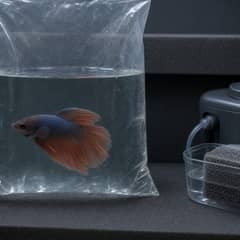
Cold is this species' transit risk. Black skirts start to eat less at about 63°F (17°C), and activity stops at around 50°F (10°C), so a box that chills on the way is the main risk of an online order. The water in the sealed bag changes too: the fishes' breathing and waste push the pH down and the ammonia up over a long trip.
Ongoing Costs: Food, Conditioner and Test Kit Refills
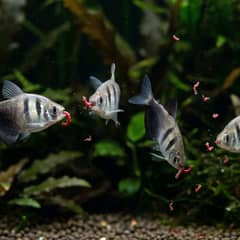
Black skirts take almost any food offered. Flakes or small pellets make the everyday diet, and the first supply in the table costs $5 to $10. Small frozen or live foods such as daphnia and bloodworm, offered regularly alongside, are the only other food spend.
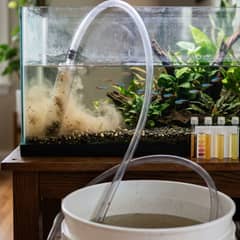
A bottle of water conditioner runs $5 to $15 and gets used at every change, which makes the water change schedule the thing that sets how often it is replaced. Power for the heater and filter and fresh test reagents cover the remainder. The heater's share of the power bill depends on the equipment and on how far the room falls below the tank's range.
Vet Costs
A fish vet earns a place in the budget when fish keep dying and the cause is not obvious. Black skirts stay healthy on clean water, with over-the-counter treatment when the problem is clear. When it is not, fish are often given one over-the-counter product after another when the first fails, which usually does more harm than good. When fish begin to die, the signs that tell a water problem from a disease decide whether the money goes on a water change, a medicine, or a vet who sees fish. A fish health lab needs live, sick fish and a water sample taken from the tank before any water change, so the time to collect both is as soon as fish start acting abnormally.
Lifespan
A black skirt tetra lives about 3 to 5 years. The heater, the filter and the 20 gallon long keep working long after that, which spreads their cost across more than one school.
Sources & Further Reading
Last reviewed 31 Oct 2026 · 4 sources
- Gymnocorymbus ternetzi (Black Widow Tetra), Seriously Fish
- Environmental Risk Assessment of the GloFish Electric Green Tetra and the GloFish Long-Fin Electric Green Tetra, Leggatt, Johnson and McGowan, Fisheries and Oceans Canada (2018) (PDF, downloads)
- GloFish License Notice, GloFish (Spectrum Brands)
- University of Florida IFAS Extension: Francis-Floyd R, Yanong RPE, Pouder DB. Ichthyophthirius multifiliis (White Spot) Infections in Fish. UF/IFAS Extension CIR920; Klinger R, Francis-Floyd R. Submission of Fish for Diagnostic Evaluation. UF/IFAS Extension FA55
Frequently Asked Questions
How much does a black skirt tetra cost?
About $3 to $6 each at a pet store, and white skirts and long-fins cost the same. Twelve of them come to $35 to $75.
How much are GloFish skirt tetras?
About $12 to $13 a fish in stores, so a school of 12 runs roughly $144 to $156. They need nothing in the tank that a plain black skirt does not.
What does a black skirt tetra tank setup cost?
Plan on $165 to $340 for a 20 gallon long with a heater, a gentle filter, live plants, sand, a liquid test kit, water conditioner and the first food. A bare quarantine tank with its own heater and filter is extra.
How many black skirt tetras should I buy?
Twelve. In a group that size their nipping stays among themselves, so slower tankmates keep their fins.
How long do black skirt tetras live?
About 3 to 5 years, so one well-kept setup can house more than one school.
Can I breed GloFish skirt tetras?
No. GloFish license terms prohibit intentional breeding and any sale, barter or trade of the offspring, with an exception for teachers and students at educational institutions. Every GloFish in a school is a fish someone bought.
Are black skirt tetras wild-caught?
No. The fish in the trade are captive bred, so a buyer chooses between plain, white, long-fin and GloFish forms of the same species, never between wild and farmed stock.
Do black skirt tetras need a quarantine tank?
Yes. A new batch spends at least 30 days in a bare tank with its own heater and sponge filter before it meets the school, and every batch added later gets its own 30 days.
More on the Black Skirt Tetra
Recommended Gear
As an Amazon Associate I earn from qualifying purchases through the links above, at no extra cost to you.
Written by Michael Ryan
Mike keeps two rescued bearded dragons, Dex and Cera, and writes the care guides on BeastlyFacts from his own research and mistakes. He is not a veterinarian.
More about Michael Ryan →You May Also Like
Subscribe - it's free
An occasional email when something new is worth your time. No spam.
Deep Dive
Health and More