Black Skirt Tetras Nip Fins, So the School and the Tankmates Come First
On This Page▾

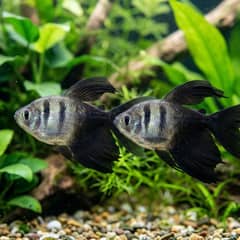
The black skirt tetra (Gymnocorymbus ternetzi), also sold as the black widow tetra, is a round-bodied tetra that grows to 2 to 2.5 inches in a home tank, 3 inches at the most. No one holds one. The handling it gets is a net, a bag and an hour of mixing water, and the choice that shapes its life in the tank comes earlier: which fish it shares the water with.
A Lively Fish With a Nipping Habit
Black skirts are generally peaceful and busy, and they rank among the better tetras for a general community tank. They also carry a reputation as fin nippers, and it is earned. The fish most at risk are slow swimmers and anything with long, trailing fins.
The school is what decides where that energy goes. A big enough group spends its chasing on its own members, where it does no damage, and a group of three or four has nowhere to spend it except on the neighbors.
Black skirts nip fins: keep a school of 12 and skip slow or long-finned tankmates.
How Many to Bring Home: Twelve
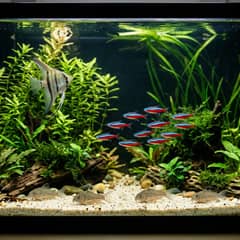
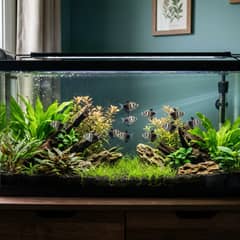
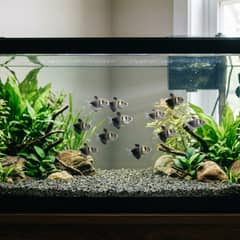
Twelve is the number that keeps the nipping in house. In a group of at least 12, the squabbling usually stays between black skirts.
Getting close to twelve is not the same thing. Tiger barbs, another fin-nipping species, showed no drop in aggression as their groups grew to eight fish, and eight may simply be too few for it to fall. So the dozen is the purchase, and a group of eight is not a slightly smaller version of it.
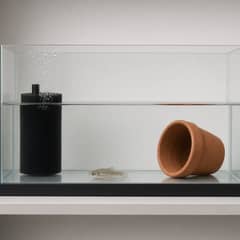
Twelve is also the school a 20-gallon long tank with a 30 x 12 inch (75 x 30 cm) base is sized for. Twelve new fish add their waste all at once, so the tank they go into has completed its nitrogen cycle and kept running steadily afterward.
Tankmates That Work
A full school of black skirts settles in well with:
- Most livebearers.
- Danios and rasboras.
- Other tetras.
- Peaceful bottom dwellers such as Corydoras and the smaller plecos.
- Sturdier dwarf cichlids, the kribensis among them.
Tankmates to Leave Out
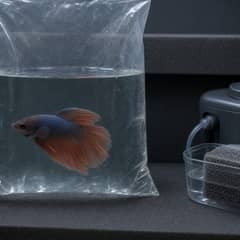
Anything slow with flowing fins is on the wrong side of the rule, and a betta is the clearest example. The fish whose whole appeal is its fins should never share a tank with a known nipper, which is why the betta's own tankmate list rules out fin nippers by name. The same reasoning applies to any fancy long-finned fish.
Long fins on the black skirt itself raise the same problem. The long-fin black skirt, the long-fin white skirt and the long-fin GloFish Skirt Tetra all grow the trailing fins that nippers aim for, so a tank holding them is a tank to keep free of other nippers. Before any new species goes in, fins against nippers sits alongside temperature, water chemistry and mouth size in the stocking decision.
What to Check in the Shop Tank
Every black skirt in the trade comes from captive breeding, and that history is why the species is so easygoing about water and food. The plain black skirt, the pale white skirt, the long-fin forms and the GloFish Skirt Tetra are all the same species with the same care, so choosing between them is a matter of looks and of the tankmate rule above.
What to look for before pointing at a fish:
- Movement. A healthy black skirt is active and keeps with the group.
- Fins. They should be held open. GloFish lists droopy or flat fins as a warning that the water is wrong.
- The whole tank. Pass on any tank where a fish carries salt-grain white spots, ragged fins or sits apart from the others, since every fish in it shares that water.
- Dye. Leave "painted" or "berry" tetras on the shelf. They are white skirts that have been dipped in or injected with dye, which distresses the fish and tends to cut their lives short.
Netting
The net is the one tool that touches the fish, at the shop and again at home. The cleaner transfer keeps the bag in the water: float a partly filled bag on the surface, open it there, and net the fish straight across into it, never into a bag someone holds open in the air. After each transfer, look over the net, the bag and the floor, because a fish can stay caught in the mesh or jump out unseen.
The Drive Home
For the trip, the bag should hold one part water to three parts air. The air carries the oxygen supply, so a bag that looks half empty is correctly packed. Set it in a dark box, or wrap it in a towel or newspaper, for the ride home.
On the road, the fishes' waste pushes the ammonia up while the carbon dioxide they breathe out pulls the pH down. A drive longer than a short local trip needs the insulation and oxygen planning that go into moving fish over a longer distance.
Acclimation: Shop Fish, Shipped Fish and the GloFish Routine
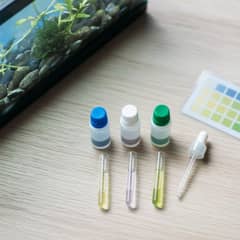
Black skirts are kept at a pH of 6.0 to 7.5 and a hardness of 5 to 19 dGH, and captive-bred stock is unfussy about water chemistry. A tank inside those ranges suits them, and testing the pH and hardness before the trip shows whether it is.
| Method | How long | When it fits a black skirt |
|---|---|---|
| Floating and mixing | 30 to 60 minutes | Fish from a local shop; the longer end gives them more time when shop water and tank water differ |
| Drip acclimation | A couple of hours | Meant for sensitive animals such as Caridina shrimp and specialist fish, and a captive-bred black skirt is neither |
| Temperature match, then straight in | Only until the temperatures even out | Fish that arrive after long shipping. The bag fills with ammonia while the pH sinks, and at a low pH most of it sits in its milder form; tank water raises the pH and turns a growing share toxic, so a long mix keeps the fish in water that gets worse with every cup. The other option is an ammonia detoxifier in the bag, then a normal mix |
| GloFish's own routine | 25 minutes, starting with the sealed bag floating for 15 | Its fluorescent skirt tetras |
The floating routine, step by step:
- Lights off. New arrivals settle better in a fairly dim tank than under full lighting.
- Mix in tank water a little at a time. Every few minutes, add a small amount of aquarium water to the bag. Carry on until the bag holds more tank water than shop water.
- Move the fish with the net. The bag water stays out of the tank, because pouring the whole bag in is poor practice: it carries the trip's waste and can carry pest snail eggs.
- Count before the bag goes. Recheck the bag, the net and the floor for any fish left behind.
GloFish's shorter method finishes by pouring the fish and all the bag water into the aquarium. Keep the floating and replace that last step with step 3 above. For fish that arrive by mail, GloFish adds one step before anything else: take out any heat pack or cold pack in the box.
Do not expect the first meal on day one. New arrivals often take a day or two to start feeding; offer a little food and remove what is ignored. If they are still refusing after that, the fix is a different food, not more of the same.
A finished cycle is the single most important step when the tank is first set up, and quarantine is the single most important step for every fish added, wherever it came from. The same acclimation routine applies when the bag goes into quarantine first.
Telling Males From Females
| Trait | Male | Female |
|---|---|---|
| Body | Noticeably slimmer | Fuller through the body |
| Size | A little smaller | A little larger |
| Dorsal and anal fins | End in a sharper point | Less pointed |
A mixed school needs no sexing, and the difference matters only to a keeper picking out a breeding group.
A black skirt's color is not fixed. The black can fade or deepen with the fish's mood, and the intense black of a young fish slowly fades as it grows older.
Source: TFH Magazine and Seriously Fish
Fish Tank Granuloma: Gloves Over Cuts
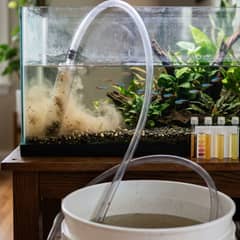
Floating bags, netting fish across and the weekly water change all put hands into aquarium water. Mycobacteriosis, known as fish tank granuloma or swimming pool granuloma, is one of the diseases pet fish can pass to people, and it gets in through broken skin. Children under 5, adults 65 and older and anyone with a weakened immune system run the higher risk.
The habits that keep it out of a household:
- Gloves on. Wear them to clean or care for the tank, and always when a hand has a cut or wound.
- Scratches washed at once. Soap and water straight away, then medical care if the wound turns red, warm, swollen or painful.
- Hands washed. Before and after every job in the tank.
- Small children kept back. Nobody under 5 cleans the tank or handles its equipment.
- Tank water out of the kitchen. Empty it in a bathtub, a laundry sink or outdoors, and disinfect the sink after.
First-Timer Mistakes
- Buying fewer than 12. A smaller group spends its nipping on the neighbors.
- Adding slow, long-finned tankmates. Bettas and fancy long fins are the targets.
- Buying dyed fish. The shop checklist above says why.
- Pouring the bag in. Net the fish, including at the end of the GloFish routine.
- Slow-mixing a shipped order. Temperature first, then the net or a detoxifier.
- Stocking an uncycled tank. Twelve fish arrive with twelve fishes' waste.
- Skipping quarantine. It applies wherever the fish came from.
- Bare hands over a cut. Gloves first.
A dozen black skirts in a tank with no long fins to chase are one of the easier community tetras to keep, and the nipping that worries new keepers mostly turns into a game the school plays with itself.
Sources & Further Reading
Last reviewed 31 Oct 2026 · 6 sources
- Gymnocorymbus ternetzi (Black Widow Tetra), Seriously Fish
- Saxby A, Adams L, Snellgrove D, Wilson RW and Sloman KA (2010). The effect of group size on the behaviour and welfare of four fish species commonly kept in home aquaria. Applied Animal Behaviour Science 125(3-4): 195-205. DOI 10.1016/j.applanim.2010.04.008
- What you need to know about bagging fish, Nathan Hill, Practical Fishkeeping
- GloFish Set Up and Care, GloFish
- Francis-Floyd R, Watson C, Petty D, Pouder DB. Ammonia in Aquatic Systems. UF/IFAS Extension FA16
- Fish, Healthy Pets, Centers for Disease Control and Prevention
Frequently Asked Questions
Do black skirt tetras nip fins?
Yes, and slow fish with long fins take the worst of it. Kept in a group of 12 or more, they usually turn most of that energy on each other, where it does no harm.
Can a black skirt tetra live with a betta?
No. A betta is slow and trails exactly the kind of fins black skirts go after, so the two belong in separate tanks.
What fish can live with black skirt tetras?
Livebearers, danios, rasboras, other tetras, Corydoras and smaller plecos all suit them, and so does a sturdy dwarf cichlid such as the kribensis.
How many black skirt tetras should be kept together?
Twelve. That school fits a 20-gallon long tank, whose base measures 30 by 12 inches.
How long does it take to acclimate black skirt tetras?
Allow 30 to 60 minutes of adding tank water to the bag in small amounts with the lights off. Net the fish into the tank at the end and throw the bag water away.
How can you tell a male black skirt tetra from a female?
Look at the body and the fins. A male is slimmer and slightly smaller, with dorsal and anal fins that come to a sharper point.
Should GloFish Skirt Tetras be poured into the tank with their bag water?
No. Float the bag to match the temperature, then net the fish across and throw the bag water away. Water from the trip carries waste and can carry pest snail eggs, so none of it belongs in the aquarium.
More on the Black Skirt Tetra

Written by Michael Ryan
Mike keeps two rescued bearded dragons, Dex and Cera, and writes the care guides on BeastlyFacts from his own research and mistakes. He is not a veterinarian.
More about Michael Ryan →You May Also Like

Subscribe - it's free
An occasional email when something new is worth your time. No spam.
Deep Dive
Health and More