Zebra Finch Cage Setup: The Pair Comes Before the Cage
On This Page▾

Cage size and bar spacing matter, but the setup decision that determines whether a zebra finch thrives is how many birds go into it, never just one.
The Non-Negotiable Part: A Pair or Small Group, Never Solo
This has to come before cage dimensions, because it changes what the cage is actually for. Zebra finches are a flock-oriented species, in the wild they live in flocks of dozens up to around 100 birds, and in captivity that means a bird that should never be housed alone without a compelling veterinary reason. Long-term solo housing isn't a design choice here the way it can be for, say, a solo canary, it's a welfare problem.
Plan the cage size, perch layout, and even the number of feeding stations around at least two birds from the very start.
Cage Size and Shape
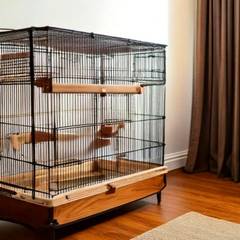
A pair needs at least 24 inches long by 14 inches deep by 18 inches tall. Treat that as a floor, not a target, since more length is genuinely better. Communal aviary housing is the ideal setup, and where space is limited, the compromise is on width, with vertical height and length kept generous to allow free flight. The width given up there is depth, the front-to-back measurement: the side-to-side length is the flight path and the one dimension not to cut. Zebra finches fly rather than climb, so a long flight cage that lets the birds cross the length of it in real flight suits this species far better than a tall, narrow cage built with a climbing bird in mind, the same principle that applies to canaries.
Bar Spacing
No wider than 3/8 inch. That's tighter than the roughly 1/2 inch that works for a canary, since zebra finches are a genuinely smaller bird, and wider spacing carries a real risk of a head getting caught or a bird squeezing through entirely.
Temperature
Normal household temperature, 65 to 80°F, works well for zebra finches, the same comfortable range that works for canaries. Keep the cage away from drafts, air conditioning vents, and direct sun. No supplemental heat is needed indoors.
Light and Dark Cycle
Pet birds generally settle into a rhythm of approximately 12 hours of light and 12 hours of darkness each day, with natural daylight or full-spectrum artificial lighting during the day. A consistent daily schedule matters more than hitting an exact hour count, covering the cage at a predictable time each evening (or moving it to a dark, quiet room) is a simple way to keep that rhythm steady.
Zebra finches breed opportunistically, timed to rainfall in the wild rather than a fixed season, and a stable light cycle at home can inadvertently cue breeding behavior in a mixed-sex group. That's worth knowing if you're not intending to breed, since a hen that lays eggs regularly faces a real, ongoing calcium demand.
Perches and Bathing
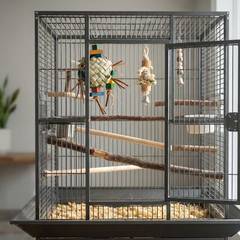
Provide several perches of varied diameter, positioned with enough distance between them that the birds fly rather than just hop across. A shallow bird bath is genuinely worth adding too, zebra finches bathe readily and it supports healthy feather condition. Keep the overall furnishing simple, this is a bird that needs open flight space more than a cage full of toys.
Substrate and Cage Lining
A paper liner on the cage floor, spot-cleaned daily and fully changed weekly, is a low-maintenance standard that also makes it easy to monitor droppings for early signs of illness, worth doing given how well this species hides being sick.
The Zebra Finch encyclopedia profile covers the wild flock behavior this setup is built around.
Sources & Further Reading
Frequently Asked Questions
Can I set up a cage for just one zebra finch?
No, not as a long-term setup. The species is extremely social and gregarious, and should never be housed alone without a compelling veterinary reason. Plan the cage around at least two birds from the start.
What size cage does a pair of zebra finches need?
The minimum for a pair is 24 by 14 by 18 inches. Read that as a floor, not a target: communal aviary housing is better, and where space is tight, keep length and height generous at the expense of depth, the front-to-back measurement, so the birds can fly.
How wide can the bar spacing be on a zebra finch cage?
No wider than 3/8 inch. That's tighter than the 1/2 inch spacing that works for a canary, since zebra finches are a smaller bird with a genuine risk of squeezing through or getting a head caught in wider bars.
What temperature and light cycle does a zebra finch need?
Normal household temperature, 65 to 80°F, works well, kept away from drafts and direct sun. Pet birds generally settle into approximately 12 hours of light and 12 hours of dark each day, with natural daylight or full-spectrum lighting during the day, a consistent schedule matters more than the exact hours.
Do zebra finches need special cage furnishings beyond perches?
A shallow bath dish is worth including, zebra finches bathe readily and it supports feather condition. Beyond that, keep the setup relatively simple: several perches of varied diameter positioned so the birds can fly the length of the cage, rather than a cage crowded with toys.
Recommended Gear
As an Amazon Associate, we earn from qualifying purchases through the links above - at no extra cost to you.

Written by Michael Ryan
Mike keeps two rescued bearded dragons, Dex and Cera, and writes the care guides on BeastlyFacts from his own research and mistakes. He is not a veterinarian.
More about Michael Ryan →