Bird Emergency Plan: Power Outages, Travel, and Transport
On This Page▾

Our reptile emergency plan is built around one fact: a reptile can't produce its own body heat, so the plan is temperature and time, and the food bowl gets pulled the moment heat becomes unreliable. A pet bird flips almost every part of that plan. Birds are warm-blooded and can generate their own heat for a while, but a small parrot carries almost no energy reserve to draw on, so the outage rule for feeding runs backward. And the thing most likely to hurt a bird during a power outage usually isn't the cold at all, it's what people reach for to fight it.
The Inversion: Keep Feeding, Not Stop Feeding
A reptile keeper stops offering insects or prey the moment heat goes unreliable, because a cold-blooded animal can't digest food without external warmth, and undigested food sitting in a cold gut becomes an impaction and bacterial risk. None of that applies to a bird. A bird's own body is the heat source, and running that furnace takes constant fuel.
That's the part owners underestimate. An adult budgie is a tiny bird with almost no fat to spare between meals, and a body that small burns through its stored energy fast just idling. Skip feeding a bird the way you'd skip feeding a bearded dragon during an outage and you're not buying time, you're spending down a reserve that was never there to begin with.
For a reptile, a power outage means stop feeding and find heat. For a small bird, it means keep food and water in front of it the entire time, and worry less about a few cool hours than about what's burning in the room to fix them.
So during an outage: keep the normal feeding schedule running, pellets or seed mix plus fresh water, checked and refilled by hand if an automated feeder or waterer depends on power. A bird that goes off food during a stressful outage, rather than one that's simply eating less than usual, is the signal to call a vet, not a reason to pull the bowl.
The reptile emergency plan is the version of this page where the food bowl comes out the moment heat fails.
The Real Danger Isn't the Cold, It's Combustion
The instinct in a cold, dark house is to light something. That instinct is the actual hazard. The products behind the most home CO poisonings during outages are portable generators, gas ranges and ovens used to heat a room, and fuel-burning camping equipment, kerosene heaters and propane heaters among them, run indoors or in an attached space like a garage. Never use a gas range or oven to heat a home. Fireplaces and woodstoves, and charcoal burned indoors, round out the list of CO sources when used or vented improperly.
Candles carry a different but related risk. Flashlights or battery-operated candles beat open flame during an outage, and real candles should never be left burning unattended or near anything flammable. In a bird's cage room that's a double hazard, since open flame both burns oxygen and adds combustion byproducts to a small enclosed space a bird can't leave on its own.
Generators need real distance, not just an open window. Run a generator and any other gas-powered equipment outside, at least 20 feet from doors, windows, and vents, and never in or near an enclosed space such as a garage, a house, or a shed. Near counts as much as inside, and twenty feet is the measure of near.
Why this matters more for a bird than for the people in the same house: a bird's respiratory system pulls far more air, and far more of whatever is in it, through its body per breath than a person's does, the same efficient design that makes everyday household fumes like an overheated nonstick pan so dangerous to birds. Carbon monoxide is odorless and colorless to everyone in the room, and people need concentrations above about 70 parts per million before symptoms like headache and nausea even start. A bird sharing that air has no such buffer, and by the time a human occupant notices anything wrong, a bird in the same room may already be in serious trouble. A working CO detector in any room with gas heat, a gas range, or a generator running nearby is worth having in any home, and matters more with a bird in it.
During an outage, don't:
- Don't light candles, or run a kerosene heater, propane camping heater, or gas stove for heat in any room the bird is in.
- Don't run a generator in a garage, breezeway, or anywhere closer than the 20-foot minimum from doors, windows, and vents.
- Don't assume an open window or a cracked garage door is enough ventilation for any of the above.
- Don't stop feeding. See above.
Keeping a Bird Warm Without Any of That
Warmth without combustion comes down to trapping the heat a bird and the house already have. Cover most of the cage with a thick towel or blanket, leaving a gap for airflow, the same principle as insulating a coat. Move the covered cage to the warmest interior room in the house, typically one without exterior walls or windows, rather than a sunroom or an attic bedroom that loses heat fastest. For a very small or visibly cold bird, holding it against your own body under a loose shirt or robe for short stretches adds real heat with no equipment at all.
The ideal recovery temperature for a sick bird is 75 to 80 degrees Fahrenheit (24 to 27 degrees Celsius), and birds recover and eat better at the upper end of that range because the added warmth stimulates appetite and digestion. That range was written for a sick or recovering bird rather than a healthy one riding out a few cool hours, but it's a reasonable target to aim for with a covered cage and a warm room during any outage, and a useful number to have in mind if the bird is also stressed, elderly, or unwell.
A wrapped hot water bottle placed near, not against, the cage can help in a genuinely cold house, using the same "beside, never touching" rule as any other emergency heat source, since a bird pressed against something hot for too long can be burned before it thinks to move.
Travel Carrier Versus the Main Cage
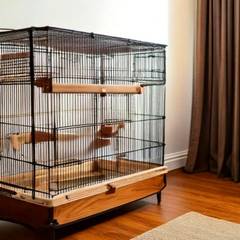
The bird's everyday cage is built to be a stationary home, not a vehicle. It's wide, often has a loose or slide-out base, and hangs food and water dishes off the bars where they can swing or spill under braking. Transport cages need to be secured with a seat belt to prevent shifting in the car, something a full-size cage's shape and dish placement generally don't cooperate with the way a compact, purpose-built carrier does.
A proper travel carrier solves the problems a full cage creates: a narrower footprint that actually buckles in, a solid or semi-solid floor, and a low profile that doesn't shift with every turn. A soft-sided carrier built with a fitted standing perch, sized for something in the budgie-to-Quaker range, is the kind of thing worth owning before the first emergency vet trip rather than shopping for it during one.
| Main cage | Travel carrier | |
|---|---|---|
| Shape | Wide base, hangs off bars, built to stay put | Compact, low center of gravity, made to move |
| Securing in a car | Hard to seat-belt without shifting | Fits a seat belt or carrier strap as intended |
| Floor | Grate or loose substrate over a tray | Solid or padded floor, no gaps to trip a foot |
| Perches vs. floor | Full perch setup, fine for a stationary bird | A low, secured perch or a padded floor for a bird that may need to brace during stops and turns |
| Visibility | Open on most sides | Can be partly covered to reduce stress |
- Purpose-built for a moving vehicle
- Secures with a seat belt or strap
- Smaller footprint keeps the bird from being thrown side to side on turns
- Easy to carry one-handed into a vet's office
- Not a full-time home, too small for normal daily living
- An extra item to own and store
- Needs its own cleaning routine separate from the main cage
A carrier with a perch works for a calm, stable flier, but loose toys and swings come out before a trip to prevent injury on a rough stretch of road, so a stripped-down perch or a low, padded floor beats a fully decorated one for actual transport. Secure the carrier itself with a seat belt or a carrier strap rather than setting it loose on a seat, and keep it in the back seat away from an active airbag. Covering part of the carrier with a light, breathable cloth cuts down on the visual stimulation of a moving car, which for most birds reduces stress more than leaving every side open. Skip a water dish for the drive since it spills under braking, offering a slice of fruit or a leafy green for hydration instead, the standard swap for shorter trips.
Never a Parked Car, Not for a Minute
This is the one absolute in this guide. A bird is never left unattended in a car, because of the risk of overheating: even birds from naturally hot climates can suffer heat stroke very quickly once the car stops moving and the airflow that was managing the temperature disappears. A closed car heats up fast in mild weather, not just in summer, and a bird has no way to signal distress to anyone outside the vehicle. The same logic runs in reverse in cold weather: a parked car with the engine off loses heat quickly, and a covered carrier alone won't hold a stable temperature the way a running cabin does. If a stop requires leaving the car, the bird comes inside with you or the trip gets restructured, there isn't a safe middle option.
Heat runs on a shorter clock than any errand. The inside of a parked car can climb 20°F in as little as 10 minutes and 50°F in an hour, so a 75°F day puts the cabin near 95°F by the time a quick stop turns into a checkout line. A carrier sitting in direct sun does the same thing on a smaller scale, in the car or out of it: a bird that lives indoors should spend under 20 minutes in direct sunlight, with shade it can reach, and a covered plastic carrier on a sunny seat offers none. Keep the carrier out of direct sun through the windows, and keep one side of the cover open for air. A bird that is overheating pants with its beak open, its feathers held sleek and flat, and its wings held away from its body. Fluffed feathers are the opposite signal, a bird that is cold or sick. Move it into shade or air conditioning, mist it with room-temperature water, never cold water, which can send a bird into shock, and call an avian vet on the way.
Build Your Pet-Sitter Sheet
A bird sitter needs the same thing a reptile sitter needs: one page that removes every guess. Since feeding is the one thing that can't lapse for a bird, put it first.
- Contact block: your phone number, your avian vet, the nearest 24-hour exotics clinic, and a backup contact.
- Feeding, written out: exact food, exact amount, exact times, and where it's stored. Note that missed meals are not acceptable to skip "just this once," unlike with many reptiles.
- The numbers: the room's target temperature range and what a normal dropping looks like day to day. Our bird droppings guide is worth printing alongside the sheet so a sitter has a real photo reference, not just a written description.
- A short "please don't" list: don't use any candle, space heater, or scented product in the bird's room, don't let the bird outside unsupervised, don't introduce new toys or foods without asking first.
- A clear "call me if" list: the bird stops eating entirely, sits fluffed and unresponsive, breathes with an open beak or tail bob, or the room's power or heat goes out and can't be restored quickly. If you can't be reached, call the vet number above.
Walk the sitter through an actual feeding and a cage check in person before the first solo visit. A sheet backs up that conversation, it doesn't replace it: a practice run catches gaps no page of instructions can.
The Real Takeaway
A bird's emergency plan runs on almost the opposite logic from a reptile's: keep the food coming because there's no reserve to protect by withholding it, and treat the outage itself as less dangerous than what people burn trying to beat it. Skip the candles, the indoor generator, the propane heater, and the gas stove turned into a space heater, cover the cage and move it to the warmest room instead, and save the travel carrier, not the main cage, for anything that involves a car. Get those pieces right and a cold night or a short trip stops being the emergency this guide is written for.
Sources & Further Reading
Last reviewed 16 Sep 2026 · 5 sources
- U.S. Consumer Product Safety Commission: Carbon Monoxide Fact Sheet
- CDC: Prevent Carbon Monoxide Poisoning
- VCA Animal Hospitals: Transporting Your Bird, Car and Air Travel; Nursing Care for Sick Pet Birds
- National Weather Service, Corpus Christi: Beat the Heat, Check the Backseat
- Lafeber Pet Birds: Summer Heat and Our Birds
Frequently Asked Questions
Should I stop feeding my bird during a power outage?
No, the opposite of the reptile rule. A small parrot has almost no fat reserve to fall back on, so food and fresh water need to stay in front of the bird the entire time the power is out, not withheld the way you would for a cold-blooded pet.
What actually kills birds during power outages, the cold or something else?
In most documented outage deaths it's combustion byproducts, not temperature. Portable generators, gas stoves used for heat, and fuel-burning camping equipment used indoors are the leading sources of home CO poisoning, and a bird's fast, efficient gas exchange makes it far more vulnerable to an airborne toxin than a person in the same room, often with no warning.
Is it safe to run a generator in the garage with the door open during an outage?
No. A generator runs outdoors, at least 20 feet from any door, window, or vent, and never in or beside a garage, house, or other enclosed building. Carbon monoxide from one parked by an open window reaches a bird long before it bothers a person.
Can I just use the bird's regular cage as a travel carrier?
For a short trip in a pinch, yes, but a proper travel carrier is safer for anything beyond a quick errand. Transport cages should be secured with a car seat belt to prevent shifting, which a full-size cage with a wide base and loose bar-mounted dishes generally can't do as securely as a purpose-built carrier.
How long can I leave a bird alone in a parked car?
Never, not even for a minute, in hot or cold weather. Once the engine and the airflow stop, a closed car heats up fast, and heat stroke can take even a bird from a hot native climate in minutes. The bird comes inside with you.
What temperature should I keep a stressed or unwell bird at during an emergency?
The ideal recovery range for a sick bird is 75 to 80 degrees Fahrenheit (24 to 27 degrees Celsius), achieved by covering the cage and moving it to the warmest interior room rather than by adding an open flame or unvented heater.

Written by Michael Ryan
Mike keeps two rescued bearded dragons, Dex and Cera, and writes the care guides on BeastlyFacts from his own research and mistakes. He is not a veterinarian.
More about Michael Ryan →