Colony and Aviary Keeping: Budgies, Canaries, and Finches in Groups
On This Page▾

Budgerigars, canaries, and finches are the small birds people actually keep in groups rather than as a single pet or a bonded pair. Most bird-care advice is written around one bird or two, and that advice doesn't stretch cleanly to five, ten, or twenty. A colony changes the math on space, it changes how perches and food need to be arranged, it turns an uneven mix of males and females into a real aggression risk, and it makes nest sites the single most important thing you control. It also raises a disease question that a two-bird household never quite faces the same way. This guide covers all of that for the three species where colony and aviary keeping is genuinely common practice, and it's honest about where the aviculture community's numbers stop and where actual published guidance starts.
Why a Group Is a Different Animal, Not a Bigger Cage
The instinct is to take a single-bird or pair cage size and multiply it by however many birds you're adding. That's the wrong model. A colony isn't a stack of individual cages sharing one enclosure, it's a shared social space where every bird competes for the same perches, the same food dishes, and the same nesting spots at the same time. Crowding four budgies into a cage sized for a pair, using the budgie cage setup guide as your baseline and just adding volume, concentrates exactly the competition that causes fighting and stress, even if the square footage on paper looks adequate.
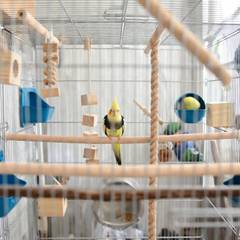
There is no rule of thumb for how much space a colony needs once you're past a single cage's worth of birds, and figures quoted in square inches or centimeters per bird break down at small numbers because they produce absurdly small enclosures. The direction to move in is what's useful. A colony needs meaningfully more total space than the sum of what each bird's own single-bird cage guide recommends, not because the birds need more personal square footage individually, but because a group needs room for subordinate birds to retreat, for multiple birds to fly at once without collision, and for the visual breaks covered next. If you're building an enclosure from scratch for a small group rather than converting an existing single-bird cage, a genuine flight-style aviary cage, built with enough interior room for several birds to spread out and use multiple perches at once, is the right category of product to start from rather than a taller or wider version of a two-bird cage.
Zebra finches are a flock species in the wild rather than a pair species, which is part of why solo housing is a welfare problem for them rather than just a preference. Our zebra finch cage setup guide goes into that in more depth. No flock-size figure is quoted here, because none of the sources behind this article gives one. That same flock instinct is exactly what makes finches tolerate colony housing better than a naturally territorial species does.
Spreading Perches and Feeding Stations So One Bird Can't Monopolize Everything
A single food dish and one favorite perch work fine for a pair. In a colony, that same setup hands one dominant bird an easy way to control access to food and rest for the whole group, and the birds lower in the pecking order pay for it in stress, thinness, and constant low-grade harassment. In a crowded multi-pair finch cage, multiple feeding stations is a direct way to prevent food-related fighting, since a bird that can simply move to a different dish isn't forced into a confrontation to eat.
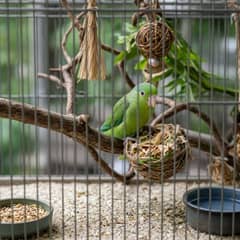
The same logic extends to perches. Spread perches at different heights and in different parts of the enclosure rather than clustering them together, and break up long sightlines with a hanging toy, a leafy branch, or a divider so a dominant bird can't watch and guard the entire space from one spot. A colony where every perch and dish is visible and reachable from a single vantage point is a colony built for one bird to run the show. More stations than birds, not just enough stations for the group, gives a subordinate bird somewhere to go that isn't actively contested.
| Species | Typical group tolerance | Key risk to plan around |
|---|---|---|
| Budgerigar | Generally tolerates group housing well | Uneven sex ratios and unmanaged nest sites turning a flock into an active breeding colony |
| Canary | Poor as a rule: one per cage is safest, though a pair can share a large flight | Territorial aggression between individuals, two males above all, that can end in real injury |
| Finches (zebra, society, and similar) | Naturally flock-oriented and generally the easiest of the three to keep in numbers | Nest-site competition between pairs once any nest box or dense cover is available |
Sex Ratios and the Aggression Problem
An uneven mix of males and females doesn't just change breeding output, it changes how much the birds fight. Concentrate several males around too few females, or the reverse, and competition for mates gets funneled onto whichever birds are outnumbered, which shows up as chasing, feather-pulling, and in worse cases real injury. Colony breeding makes birds more territorial, and a single dominant male can end up mating with several females while other pairs are left fighting over the birds and nest sites that remain.
There is no ideal sex ratio for a budgie, canary, or finch colony. What holds up across the species is a simpler rule: an uneven ratio concentrates conflict, and the reliable fix is keeping a non-breeding group single-sex rather than trying to tune a mixed ratio to some ideal balance. Canaries add their own layer on top of this. Because they're territorial as individuals and not just as competing pairs, a same-sex group of canaries, males above all, can produce real aggression that a same-size group of budgies or finches usually wouldn't. That's the species difference to plan around, not a numbers problem to solve with a formula.
Nest Site Control Is the Main Lever
If there's one thing that determines whether a colony stays a colony or turns into an active hatchery, it's whether nest sites are available. Removing nest boxes, alongside removing mates and reducing day length, is a core piece of managing reproductive activity, since a nest box is one of the main environmental triggers that stimulates birds to breed in the first place. The mechanism doesn't change in a group: a nest box, a dark cavity, a dense corner of foliage, or even a food cup a bird decides to nest in all send the same signal.
In practice, that means auditing the whole enclosure for anything that could function as a nest site if you don't want the colony to breed, not just checking whether you've hung an actual nest box. When nest sites are left in a crowded finch group and breeding isn't the intended outcome, pairs get territorial over the nests they've claimed, raid each other's nests once eggs appear, and can destroy eggs or kill chicks that belong to another pair. Removing the nests and boxes entirely brings the group back down to occasional harmless sparring, which is the outcome you're generally aiming for in a non-breeding colony. A hen already laying heavily on her own is a different problem from group breeding, with its own trigger list and its own point where chronic egg laying becomes a same-day vet visit.
A mixed-sex colony with any nest site available, intentionally provided or just left in place, is a breeding setup whether or not that was the plan. If you don't want chicks, the two levers that actually work are keeping the group single-sex or removing every nest site, not hoping the birds sort it out on their own.
The Disease Risk of Sharing One Airspace
A colony shares more than perches and dishes, it shares air, and that changes the stakes of a single sick or carrier bird in a way that doesn't apply the same way to one or two pets. Avian polyomavirus shows why: a bird that recovers from infection can remain a carrier, shedding the virus intermittently with no outward signs of illness at all, and feather dander and bodily fluids from an infected bird are a frequent route of transmission to others nearby. A carrier bird in a colony isn't a contained risk to one cage-mate, it's exposure for every bird sharing that airspace, since there's no separation keeping dander or droppings confined to one part of a shared enclosure.
That's the reasoning behind never adding a new bird straight into an established group, no matter how healthy it looks on arrival. The bird quarantine guide covers the actual recommended timeline, how to set up a genuinely separate airspace, and what a vet visit and testing add during that window, and none of it shortens just because the destination is a colony of ten birds instead of a single companion bird. If anything, the case for a full quarantine window gets stronger with a larger group waiting on the other side of it, since a mistake there costs more than it would with just one existing bird at risk.
- More natural, flock-appropriate social environment for budgies and finches
- Spreads out feeding, foraging, and social interaction across more birds
- Can be genuinely lower-maintenance per bird once the setup is right
- No space-per-bird or sex-ratio figure to design around, you're working from principles, not a formula
- One sick or carrier bird exposes the whole group, not just a cage-mate
- An unmanaged mixed-sex group will breed, whether or not that was the goal
- Canaries specifically tolerate this far less well than budgies or finches
Building the Space Itself
For anyone setting up a dedicated colony or aviary rather than adapting an existing cage, a large flight-style enclosure gives you the room to actually apply the principles above, spaced-out perches, multiple feeding stations, and sightline breaks, rather than trying to retrofit them into a cage sized for one or two birds. A five-foot rolling flight cage is a reasonable starting point for a small group of budgies, canaries, or finches, since its interior volume leaves genuine room to spread resources out rather than clustering them near a single door or feeding tray the way a smaller cage forces you to. Whatever enclosure you choose, treat the dimensions on the box as a starting point for a small group, not a finished answer, and keep building in more perches, more stations, and more visual breaks as the group grows.
The Bottom Line
Colony and aviary keeping is common practice for budgies, canaries, and finches, and it's also an area where the clinical literature has less to say than the aviculture community does. Where a specific space-per-bird figure or sex ratio would be genuinely useful, it doesn't exist in a form this guide can verify and print, and the honest move is saying so rather than borrowing a number from a forum thread. What does hold up is the set of principles behind those numbers: meaningfully more space than a stack of single-bird cages, more feeding stations than birds, perches and sightlines that don't let one bird dominate the whole space, and the recognition that any mixed-sex group with a nest site available is a breeding operation, intended or not. Get those right and the specific dimensions matter far less than getting the mechanics of a shared space correct in the first place.
Sources & Further Reading
Last reviewed 14 Sep 2026 · 3 sources
- Lafeber Pet Birds: Size of Aviary; Finches Behavior; Canary Personality, Food & Care
- Merck Veterinary Manual: Reproductive Diseases of Pet Birds
- VCA Animal Hospitals: Polyoma Virus Infection in Birds
Frequently Asked Questions
Is there a set amount of space per bird for a budgie, canary, or finch colony?
No. There is no rule of thumb for aviary sizing once you're past a single cage's worth of birds, and per-bird figures break down at small numbers because they produce absurdly small enclosures. The direction to move in is clear: significantly more total space than the sum of what each bird's own care guide recommends individually, with room to add sightline breaks and multiple stations, not just floor area.
Can canaries be kept in a colony the way budgies can?
Less reliably. Canaries are territorial, so a cage of its own is the safest default, and two males should never share one, since they fight. A male and female pair can share a roomy flight cage, but that is close to the limit. Budgies and finches tolerate group living in a way that individual canaries often do not, which is why a canary aviary usually means more space and more territory breaks per bird than the same size group of budgies or finches would need.
What sex ratio should a budgie, canary, or finch colony have?
There is no set ratio to aim for. What matters is the mechanism: an uneven ratio concentrates competition for mates, nest sites, and food onto fewer birds, and in a finch colony a single dominant male can end up mating with multiple females while other pairs raid each other's nests. The practical fix is keeping the group single-sex if you don't want breeding, rather than trying to tune a ratio.
How do I stop a group of budgies, canaries, or finches from breeding if I didn't mean to start a colony?
Remove nest sites and anything that can be used as one. Nest box removal is a core part of reducing reproductive behavior in pet birds, alongside removing mates and cutting back day length, and it works the same way in a group as it does for a single pair. A mixed-sex colony with any cavity, box, or dense corner available to nest in should be treated as a breeding setup, whether or not that was the intention.
Why is disease a bigger concern in a colony than with one or two birds?
Because every bird shares the same air and surfaces, and a carrier doesn't have to look sick to spread something. Birds infected with avian polyomavirus can recover and still remain carriers, shedding the virus intermittently with no outward signs, and that feather dander and bodily fluids are a frequent transmission route. In a colony, one such bird exposes the entire group, not just a single cage-mate.
Do I need to quarantine a new bird before adding it to an existing colony?
Yes, and the same standard quarantine window applies whether you're adding to one bird or fifteen. It doesn't shorten just because the destination is a group rather than a pair.
Recommended Gear
As an Amazon Associate I earn from qualifying purchases through the links above, at no extra cost to you.

Written by Michael Ryan
Mike keeps two rescued bearded dragons, Dex and Cera, and writes the care guides on BeastlyFacts from his own research and mistakes. He is not a veterinarian.
More about Michael Ryan →