Sexing, Weight, and Body Condition in Pet Birds: What Actually Works
On This Page▾

Two questions come up constantly among parrot owners, and both get answered wrong more often than not. The first is "is my bird male or female," usually settled by someone's opinion about head shape or feather sheen. The second is "is my bird a healthy weight," usually never asked at all, because most owners have never put their bird on a scale. Both questions have real answers. Neither answer is a guess.
Why You Usually Can't Just Look
Most commonly kept parrot species are sexually monomorphic, meaning males and females look the same to the eye. Lovebirds are a textbook example: nothing about plumage, size, or shape reliably separates a male from a female. This isn't a quirk of a few species. A 2023 study notes that more than half of the world's bird species show no distinct sexually dimorphic traits at all. Among parrots specifically, most, lovebirds included, fall into that monomorphic group while only some species become visibly dimorphic at sexual maturity.
That's why the visual sexing tips that circulate among keepers, head size, "eye ring shape," feather sheen, personality, don't hold up. None of it is backed by anything beyond anecdote, because for a monomorphic species there is genuinely nothing external and consistent to see. If your bird's species is one of the exceptions, that's worth knowing, but it's the exception, not the rule.
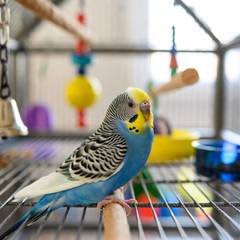
Budgies are the clearest real exception. Adult male and female budgies show a genuinely different cere, the fleshy patch above the beak where the nostrils sit, and it's one of the few visual sexing methods experienced keepers trust without reaching for DNA testing. It isn't foolproof, though: cere color and texture shift with hormonal state, and disease can change it too, so it's read alongside context rather than as a standalone verdict. Our budgie cere color guide covers exactly what's normal hormonal variation and what's actually a red flag, in more depth than belongs here.
Cockatiels: A Real Cue, But Only in a Wild-Type Adult
Cockatiels are the other species where looking actually works, and the cue is more than a shade difference. A male has a yellow forehead, throat, crest and cheeks with orange ear patches, and solid black plumage under the wings. A female has much less yellow and a barred pattern under the wings. So there are two things to read, not one. The face is the obvious half, a bright clean yellow mask with vivid orange cheeks against a duller, grayer face carrying much less yellow. The underwing and tail are the more reliable half, because they are a pattern rather than a brightness judgment: barring underneath in a female, solid black in a male. If the face reading and the wing reading disagree, trust the wing.
Two limits come with it, and the sheet states both. The first is age. "Until maturity at 6 months of age, coloration will resemble that of a female including yellow or white bars on the ventral surface of the wings." Every young cockatiel looks like a hen, so a bird under six months tells you nothing, and a "female" bought as a chick can turn out to be a cock after the first molt.
The second limit is the one that catches most owners, because most pet cockatiels are not wild-type birds. The sheet scopes the cue explicitly: "Sexual dimorphism is most obvious in the standard or wild type cockatiel." That is the gray bird with the yellow face and orange cheeks. The cue works by contrasting two pigments, the yellow and orange against the gray and black, so any mutation that strips out or scrambles either one takes the cue away with it. A lutino has no melanin left to make the dark barring or the solid black underwing readable. A whiteface has no yellow or orange to brighten. An albino, which is a whiteface lutino, has neither. A pied bird scatters both pigments at random, which is why pieds are the hardest of all to call. A pearl hen keeps her pearling while a pearl cock usually molts his away, which is a clue rather than an answer. For any of those birds, the honest position is that the visual method does not apply and DNA testing is the answer, exactly as it is for a lovebird.
The Cockatoo Exception: Iris Color, With Real Limits
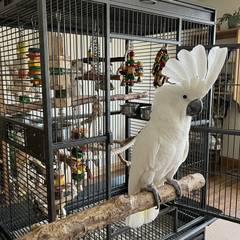
White cockatoos are the other partial exception, and it's worth naming precisely because it's so often overstated. Across the Moluccan, greater and lesser sulfur-crested, umbrella, citron-crested, Goffin's and rose-breasted cockatoos, a mature male's iris is black or dark brown and a female's is light brown or red-brown. The caveat is age: immature cockatoos have a pale gray iris, so this cue isn't available in young birds, only once they've matured enough for adult eye color to set in.
Iris color sexing only works because these are white-plumaged Cacatua species where the eye is easy to see clearly against the feathers. It doesn't extend to dark-plumaged cockatoos or to most other parrot genera, which is exactly the kind of species-specific detail that gets lost when a cue like this gets repeated as a general "parrot" rule.
Even within its own species, this cue has real limits: it depends on getting a good look at the iris in decent light, some individual birds fall outside the typical pattern, and it's a shade difference, not a hard binary. Treat it as a supporting clue in a mature white cockatoo, never as a substitute for a definitive answer.
DNA Testing Is the Actual Answer
For every species where a bird can't be reliably sexed by eye, and for confirming any visual guess before it matters, DNA testing is the real answer. The method is straightforward: a blood sample or a plucked feather provides enough genetic material to identify sex, run either by a diagnostic lab or through an avian vet.
The 2023 Animals study found that blood is the more accurate of the two common sample types. Blood samples "contain a higher DNA concentration than oral swab or feather samples," which translates into fewer failed or inconclusive results. That said, the same research notes that moderately invasive options like feather and oral swabs are recommended specifically for very young chicks and small-bodied adult birds, where drawing blood carries more risk relative to the benefit. In practice, most companion bird owners will get a feather sample request from a lab, since it's simple to collect at home and mail in, while a blood draw is more often done in-clinic when a vet is already handling the bird for another reason.
Whichever sample type is used, this is the only method that gives you a definite answer regardless of species, age, or plumage color, and it's worth doing before making breeding, pairing, or naming decisions based on a guess.
Weight Is This Class's Vital Sign
If sexing is the question owners ask too casually, weight is the one they don't ask often enough, and it matters more. Birds are prey animals, and hiding weakness is a survival instinct that doesn't switch off in a cage. A sick bird's default behavior is to act completely normal for as long as it possibly can, which means the earliest sign of a real problem is frequently invisible to a person just watching and handling the bird day to day.
A gram scale catches what your eyes and hands can't. Weight loss shows up on a scale days to weeks before a bird looks visibly thin, sick, or fluffed up, because feathers hide body condition extremely well. This is the single most useful health habit available to a bird owner, and it costs less than a vet visit.
The practical version is a kitchen scale that reads in grams, used every day before breakfast. The grams part matters, not ounces, because the swings worth catching in a small bird are often a handful of grams, invisible on a scale built for kitchen measuring in coarser units. Weight and muscle move together during illness: a sick bird's metabolism speeds up, its muscle mass drops, and the keel becomes more prominent. In other words, the two checks in this guide, weight and keel, aren't separate habits. They're reading the same underlying thing from two angles.
The other half of Orosz's advice is just as important as the scale itself: "Write down the weight so you can chart your bird's daily weight. That is the best way to know if what you are doing to improve the health of your bird is working." A single weight reading tells you almost nothing on its own. A logged trend, taken at the same time of day on the same scale, tells you everything. It's the same habit that catches a slow-burning problem like avian gastric yeast, where a bird can keep eating normally while quietly losing weight underneath its feathers. A perch-style scale that a bird can stand on naturally, rather than a flat platform it has to be coaxed onto, makes the daily habit far easier to keep up, which is the actual point, since a scale that gathers dust in a drawer catches nothing.
A digital gram scale with a removable perch is built around exactly this problem: a bird stands on a perch it would land on anyway, rather than fighting a flat surface, which makes the daily weigh-in fast enough to actually stick as a routine.
Body Condition: What the Keel Tells You
Weight alone has one limitation: a number in grams doesn't tell you whether that weight is muscle, fat, or an empty crop, and a healthy weight for one individual bird isn't automatically healthy for another of slightly different frame size. That's what body condition scoring is for, and in birds it's built around a single landmark: the keel, the blade-like extension of the breastbone (sternum) running down the center of a bird's chest, where the major flight muscles attach on either side.
The avian body condition scale runs from 1 to 5, with 1 emaciated and 5 obese for a typical bird. That scale is assessed by feel, not by eye, since feathers make visual assessment nearly useless. Run a finger gently along the keel: in a bird with good muscle condition, the bone itself feels like a subtle ridge with muscle rounded out on either side of it, not sharp, not buried. A keel that feels sharp and prominent, with little muscle padding it on either side, points toward underweight. A keel you can barely find at all, because it's cushioned in fat, points the other way, toward overweight.
Don't chase a number. The real value of body condition scoring is tracking the same bird over time, ideally at the same vet visits or the same home checks, since "ideal" varies by individual frame size in a way a single keel check can't tell you on its own. A keel that's gotten sharper since last month is the signal, not a specific score in isolation.
| Method | What It Actually Tells You |
|---|---|
| Budgie cere color | Genuinely useful in adult budgies specifically, but shifts with hormonal state and disease, not sex alone |
| Cockatoo iris color | Partial cue in mature white cockatoo species only, absent in juveniles, lighting-dependent |
| DNA testing (blood or feather) | Definitive, works across species and age, the only real answer for monomorphic birds |
| Gram scale, tracked daily | Catches illness-driven weight loss days to weeks before it's visible by eye |
| Keel palpation (body condition) | Shows whether current weight is muscle, fat, or neither, tracked over time per individual bird |
One clarification worth making explicit, because the confusion is common: this keel-based scale is not the same system used for dogs and cats. The familiar 9-point body condition scale built around palpating ribs, waist, and abdominal fat in mammals doesn't transfer to birds at all, since a bird's frame, fat distribution, and the keel landmark itself have no real mammalian equivalent. If you've used a dog or cat body condition chart before, set that mental model aside entirely when you pick up a bird.
Weight and keel scoring meet at the obesity end of the scale: obesity typically means a bird 20% over its ideal weight, with a body condition or keel score of 4 out of 5. That's a genuinely useful anchor point, but it only works if you already know your bird's own ideal weight, which is exactly why the daily gram habit above comes first. A keel score without a weight history is a single snapshot. A keel score alongside months of logged grams is an actual trend line.
Putting Both Habits Together
Sexing and body condition sound like unrelated topics, but they share the same underlying lesson: a bird's appearance tells you far less than it seems to, and the animals that most need a real check, a genuinely sick one, a genuinely underweight one, a female laying eggs no one expected, are the ones whose bodies are actively working to hide it. A gram scale used consistently and a keel check done by feel, not by eye, are cheap, fast, and catch far more than casual observation ever will. DNA testing closes the loop on sex the same way, replacing a guess with a lab result.
None of this requires an avian vet visit every week. It requires a scale that lives somewhere convenient, a habit of using it, and knowing what a normal keel feels like on your own bird so a change actually registers. That combination, more than any single number, is what keeps small, fast-metabolizing animals like pet birds from crashing before anyone notices something was wrong.
Sources & Further Reading
Last reviewed 24 Sep 2026 · 4 sources
- Turcu, Pastiu, Bel & Pusta (2023), "A Comparison of Feathers and Oral Swab Samples as DNA Sources for Molecular Sexing in Companion Birds," Animals 13(3):525, DOI: 10.3390/ani13030525, PMC
- LafeberVet: Basic Information Sheet for the Cockatoo; Basic Information Sheet for the Cockatiel; Body Condition Scoring in Birds, Christal Pollock DVM
- Lafeber Co.: Is Your Pet Bird a Healthy Weight?, Susan Orosz DVM
- Merck Veterinary Manual: Nutritional Diseases of Pet Birds
Frequently Asked Questions
How can I tell if my parrot is male or female just by looking at it?
For most parrot species, you can't. Species like lovebirds are sexually monomorphic, meaning males and females look alike, and more than half of the world's bird species show no reliable visual sex difference at all. Budgies and cockatiels are genuine exceptions with real visual cues, and mature white cockatoos show a partial one in iris color, but for most commonly kept parrots, DNA testing is the only reliable answer.
What's the actual way to find out my bird's sex?
DNA sexing from a blood sample or a plucked feather, sent to a lab or run through your avian vet. The 2023 Animals study found blood samples give the most accurate results because they carry a higher DNA concentration than feather or oral swab samples, though feather sampling is less invasive and works well for most companion birds.
Why do avian vets care so much about weighing birds in grams?
Because birds are prey animals that instinctively hide illness, and weight is often the first measurable sign something is wrong, well before a bird looks or acts sick. Weigh daily, before the first meal, and chart the number, since a gram scale documents weight loss long before it's visible by handling the bird.
Can I use the dog and cat body condition scale on my bird?
No. The familiar 9-point body condition scale used for dogs and cats doesn't transfer to birds. Avian body condition is assessed differently, by palpating the keel, the breastbone that runs down a bird's chest, and avian scoring systems are built around that keel check rather than the fat-and-rib assessment used in mammals.
What counts as an obese bird?
Obesity in a pet bird means being roughly 20% over ideal body weight, corresponding to a body condition or keel score of 4 out of 5 on the standard avian scale. Getting there requires knowing what your own bird normally weighs, which is exactly what regular gram-scale tracking gives you.
Does cere color tell me my budgie's sex for certain?
It's one of the more reliable visual sexing methods in the bird world for adult budgies specifically, but it isn't foolproof. A female's cere can shift with hormonal state, not just sex, and disease can change it too, so a sudden or unusual cere change is worth mentioning to a vet rather than reading purely as a sexing clue. Our full budgie cere color guide covers what's normal and what isn't.
Recommended Gear
As an Amazon Associate I earn from qualifying purchases through the links above, at no extra cost to you.

Written by Michael Ryan
Mike keeps two rescued bearded dragons, Dex and Cera, and writes the care guides on BeastlyFacts from his own research and mistakes. He is not a veterinarian.
More about Michael Ryan →