Chronic Egg Laying and Egg Binding in Budgies, Cockatiels, and Lovebirds
On This Page▾

A hen doesn't need a mate to lay an egg. She doesn't even need another bird in the house. Give a single female budgerigar, cockatiel, or lovebird the right combination of light, food, and a spot that feels like a nest, and her body will build and lay eggs on its own schedule, clutch after clutch, indefinitely. Single female cockatiels, lovebirds, and budgerigars (parakeets) are among the birds that most often become chronic egg layers, alongside eclectus parrots and, less often, Amazons and macaws. Some of the small and medium conures belong in the most prone group too, the Aratinga conures that include the sun conure, and like the other three they lay with no mate present. Everything below applies to a conure hen the same way it applies to a cockatiel.
That matters because chronic laying is not a curiosity to smile about, it's a welfare problem with a real physical cost. Chronic egg laying can cause malnutrition by draining the calcium used to build eggshells, and the low blood calcium that follows, hypocalcemia, shows up as weakness, lethargy, brittle bones that can fracture during normal handling, egg binding, seizures, and death. After months or years of chronic laying, the oviduct itself can become diseased and start producing abnormal or soft-shelled eggs, and that hens under sustained reproductive hormones often become less friendly, more vocal, and more aggressive while guarding a clutch. A hen who lays and lays is spending down a body budget she can't easily rebuild on an ordinary seed-heavy diet, and the bill eventually comes due, sometimes as a bird that's simply thin and worn down, sometimes as an egg that gets stuck.
What follows is the complete trigger list, the reasoning behind the single hardest piece of advice to follow (leave the clutch alone), the veterinary options once environmental fixes aren't enough, and the egg-binding emergency itself.
The Full Trigger List
Nothing here is any one single cause. Chronic laying is almost always several triggers stacking on top of each other, and knowing the full list is what lets you actually take triggers away instead of guessing at one.
- Photoperiod. A long day is one of the major factors that switch on reproductive activity in pet birds. Cutting it back is the first lever to pull, and the bird photoperiod and sleep guide has the hours and the covered-cage routine that do it.
- An abundant, unlimited food supply. This sits alongside photoperiod as a major reproductive trigger. A steady surplus of rich food mimics the conditions that would support raising a wild clutch, so the body responds as though it should.
- A nest box or a nest-like site. A nest box stimulates laying, and some birds seek out nesting places on their own initiative, including boxes, cupboards, closets, and drawers, the same instinct that turns a dark enclosed hideaway or an unwatched cage floor corner into a perceived nest site in a pet bird's cage.
- A mate, or something the bird treats as one. A mate stimulates reproductive behavior, and so does a perceived mate, which can be the owner. Birds can also pair bond to a favorite toy, a mirror, or another shiny, reflective surface. A mirror left in the cage, or a particular toy a hen fixates on, can function as a mate for the purposes of triggering reproductive behavior, even with no other bird anywhere nearby.
- The owner's own petting. This one is the most under-known, and the most avoidable. A bird often reads constant petting or stroking along its back as mating behavior, so the back, rump, and hind end are off limits for scratches while a hen is laying. To a hen, a hand running down her back and toward her tail isn't affection, it reads the same way a mate's contact would. If a hen is actively laying, keeping physical contact to the head and neck, and shortening handling sessions generally, is a genuine, no-cost lever most owners never think to pull.
A hen doesn't distinguish between a real potential mate and a favorite toy she has bonded to. A bird can pair bond to a mirror, a toy, or another reflective surface strongly enough for it to trigger the same reproductive behavior a real mate would.
Do Not Pull the Clutch
The instinct, once a hen starts laying with no end in sight, is to remove each egg the moment it appears. That instinct works against you. In most cases, removing eggs that have already been laid prompts the bird to lay even more to replace them. Pulling eggs one at a time keeps her body reading the nest as incomplete, so the cycle never gets the signal to stop.
The standard advice runs the other way. Leave the bird to sit on her eggs for a complete incubation period, generally 21 to 28 days depending on the species, which may tell her body to stop laying. At the end of that period, remove the eggs gradually rather than all at once, roughly one every one to two days, since clearing a full clutch in a single sitting can restart the cycle the same way pulling eggs early does.
Removing eggs as your hen lays them tends to make chronic laying worse, not better. Leaving a full clutch in place, real eggs included, until she loses interest on her own is what lets her body register that the clutch is finished.
This is genuinely one of the harder pieces of advice to follow, since it means watching a hen sit on eggs you know will never hatch for close to a month. It's also the piece that actually works with her biology instead of against it. If nest-like furnishings, mirrors, and favorite toys are also removed at the same time, per the trigger list above, most hens do wind the behavior down once a completed clutch has run its course.
Diet's Role in Egg Binding Risk
Triggers decide whether a hen keeps laying. Diet decides how much margin her body has left when she does. Seed-based diets are short on many vitamins and minerals, especially calcium, selenium, and vitamins D and E, and obesity from a high-fat, all-seed diet is another cause of egg binding, alongside hereditary factors, old age, and an improper laying environment. The link is mechanical: without those nutrients the oviduct cannot contract hard enough to push the egg out. An egg pushed by an oviduct that cannot contract the way it should is exactly the combination that tends to end up stuck.
This is why a pelleted diet with proper calcium is standard advice for a chronic layer, not just a general nutrition tip. It's addressing the same depletion described earlier, calcium spent on eggshells that an all-seed diet never replaces, before that shortfall shows up as a bird too weak to pass an egg on her own.
When Environmental Changes Aren't Enough: Veterinary Options
Cutting the triggers, adjusting the light schedule, and letting a clutch sit its course resolves chronic laying for a lot of hens. For hens who keep cycling back into laying anyway, an avian vet has hormonal treatments available as vet-directed prescription decisions, not something to source or dose on your own.
Leuprolide acetate, given by injection, is the drug most commonly named for this. Birds typically stop laying for only three to four weeks on it, so injections generally need to be repeated on a schedule the vet sets. For longer suppression, a vet can place a deslorelin implant under the skin, which slowly releases the hormone over time and generally lasts three to six months or longer before it needs replacing. Both options are decisions an avian vet makes based on an individual bird's history, body condition, and bloodwork. Neither one substitutes for removing the light, diet, and nesting triggers that started the laying cycle in the first place, they buy the body time to recover while those changes take hold.
Egg Binding: The Emergency
Egg binding is the complication all of the above is trying to prevent: an egg forms but fails to pass, and lodges in the oviduct. It is the point where chronic laying stops being a management problem and becomes a same-day emergency.
The classic picture is short and worth memorizing: a bird sitting on the cage floor, depressed, eyes closed, tail bobbing, and struggling to breathe, sometimes with a swollen abdomen. Egg-bound birds often arrive at the clinic as emergencies, which is the framing to keep.
The fuller sequence runs in a rough order of severity: a hen that may or may not have passed an egg within the last 48 hours, usually weak and not perching, often sitting low or on the cage bottom, usually straining as if trying to defecate or lay, usually with noticeable abdominal swelling, sometimes with an egg bulging from the vent or a retained egg causing a prolapse. The last sign is the one people miss for what it is: a hen that cannot stand or has trouble gripping the perch because the egg is pressing on the nerves that control her legs. A bird that suddenly cannot grip is not clumsy, it is compressed.
| Stage | What to watch for |
|---|---|
| Early | Depression, closed eyes, sitting low or on the cage bottom, no egg passed in 48 hours |
| Progressing | Weak and not perching, straining as if to lay or defecate, noticeable abdominal swelling |
| Advanced, act now | A bobbing tail and labored breathing, an egg bulging at the vent or a prolapse, or a hen unable to stand or grip the perch |
Time matters more here than almost anywhere else in bird care. Small birds can die within a few hours of becoming egg-bound, as the trapped egg compresses circulation and puts pressure on the air sacs. There is no home remedy that safely dislodges a bound egg, and no version of this where waiting until tomorrow's appointment is the right call. Any hen showing straining, abdominal swelling, or a missed egg past the 48-hour mark needs an avian vet the same day, ideally the same hour.
Watching for Trouble Before It Starts
A hen who is laying heavily, thin, and slow to bounce back between clutches is worth a vet visit before anything actually gets stuck, not after. The same triggers that start chronic laying, an uncontrolled photoperiod, unlimited rich food, an available nest-like corner, a mirror or toy treated as a mate, and well-meaning petting along the back, are also the levers you can pull before a bird ever reaches an emergency. Removing them, correcting an all-seed diet before calcium reserves run low, letting a clutch run its natural course instead of pulling eggs early, and looping in an avian vet for hormonal treatment when a hen won't stop cycling on her own, covers the vast majority of cases that never need to reach the emergency stage at all.
None of this requires guessing which species will react differently. Budgerigars, cockatiels, and lovebirds are the hens most often affected by both chronic laying and egg binding, conures are close behind, and the same trigger list, the same don't-pull-the-clutch advice, and the same emergency signs apply across all four. What differs between individual birds is how far along the cycle has already gone by the time it's noticed, which is exactly why catching the early signs, in a hen already known to be laying, matters more than trying to predict which species is more at risk.
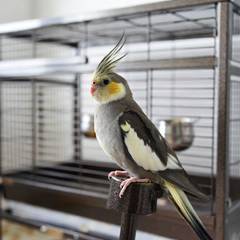
The cockatiel is the species this comes up in most, and egg binding sits at the top of the list of cockatiel health problems for a reason: a single hen with a long day and a seed bowl is the whole trigger list in one cage.
Sources & Further Reading
Last reviewed 25 Sep 2026 · 3 sources
- VCA Animal Hospitals: Chronic Egg Laying in Birds; Egg Binding in Birds; Sexual Behavior in Birds
- Merck Veterinary Manual: Reproductive Diseases of Pet Birds
- Teresa L. Lightfoot, DVM, DABVP (Avian): Chronic Egg-laying (Atlantic Coast Veterinary Conference 2001)
Frequently Asked Questions
Why does a single female bird lay eggs with no male present?
A hen's body doesn't need fertilization to build and lay an egg, it only needs the right environmental cues. Single female cockatiels, lovebirds, and budgerigars are among the birds that most often become chronic egg layers on their own, with no mate in the household at all, and some small and medium conures, sun conures among them, do the same.
What actually triggers chronic egg laying in budgies, cockatiels, and lovebirds?
A long daily photoperiod, an abundant food supply, a nest-like space such as a dark enclosed hideaway or a cage floor corner, a mirror or favorite toy the bird pair-bonds to as though it were a mate, and an owner's own petting along the back or hindquarters, which a bird reads as a mating cue rather than affection.
Should I remove the eggs as soon as my bird lays them?
No. Removing eggs as they are laid can push a hen to lay even more to replace them. The standard advice is to leave a completed clutch in place, real or dummy eggs, until she loses interest and stops sitting on it herself.
What can a vet do if my bird will not stop laying?
For hens that keep cycling despite diet, light, and nest-site changes, an avian vet may offer hormonal treatment. Leuprolide acetate injections and deslorelin implants are the two most commonly used, both are vet-directed prescription decisions based on the individual bird, not something to request or dose on your own.
What are the signs of egg binding, and how urgent is it?
A bird sitting on the bottom of the cage, depressed, eyes closed, tail bobbing and breathing hard, sometimes with a swollen abdomen. Watch too for a hen that has not passed an egg in 48 hours, is weak and not perching, is straining as if to lay, has visible abdominal swelling, or cannot grip the perch because the egg is pressing on the nerves that control the legs. Small birds can die within a few hours of becoming egg-bound. Any suspicion of egg binding is a same-day avian vet visit, not a wait-and-see situation.
Does petting my bird really encourage it to lay more eggs?
For a hen already laying, yes. Stroking or petting a bird's back, rump, or hind end is contact a bird can read as mating stimulation. Keeping contact to the head and neck during a laying episode is the standard recommendation.

Written by Michael Ryan
Mike keeps two rescued bearded dragons, Dex and Cera, and writes the care guides on BeastlyFacts from his own research and mistakes. He is not a veterinarian.
More about Michael Ryan →