Blue-Tongued Skink Enclosure Setup: Northern vs. Indonesian, the Difference That Actually Matters
On This Page▾

Enclosure size and lighting are nearly identical between the two most commonly kept blue-tongued skink types. Temperature and humidity are where they diverge, and getting that split right matters more than almost anything else in this species' care.
Enclosure Size
Adult minimum is 4x2x2 feet, roughly 8 square feet of floor space, for either type. Bigger is always better. Front-opening PVC enclosures are preferred over glass since they hold humidity more effectively, which matters more for Indonesian skinks specifically, covered below. That's the same adult minimum recommended in our Bearded Dragon enclosure setup guide, if you're weighing the two starter lizard options against each other, base footprint requirement is one of the few things that doesn't change.
Temperature: Hotter for Northerns
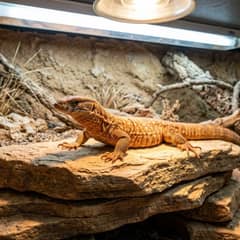
Northern basking surface: 105 to 115°F. Indonesian basking surface: slightly cooler, 100 to 105°F. Cool side (both): 70 to 80°F. Nighttime: stays above roughly 70°F for both types. A heat source (halogen or a deep heat projector) is required, mounted with a basking dome fixture and run on a thermostat, which is what holds the surface inside those ranges instead of letting an unregulated bulb climb past them and burn the animal. In a 24-inch-tall 4x2x2, start with at least two 75-watt halogen floods clustered in the dome over the basking spot, then go up in wattage if the surface reads cool or down if it runs hot.
Humidity: The Dividing Line Between the Two Types
This is the single biggest care difference between Northern and Indonesian skinks. Northerns need relatively low humidity, around 40%. Indonesians need considerably more, 60 to 80%. Achieve the higher Indonesian range through moisture-retentive substrate, regular misting, and a larger water bowl, standard low-humidity setups that work fine for a Northern will run too dry for an Indonesian.
Two skinks that look nearly identical side by side, a Northern and an Indonesian, need humidity levels as much as double apart, roughly 40% for one and 60 to 80% for the other. It's an invisible difference, but it matters as much as anything visible in the enclosure.
Substrate
A naturalistic soil mix works for both, roughly 60% topsoil to 40% play sand for Northerns, with Indonesian setups benefiting from added moisture-retentive elements, leaf litter, sphagnum moss, or a coco-fiber-based product, to help hold the higher humidity they need. Keep it 4 to 6 inches deep. Avoid loose substrate for any sick or injured skink specifically, since normal movement is more limited during recovery. A bed that deep hides waste, so remove droppings as soon as they appear, taking the soiled soil with them, and strip the whole vivarium for a full clean with a reptile-safe disinfectant once a month.
Lighting
UVB is required for this species to thrive, not just survive. A T5 HO bulb anywhere from 5 to 12% output, picked against how high above the basking area it will hang, spanning at least half the enclosure on the warm side, replaced every 12 months regardless of whether it still visibly lights up. Keep the skink no closer than about 10 inches from the bulb. Run a photoperiod of roughly 11 to 13 hours depending on season for either type.
The Non-Obvious Requirement: Quarantine for Wild-Caught Animals
If you've acquired an Indonesian skink, or any skink of uncertain origin, quarantine and a fecal test before it's treated as a healthy, established animal isn't optional extra caution, it's a standard part of responsible setup for this specific situation. It belongs in the setup conversation, since quarantine is really the first step of housing a wild-caught animal properly.
Furnish the enclosure with at least one solid hide and a soakable water dish large enough for either type to fully submerge in, since Indonesians in particular will use it to help manage humidity on their own terms.
If humidity management like this is new territory, our White's Tree Frog enclosure setup guide and Pacman Frog enclosure setup guide cover two amphibians built around similarly moisture-heavy enclosures.
Our complete guide to UVB lighting explains why glass blocks UVB and why a bulb needs replacing long before it stops looking bright.
Sources & Further Reading
Last reviewed 24 Sep 2026 · 3 sources
Frequently Asked Questions
What size enclosure does a blue-tongued skink need?
4x2x2 feet, about 8 square feet of floor, is the adult minimum for either type, and bigger is always better. Front-opening PVC beats glass because it holds humidity better, which counts most for Indonesians.
Do Northern and Indonesian skinks need different temperatures?
Yes, slightly. Northern basking surface should run 105 to 115°F, Indonesian basking surface a bit cooler at 100 to 105°F. Both need a cool side of 70 to 80°F and nighttime temperatures staying above roughly 70°F.
What's the biggest care difference between Northern and Indonesian skinks?
Humidity. Northerns sit around 40%, Indonesians at 60 to 80%, and a setup that runs fine and dry for a Northern will be too dry for an Indonesian.
Does a blue-tongued skink need UVB?
Yes, to thrive rather than just survive. A T5 HO bulb anywhere from 5 to 12% output, picked against how high it hangs above the basking area, across at least half the warm side, swapped every 12 months even while it still lights up, with the skink kept no closer than about 10 inches to it.
Do I need to quarantine a new blue-tongued skink?
If it's an Indonesian skink, or any skink of uncertain origin, yes. Quarantine and a fecal test before treating it as a healthy, established animal isn't optional extra caution, it's a standard part of responsible setup for a likely wild-caught animal.
More on the Blue-Tongued Skink
Blue-Tongued Skink care guide
🦎 How Much Does a Blue-Tongued Skink Really Cost?
🦎 How to Handle a Blue-Tongued Skink
🦎 Common Blue-Tongued Skink Health Issues and What Causes Them
🦎 Blue Tongue Skink Feeding: Schedule, Diet, and Why They Stop Eating
🦎 Blue Tongue Skink Enrichment: Mealworms Made Them Hide Less
Recommended Gear
As an Amazon Associate I earn from qualifying purchases through the links above, at no extra cost to you.

Written by Michael Ryan
Mike keeps two rescued bearded dragons, Dex and Cera, and writes the care guides on BeastlyFacts from his own research and mistakes. He is not a veterinarian.
More about Michael Ryan →