Blue Tongue Skink Enrichment: Mealworms Made Them Hide Less
On This Page▾

Most enrichment studies measure one thing. This one changed three, and the third is the one worth building an article around.
Nine eastern blue-tongue lizards, housed with a brick to bask on and a pipe to hide in, were given feeding enrichment. Mealworms increased time spent feeding and increased liveweight gain. They also reduced time spent hiding. One intervention, three measured outcomes.
What the Blue-Tongue Study Found
The study looked at environmental enrichment for captive eastern blue-tongue lizards (Tiliqua scincoides), a species kept in zoos and increasingly common as a pet. Nine animals were kept individually in cages furnished with a brick for basking and a pipe for hiding.
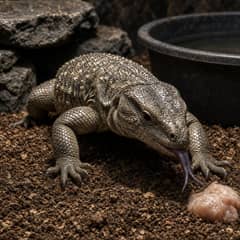
Mealworms increased the time the lizards spent feeding and increased liveweight gain. They also reduced the time the lizards spent hiding.
Reduced hiding is the result that changes how you read your own animal. A skink that spends its day in a hide is usually described as settled or shy. Here, less hiding traveled together with more feeding, which reads as an animal that found something to do rather than one that stopped being nervous.
There is also a review of welfare assessment methods in reptiles that applied the Welfare Quality protocol to the endangered pygmy blue-tongue skink, useful for framing how thin reptile welfare measurement still is compared with mammals.
Move the Food Off the Plate
This is the finding, applied. A bowl of chopped salad is a two minute event for an animal that forages across ground for hours in the wild.
Scatter food across the substrate. Hide portions under cork and leaf litter. A rolling treat dispenser makes the animal push its food out of something. Use soft-tipped tongs to give prey items movement. Vary where the food appears from day to day, so the search stays a search.
Floor Space and Substrate
Blue tongues are terrestrial and cover ground, so footprint beats height every time. A tall enclosure adds almost nothing for this species, and floor space is what makes scatter feeding possible at all.
Give them enough cypress mulch to push through and dig into. Other bag sizes are available and a decent depth wants the larger one.
A Dig Box
Separate from general substrate depth: a tub of damp diggable material gives a skink somewhere to excavate properly without you converting the whole floor. There is no purpose-made product for this, because a storage tub is the product. The same tub does the same job for a bearded dragon, the other commonly kept lizard that digs when it gets the chance.
Cover That Is Not Just One Pipe
The study animals had a single pipe. That is the baseline the enrichment was added on top of, not a target. Multiple large hides at both ends of the gradient, plus cork and leaf litter breaking up the floor, mean the animal can be concealed at any temperature it wants.
Priority Order
- Scatter and varied feeding presentation, the part with a study behind it
- Floor space, since it is what makes foraging possible
- Substrate deep enough to dig into, plus a dedicated dig box
- Multiple hides across the thermal gradient
- Scent novelty, which suits a species that leads with tongue-flicking
- Target training
- Novel objects, last
What Not to Do
Do not bowl-feed a foraging omnivore and then call the enclosure enriched. Do not build up when you could build out, because height is close to wasted on a terrestrial lizard. Do not read a permanently hidden skink as a calm one, since hiding is what the study's less-enriched condition produced. Do not overfeed while making food more interesting, because liveweight gain was a study outcome and these animals get obese easily, so hold the portion size and schedule in our feeding guide steady while you change the presentation. And do not rely on handling for stimulation.
Floor space is the constraint behind most of this. A skink given ground to cross will use it, and one given height instead will not.
Sources & Further Reading
Last reviewed 9 Sep 2026 · 4 sources
- Environmental enrichment for captive eastern blue-tongue lizards (Tiliqua scincoides)
- A review of welfare assessment methods in reptiles, with preliminary application to the pygmy blue-tongue skink
- Burghardt GM (2013). Environmental enrichment and cognitive complexity in reptiles and amphibians. Applied Animal Behaviour Science, 147, 286-298
- Training and enrichment of ectotherms. Frontiers in Ethology
Frequently Asked Questions
What did the blue tongue enrichment study test?
Nine eastern blue-tongue lizards were kept individually in cages furnished with a brick for basking and a pipe for hiding, and then given feeding enrichment. Mealworms increased the time the lizards spent feeding and increased liveweight gain, and mealworms also reduced the time the lizards spent hiding.
Why is less hiding the interesting result?
Because it is a welfare signal rather than a convenience. A skink that hides less is not becoming tamer, it is spending more of its day doing something. Reduced hiding alongside increased feeding time points to an animal that has found a reason to be out.
Is scatter feeding better than a bowl?
For this species the evidence points that way. Blue tongues are opportunistic omnivores that forage across ground in the wild, and a single dish compresses that into a two minute event. Scattering food across substrate, hiding it under cover and using tongs to make prey move all extend it.
Do blue tongue skinks need a dig box?
They dig, and a separate tub of damp diggable material lets them do it without you converting the whole enclosure floor. It is one of the enrichment items with no purpose-made product behind it, because a storage tub does the job.
How much floor space does a blue tongue need?
More than height. These are terrestrial lizards that cover ground, so footprint is the dimension that matters and a tall enclosure adds little. Floor space is what makes scatter feeding and foraging possible at all.
Are blue tongues good candidates for training?
They are among the better reptile candidates. Target and station training is used routinely in zoo collections for large lizards, and it works as cognitive enrichment and cooperative-care husbandry at the same time.
More on the Blue-Tongued Skink
Blue-Tongued Skink care guide
🦎 How Much Does a Blue-Tongued Skink Really Cost?
🦎 How to Handle a Blue-Tongued Skink
🦎 Common Blue-Tongued Skink Health Issues and What Causes Them
🦎 Blue-Tongued Skink Enclosure Setup: Northern vs. Indonesian, the Difference That Actually Matters
🦎 Blue Tongue Skink Feeding: Schedule, Diet, and Why They Stop Eating
Recommended Gear
As an Amazon Associate I earn from qualifying purchases through the links above, at no extra cost to you.
Written by Michael Ryan
Mike keeps two rescued bearded dragons, Dex and Cera, and writes the care guides on BeastlyFacts from his own research and mistakes. He is not a veterinarian.
More about Michael Ryan →