Fire Skink Feeding: Five Minutes of Insects in the Leaf Litter, Twice a Week as an Adult
On This Page▾

A fire skink is a burrowing insect hunter that spends most of its time out of sight, and feeding one well means giving it something to hunt rather than something to find in a dish. Here is the feeder list, the portion, the schedule by age, the supplement that goes on every time, and how to tell a hidden skink from one that has stopped eating.
Feeding Schedule by Age
| Age | How often | How much |
|---|---|---|
| Juvenile | Daily to every other day | As many insects as it eats in about five minutes |
| Adult | Twice a week, up to three times for a thin animal | As many as it eats in about five minutes, none wider than the head |
The five-minute window is the portion, and body condition adjusts the interval: an adult carrying a thick tail base and a rounded belly drops to twice a week, a lean one gets the third meal. One care sheet gives the adult meal as five or six insects every three days, which is the same amount on a slightly different clock, and either works.
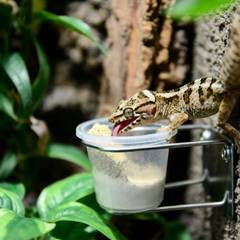
Release the insects into the leaf litter rather than dropping them in a dish. A fire skink hunts through the litter by nature, and finding the food is the activity that keeps it moving. The only feeder that goes in a dish is one that would burrow away, an earthworm or a mealworm, on a flat lid at the surface.
What Fire Skinks Eat
An insectivore with a wide appetite. Crickets are the usual staple, with dubia and discoid roaches, grasshoppers, mealworms and superworms with their beetles, earthworms, hornworms, silkworms, black soldier fly larvae, snails and isopods rotating through. The isopods and springtails of a bioactive enclosure are part of the diet too, which is one reason that setup suits the species. Variety across the week is the diet, and a skink on crickets alone is on a poor one.
Gut-load the feeders. A cricket from the shop is mostly shell until it has eaten, and the gut-loading guide covers what to feed it and for how long.
Dust every feeding. Two care sheets put a light coating of calcium powder, or an all-in-one calcium-plus-vitamin powder, on every feeder, and a third dusts every third feeding. Use the lighter every-feeding version and add a reptile multivitamin to the rotation, since the calcium-to-phosphorus balance of an insect diet is the one thing dusting fixes and a skink that is rarely seen is a skink whose bone trouble is rarely seen either. The UVB lighting guide covers the low-output bulb that lets the calcium do its work.
Treats, monthly. A pinky mouse no more than once a month, a quail egg, or a few berries add nutrients on top of the insect diet. They also add fat, which is why they stay occasional; a fire skink fed pinkies weekly is on its way to the obesity every insect eater with a big appetite runs into.
Water, two ways. A large, shallow bowl of clean water to drink from and soak in, changed daily and scrubbed weekly, plus a thorough misting morning and evening, since much of a fire skink's water comes from its prey and the damp litter it lives in. Seeing one in the bowl is rare; it is there for the day you do.
Foods to Avoid
Anything wider than the head. Pinkies more than monthly. Wild-caught insects from anywhere sprayed, and fireflies, which are toxic. Waxworms as a staple, which are fat and little else. And any feeder that is not alive: a fire skink hunts movement and ignores a dead insect on the litter.
Why Fire Skinks Stop Eating
It has not stopped. A fire skink spends most of its life buried and eats what it finds, so a skink you never see at a feeding may be eating everything you scatter. Count the crickets that disappear and weigh the animal monthly before deciding it is off food.
It is in shed. A day or two off, and a skink that eats its own shed.
It is cold, or dry. A basking surface below its range stops digestion, and a dry enclosure stops the appetite before it produces the retained shed and the respiratory infection the health guide describes. Temperature and humidity are the first two checks.
It is new, or wild-caught. Most fire skinks in the trade are wild-caught, and a new arrival is stressed and often carries parasites. The reptile quarantine guide covers the fecal screen that finds them.
It is winter. A fire skink kept with a seasonal cool-down eats less through it while holding its weight.
When to Worry
A skink that vanishes for days and holds its weight is being a fire skink. One that is visibly thinner along the tail base, that refuses in a warm, damp enclosure for two weeks, or that refuses with a swollen jaw, a kinked tail, or wheezing, sees a reptile vet, and the reptile emergency plan guide sorts those signs by urgency. The tail is the fat store, and a thinning tail is the weight loss you can see on an animal that hides everything else.
Five minutes of dusted insects scattered in the litter, twice a week for an adult, a mouse once a month at most. A fire skink fed that way stays hidden and healthy, and the litter it lives in is where the feeding happens.
Sources & Further Reading
❓ Frequently Asked Questions
How often should I feed a fire skink?
Young skinks get a meal every day or two; a grown one eats twice a week, with a third meal only if it looks lean. Let it hunt for about five minutes per session and keep every feeder narrower than its head. Some keepers work to five or six insects every third day instead, which comes to the same thing.
What insects can a fire skink eat?
Almost any live invertebrate that fits: roaches of the dubia and discoid kinds, crickets, grasshoppers, worms of several sorts including earthworms and hornworms, beetle larvae and their adults, soldier fly grubs, snails, and the isopods in a bioactive tank. Rotate them; a single feeder repeated all week is the weak diet.
Can a fire skink eat mice or eggs?
Occasionally. Keep a pinky to a monthly treat and offer a quail egg or a couple of berries only now and then. Both bring extra nutrients and extra fat, and the fat is the reason to ration them.
My fire skink is never out. Has it stopped eating?
Unlikely. This is a species that lives under the litter and takes its prey there, so an unseen skink is usually a fed one. Track how many feeders go missing and put the animal on a scale once a month; a problem shows up as both numbers dropping together.
📰 More on the Fire Skink
🛒 Recommended Gear
As an Amazon Associate, we earn from qualifying purchases through the links above - at no extra cost to you.

Written by Michael Ryan
Mike keeps two rescued bearded dragons, Dex and Cera, and writes the care guides on BeastlyFacts from his own research and mistakes. He is not a veterinarian.
More about Michael Ryan →Comments
No comments yet - be the first!