How Much Does an African Fat-Tailed Gecko Really Cost?
On This Page▾

African fat-tailed geckos cost more than most beginner geckos, and morphs push that number considerably higher.
The Animal Itself: $75 to $600, Normals Around $100
Normal, wild-type patterned animals are the cheapest, commonly around $100. Morphs change the price substantially: mid-range combinations like Amelanistic or single-gene Oreo animals often run $200 to $400, while rare or high-end combos, Whiteout, Zulu, or stacked multi-gene animals, can reach $600 to $1,000 or more, occasionally higher for truly rare lines.
Upfront Setup: $585 to $1,050 With the First Vet Exam
| Item | Cost Range |
|---|---|
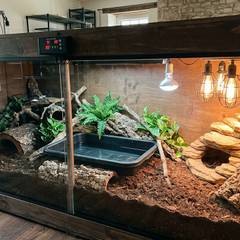
| Enclosure (36x18x18 in minimum; check the dimensions before you buy) | $200 - $260 |
| Under-tank heat mat and thermostat (check the mat size against your enclosure) | $40 - $70 |
| Three hides: warm, cool and humid | $20 - $105 |
| Sphagnum moss for the humid hide | $5 - $15 |
| Coconut fiber and reptile sand for the burrowing mix | $15 - $55 |
| Digital thermometer and hygrometer | $10 - $20 |
| Infrared temp gun for the mat's surface | $10 - $25 |
| Digital gram scale | $10 - $15 |
| Shallow water dish | $5 - $15 |
| Low-output UVB fixture about two-thirds the enclosure length (check the length against your enclosure), tube included, optional but beneficial | $105 - $135 |
| Plug-in timer for the light | $5 - $20 |
| Feeding tongs | $5 - $15 |
| Cork flat | $5 - $10 |
| Slate tiles, stacked low and stable | $35 - $55 |
| First supply of plain calcium, calcium with D3 and a multivitamin | $15 - $20 |
| Initial vet exam ($35 - $105) and fecal test ($65 - $110) | $100 - $215 |
| Setup total | $585 - $1,050 |
Typical price ranges across retailers.
Highly recommended, not counted in the total: a UV index meter, about $240 to $265. It is the only way to check that the UVB tube sits at the right height and to know when the tube needs replacing; UV cards do not measure UVB.
The thermostat isn't optional: it's what keeps the heat mat from overheating the enclosure. Every row before the vet exam adds up to $485 to $835, and the first exam and fecal test bring it to $585 to $1,050, not including the animal. Without the optional UVB and its timer, the setup is $375 to $680. Don't be fooled by the 2.5% on the UVB tube: the percentage is the share of its light that is UVB, not how strong it is, and Arcadia's own chart puts this 24-inch, 14-watt tube at a higher UV index than a short 12-inch 7% kit at the same distance (1.0 against 0.65 at 12 inches). A T5 tube's wattage is not its length: a 24-watt tube is about 22 inches long, a 39-watt tube about 34 inches and a 54-watt tube about 46 inches, so go by the length in inches when you match it to two-thirds of the enclosure. The enclosure is the biggest line: a glass 40-gallon breeder tank, 36x18x16 inches, gives the same floor.
Ongoing Costs: $270 to $570 a Year
| Item | Annual Cost |
|---|---|
| Feeder insects: gut-loaded crickets, dubia roaches, occasional mealworms | $60 - $240 |
| Supplement top-ups | about $60 |
| UVB tube replacement, if you run one: budgeted every 6 months (two a year) | $50 - $55 |
| Annual wellness exam ($35 - $105) and fecal test ($65 - $110) | $100 - $215 |
Typical price ranges across retailers.
Food and supplements come to $10 to $25 a month, mostly feeders, with about $5 a month in supplement top-ups once the first supply runs out. Electricity for a heat mat and optional UVB is modest and sits on top of the table.
The "fat tail" is more than a name. This species stores fat in its tail and can draw on it during lean periods, which is part of why a healthy fat-tail's tail should always look plump rather than thin.
Vet Costs
A routine exam commonly runs $35 to $105, plus a fecal test around $65 to $110. Illness or emergency visits with diagnostics typically run $150 to $300 or higher, with surgical intervention, for example egg-binding, costing more still.
Annual wellness exams are the recommended baseline for this species, covering body condition, hydration and nutrition. The exam plus a fecal test puts the yearly check at $100 to $215 before anything is wrong.
Why the Hygrometer and Scale Are on the List
Both are cheap, and both catch the two problems this species runs into most. The hygrometer tells you whether the humid hide is holding 70 to 80% or has quietly dried out, which is the difference between clean sheds and skin stuck on the toes. The scale matters because adults weigh only 40 to 90 grams, averaging about 50: a loss of 5 grams is a tenth of the animal and invisible by eye until the tail has already thinned. A kitchen scale that reads in single grams does the job.
One Gecko, One Setup
Budget for one animal per enclosure. Both sexes are territorial and two males should never share a tank, so a second fat-tail usually means a second full setup at another $485 to $835. A female kept alone can still produce eggs, so her setup also needs a laying box of moist, diggable substrate, which costs little compared with an egg-binding surgery.
What It Adds Up To
Feeders and supplements at $10 to $25 a month come to $120 to $300 a year. Add the $100 to $215 wellness exam and fecal, and two UVB tubes a year at $50 to $55 if you run one, and a healthy adult runs $270 to $570 a year, before electricity or any sick visit. Over 15 years that is about $4,050 to $8,550 on top of the animal and the first setup. The UVB tube is a recurring line because output drops long before the light looks dim: UVB lamps are replaced every 6 to 12 months, by the maker's rated life, and this budget assumes a change every 6 months.
Lifespan: A Long Commitment
15 to 20 years is the commonly cited range, and the best-documented figure, the maximum recorded captive lifespan, is just over 16 years. Either way, it is a long-term commitment, well beyond many other beginner reptiles.
Among the other easygoing geckos, the gargoyle heats with a low-wattage bulb instead of a mat, and the mourning gecko skips the feeder bill.
Sources & Further Reading
Last reviewed 26 Jul 2026 · 5 sources
- Reptile Breeds: African Fat-Tailed Gecko, A Beginner's Guide
- Animal Diversity Web (University of Michigan): Hemitheconyx caudicinctus
- Tree of Life Exotic Pet Medical Center: African Fat-Tailed Gecko Care
- PetMD: Egg Binding in Reptiles
- Zoo Med Laboratories: ReptiSun 5.0 UVB T5 HO and T5 HO ReptiSun 10.0 UVB product pages, lengths and wattages
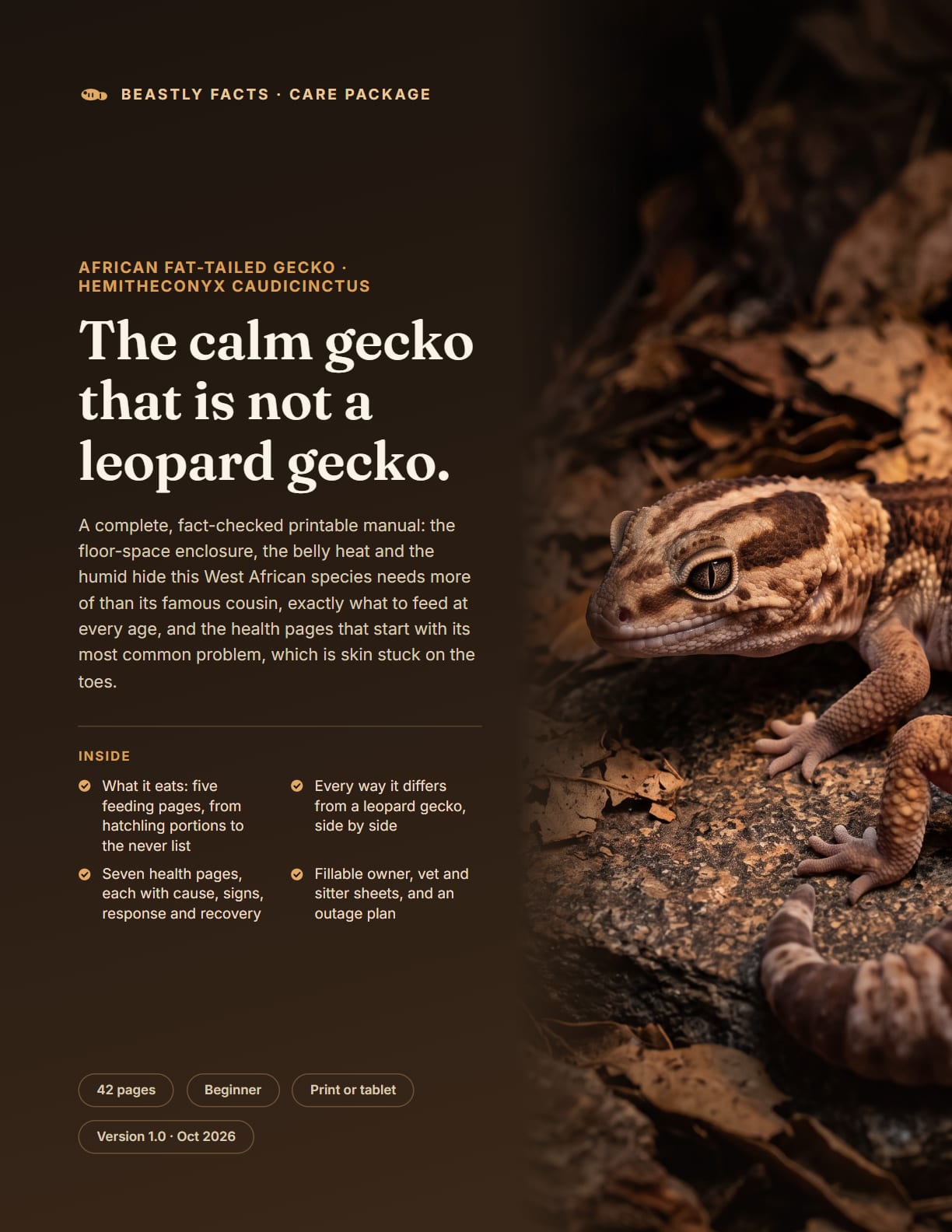
The African Fat-Tailed Gecko Care Package adds one line to this budget: $8.99 for a 45-page PDF with the setup shopping list, the budget sheet and the whole care guide on paper.
Frequently Asked Questions
How much does an African fat-tailed gecko itself cost?
Normals are the cheapest at commonly around $100, inside a typical range of $75 to $600. Mid-range morphs such as Amelanistic or single-gene Oreo often run $200 to $400. Whiteout, Zulu, and stacked multi-gene animals can reach $600 to $1,000 or more.
What does a full setup cost before the gecko?
$485 to $835 for the setup: a 36x18x18 inch enclosure, an under-tank heat mat and thermostat, three hides, sphagnum moss, the burrowing substrate, a thermometer/hygrometer, an infrared gun, a gram scale, a water dish, the optional low-output UVB and its timer, feeding tongs, cork and slate, and the first supply of calcium, calcium with D3 and multivitamin. Without the UVB and timer it is $375 to $680. The first vet exam and fecal test bring the full setup to $585 to $1,050.
What are the ongoing monthly costs?
$10 to $25 a month for food and supplements, mostly feeders: gut-loaded crickets, dubia roaches, occasional mealworms, plus about $5 a month in supplement top-ups. With two UVB tubes a year and the annual exam and fecal test, a healthy adult runs $270 to $570 a year. Electricity for the heat mat and optional UVB is modest.
How long do African fat-tailed geckos live, and how does that affect budgeting?
Plan for 15 to 20 years; the best-documented captive record is just over 16. At $270 to $570 a year for a healthy adult, that is roughly $4,050 to $8,550 over 15 years before the animal and the first setup.
More on the African Fat-Tailed Gecko
African Fat-Tailed Gecko care guide
🦎 How to Handle an African Fat-Tailed Gecko
🦎 Common African Fat-Tailed Gecko Health Issues
🦎 African Fat-Tailed Gecko Enclosure Setup: Built for the Ground, Not the Branches
🦎 African Fat-Tailed Gecko Feeding: Schedule, Diet, and Why They Stop Eating
🦎 African Fat-Tailed Gecko Enrichment: The Closest Cousin Was Studied
Recommended Gear
As an Amazon Associate I earn from qualifying purchases through the links above, at no extra cost to you.
Written by Michael Ryan
Mike keeps two rescued bearded dragons, Dex and Cera, and writes the care guides on BeastlyFacts from his own research and mistakes. He is not a veterinarian.
More about Michael Ryan →