Printable owner manual
Not a leopard gecko with a different pattern. The difference is one damp box.
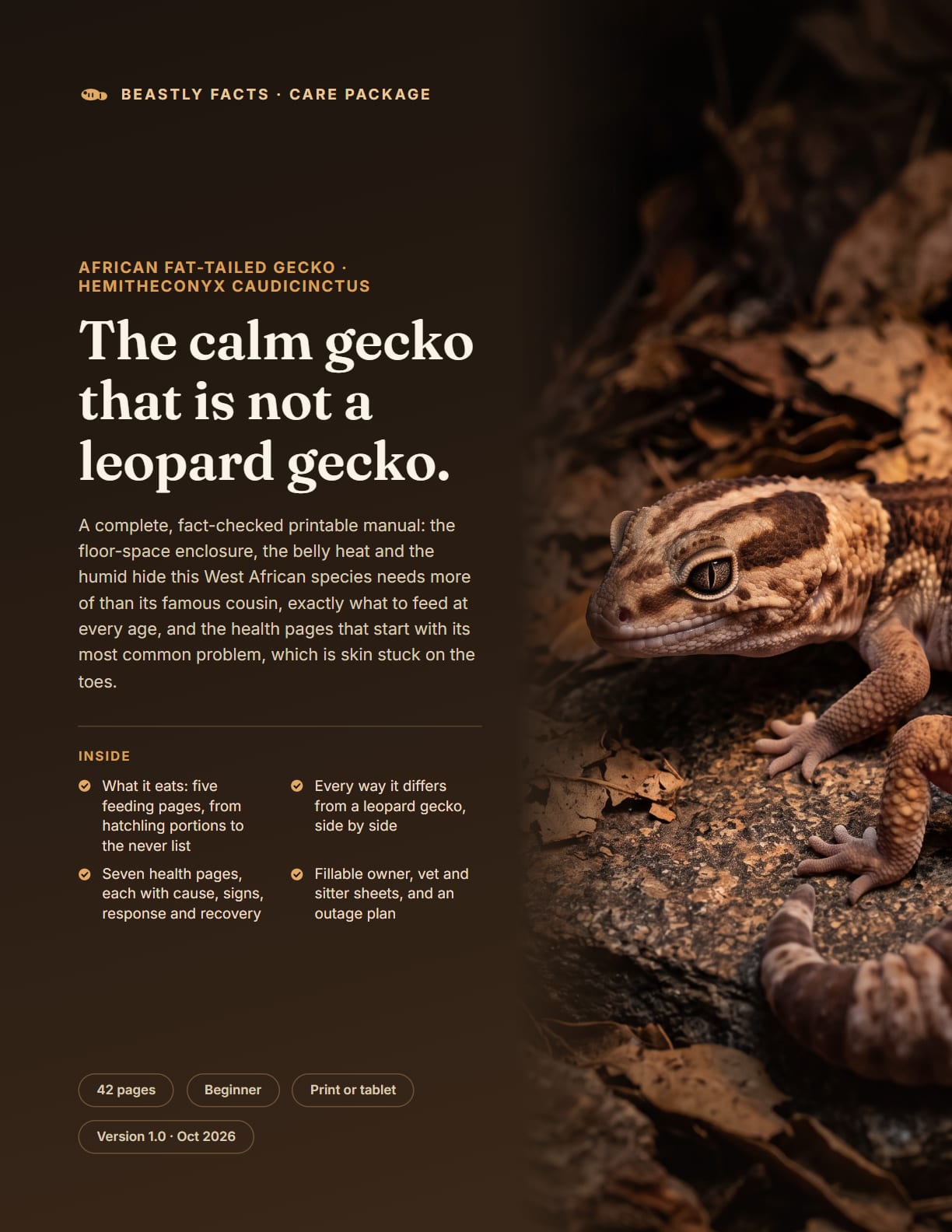
A 42-page printable manual with every way it differs from a leopard gecko, belly heat on a thermostat with the probe where it belongs, the humid hide that keeps skin off the toes, a soil mix it can burrow in, feeding by age, seven health pages, and the printable owner tools.
Not sure yet? Download the first 5 pages free, contents page included.
- 42 pages, print or view
- Beginner friendly
- No external links inside the PDF
Edition 1.0
Oct 2026 · 42 pages
Care-sheet roulette
- A leopard gecko care sheet at 30 to 40 percent humidity, and old skin ringing the toes after every shed
- A heat mat plugged straight into the wall, or a probe taped to the back of the mat
- "Pure sand" in one post and "never loose substrate" in the next, for a gecko that digs
- A feeding chart that counts days, for a gecko that can go weeks without eating and be fine
This guide
- 50 to 70 percent through the enclosure and a humid hide held at 70 to 80, the one box that prevents almost all stuck shed
- 88 to 92°F (31 to 33°C) at the warm side surface, on a thermostat, with the probe flat on the warm hide floor and a second thermometer beside it
- A 70/30 topsoil and play sand mix at least 4 inches deep for healthy adults, and paper towel for juveniles, quarantine and any unwell gecko
- Daily feeding for hatchlings easing to 3 to 4 times a week for adults, corrected by the tail: as thick as the neck or thicker
What's inside · 42 pages
Everything from first setup to daily routine.
Not a leopard gecko
Origin, humidity, temperament, substrate, heat, enclosure, nest temperature and price side by side, and what carries across.
Housing, heat and the humid hide
The 36 by 18 by 18 inch minimum or a 40-gallon breeder with the same floor, a heat mat on a thermostat, three hides, the burrowing mix, and optional UVB (ultraviolet B).
Feeding by age
Five feeding pages: hatchling portions to adult intervals, staples, treats and the never-feed list, gut-loading and dusting, and why it stops eating.
Handling, females and quarantine
A calm gecko handled low and never by the tail, sexing and body condition, the laying box every female needs, and 3 to 6 months of quarantine.
Health and red flags
Retained shed and eye problems, metabolic bone disease, impaction and respiratory infection, egg binding and prolapse, parasites, mouth rot, tail loss and burns.
Owner tools
Setup checklist, emergency card, budget and shopping list, first 30 days, symptom reference, outage plan, pet-sitter sheet, and the logs.
Every page, section by sectionThe package's own contents page, all 42 pages of it. Nothing here is a teaser for something sold separately.
Getting Started
- How to Use This Package
Quick Profile
- Quick Profile & Cost Overview
- Fat-Tail or Leopard Gecko? The Differences
Housing & Environment
- A Floor-Space Enclosure & Where It Goes
- Belly Heat, the Thermostat & the Probe
- Humidity & the Three Hides
- Substrate for a Burrower & Furnishings
- Light Cycle & UVB (Ultraviolet B) Light
Feeding
- What African Fat-Tailed Geckos Eat
- Feeding Schedule by Age & How Much
- Feeder Insects: Staples, Treats & Never
- Gut-Loading & Calcium Dusting
- Why It Stops Eating & When to Worry
Handling, Females & Behavior
- Handling a Calm Gecko
- Sexing, Weight & Body Condition
- Females, Eggs & the Laying Box
- Choosing a Gecko, Quarantine & the Law
- Common Mistakes & Enrichment
- Shedding, Seasons, Sounds & Behavior
Health & Common Issues
- Health Red Flags & Finding a Vet
- Retained Shed & Eye Problems
- Metabolic Bone Disease & Vitamin Problems
- Impaction & Respiratory Infection
- Egg Binding, Prolapse & Male Problems
- Parasites, Mouth Rot, Tail Loss & Burns
- Reading Poop & Hydration
Quick Reference
- Setup Checklist & Targets
- Emergency & Quick Targets Card
Owner Tools
- Budget & Shopping List
- First 30 Days
- Symptom Quick Reference
- Daily, Weekly & Seasonal Routine
- Power Outages, Travel & Transport
- Pet-Sitter Sheet
- Owner Log
- Equipment, Supplement & Vet Log
Reference
- Glossary, A to I
- Glossary, M to Z
- Sources
- Where the Sources Disagree, Version History & About
Take a look inside
The side-by-side, the probe and the hide, and the card that lives by the enclosure.
Click a page to see it at full size. The contents page is complete; the others fade out where the paid content starts.
The first 5 pages, free
Pages 1 to 5 as a PDF: the contents page and the introduction, so you can see every page the full package covers. None of the care guide itself.
Who this is for
- New African fat-tailed gecko owners setting up the enclosure before the gecko comes home
- Leopard gecko keepers adding a fat-tail, or running one from a leopard gecko care sheet
- Keepers whose gecko keeps leaving old skin on its toes or tail tip
What it's not
- Not a substitute for a veterinarian who sees reptiles
- Not a live website mirror, a clean printable package instead
- Not a subscription, one purchase and every corrected edition is free
Ready when you are
African Fat-Tailed Gecko Care Package
42 pages. PDF. Print it or keep it open on your phone, tablet, or computer. Yours the moment you check out.
Edition 1.0, published October 2, 2026. Paid through Stripe. The download link arrives on the next page, and it stays in your library for as long as the package exists, always as the current edition. Not a substitute for a vet.
More care packages
Same format, other animals.

Bearded Dragon Care Package
Basking temps you don't have to guess at.
35 pages · PDF · edition 3.1

Leopard Gecko Care Package
The belly heat number that actually matters.
35 pages · PDF · edition 2.1

Crested Gecko Care Package
Forgiving in some ways. Unforgiving in others.
35 pages · PDF · edition 2.1
The free African fat-tailed gecko guide is still free
This package is the same research as our African fat-tailed gecko care guide, reformatted into an offline manual with the checklists, logs, and triage tables the web pages do not carry. Read the free guide first and buy this only if you want it in your hands.