African Fat-Tailed Gecko
Geckos
Beastly Facts · Updated
The calm, velvety cousin of the leopard gecko: gentle as can be!
On This Page▾
Did you know? African fat-tailed geckos store fat in their wide, sausage-shaped tails as an energy reserve, just like leopard geckos. A plump tail is a sign of a healthy, well-fed gecko!

The first week
The numbers a new owner needs in the first week, each from the article it links to. Rows with no link come from the encyclopedia.
- Day one
- A new gecko is quarantined 3 to 6 months away from any reptile you already keep, on paper towel, with its own tools and a fecal exam inside that window.Quarantine guide →
- Enclosure
- 36x18x18 inches minimum for one adult, past the old 20-gallon long. A 36x18x16 inch 40-gallon breeder gives the same floor. Height buys little for a terrestrial burrower.Setup guide →
- Heat
- A heat mat on a thermostat for a warm-side floor of 88 to 92°F, a cool side of 75 to 80°F, and nights of 70 to 75°F. No heat rocks or strong overhead bulbs, which burn.Setup guide →
- Humidity
- Ambient 50 to 70%, higher than a leopard gecko, with a permanent humid hide at 70 to 80%, which is what prevents shedding trouble.Setup guide →
- Substrate
- For healthy adults, roughly 70% topsoil to 30% play sand at least 4 inches deep. Juveniles and animals in quarantine go on paper towel. Never pure sand, which dries the gecko and impacts.Setup guide →
- UVB and light
- A high-D3 calcium can carry a nocturnal gecko without it, but a 2 to 5% low-output UVB is increasingly recommended. A 10 to 12 hour photoperiod either way.Setup guide →
- Three hides
- Warm, cool, and humid, so it chooses temperature and moisture while concealed. Thermal choice ranked first in the leopard gecko enrichment study.Enrichment guide →
- Feeding schedule
- Hatchlings daily. Juveniles daily, easing toward 3 times a week as the tail fills out. Adults 3 times a week down to every 5 days for a gecko with a visibly fat tail.Feeding guide →
- Portion
- About 2 bugs per inch of body, or what it eats in about 15 minutes, none wider than the space between the eyes: crickets, dubia, discoids, mealworms, superworms, soldier fly larvae, in the evening. Fresh water in a shallow dish, changed daily.Feeding guide →
- Calcium
- Plain, phosphorus-free calcium at most feedings, at least 3 times a week, and a calcium-with-D3 combo once or twice a week.Feeding guide →
- Never feed
- Ladybugs, fireflies, monarchs, box elder bugs, centipedes, bees, or wasps. Only captive-bred, farmed insects.Feeding guide →
- The tail is the gauge
- A fall and winter appetite drop is normal in adults, and the tail fat lets a healthy adult fast for weeks. A tail thinner than the neck is the warning sign.Feeding guide →
- Handling, week one
- Two weeks after it comes home and once it is eating. Support the whole body and let it walk across your hands; a chirp or squeak means put it down. Never the tail, which drops and regrows smoother.Handling guide →
- Stuck shed
- Retained shed on the toes and tail tip is the commonest fat-tail problem, from low humidity or no moist hide, and the hide prevents almost all of it.Health guide →
- Budget
- Normals around $100 inside the $75 to $600 range, morphs to $600 to $1,000. $485 to $835 to set up, $585 to $1,050 with the first vet exam and fecal test. $270 to $570 a year after that.Cost guide →
- Lifespan
- 15 to 20 years cited; the best-documented captive maximum is just over 16.Cost guide →
- Adult size
- 7 to 9 inches (18 to 23 cm).
- Hygiene
- Wash hands with soap after any contact, keep the gecko out of the kitchen, and never clean the enclosure in a kitchen sink or a bathtub people use.Hygiene guide →
Emergency card
Call the vet now if you see any of these.
- A female straining to lay
- Wheezing, mucus, or open-mouth breathing, which needs antibiotics and will not clear alone
- Bloating, lethargy, appetite loss, and straining: impaction
- Lethargy, difficulty standing or walking, swollen joints, muscle twitches, or spinal curvature: bone disease
Book a vet visit promptly for these.
- Retained shed constricting a toe or the tail tip once home correction has failed
- Cloudiness, swelling, or discharge in the eyes outside a normal shed
Eye problems are reported relatively often in this species, so anything outside a shed cycle is worth a visit.
Where to go next
How Much Does an African Fat-Tailed Gecko Really Cost?
$75 to $600 for a normal and past $1,000 for stacked morphs, $485 to $835 to set up, $270 to $570 a year, and what a documented 16-year maximum means for budgeting.
African Fat-Tailed Gecko Enclosure Setup: Built for the Ground, Not the Branches
The 36x18-inch floor, the heat mat gradient, the humidity that separates this species from a leopard gecko, and 4 inches of substrate to burrow in.
African Fat-Tailed Gecko Feeding: Schedule, Diet, and Why They Stop Eating
Portion by body length, the schedule by age, the phosphorus-free calcium rule, and why the tail is a better gauge than a day count.
How to Handle an African Fat-Tailed Gecko
Two weeks before the first session, what a chirp means, and why the tail is never a handhold.
Common African Fat-Tailed Gecko Health Issues
Retained shed, metabolic bone disease, impaction, respiratory infection, and egg-binding.
African Fat-Tailed Gecko Enrichment: The Closest Cousin Was Studied
The leopard gecko study that ranked thermal and feeding enrichment first and mirrors last, and the one thing that does not transfer.
What to buy
As an Amazon Associate I earn from qualifying purchases. Underlined items are paid Amazon links, at no extra cost to you.
Prices and the reasoning behind each item are in How Much Does an African Fat-Tailed Gecko Really Cost?.
Full African Fat-Tailed Gecko gear listFrequently Asked Questions
How humid should the enclosure be?
Higher than a leopard gecko needs, though the enclosure stays mostly dry. Ambient around 50 to 70% works, and a permanent humid hide at 70 to 80% is the piece that prevents shedding problems.
How often should I dust with calcium?
Plain, phosphorus-free calcium at most feedings: every feeding at the strict end, at least 3 times a week at the other. A calcium and D3 combo is generally used just once or twice a week on top of that.
Will an African fat-tailed gecko drop its tail like a leopard gecko?
Yes, if it is grabbed roughly or badly frightened, which is why the tail is never a handhold. The tail does grow back. The replacement is smoother and more bulbous than the one it lost.
Subscribe - it's free
New care guides straight to your inbox. No spam.
Printable Guide
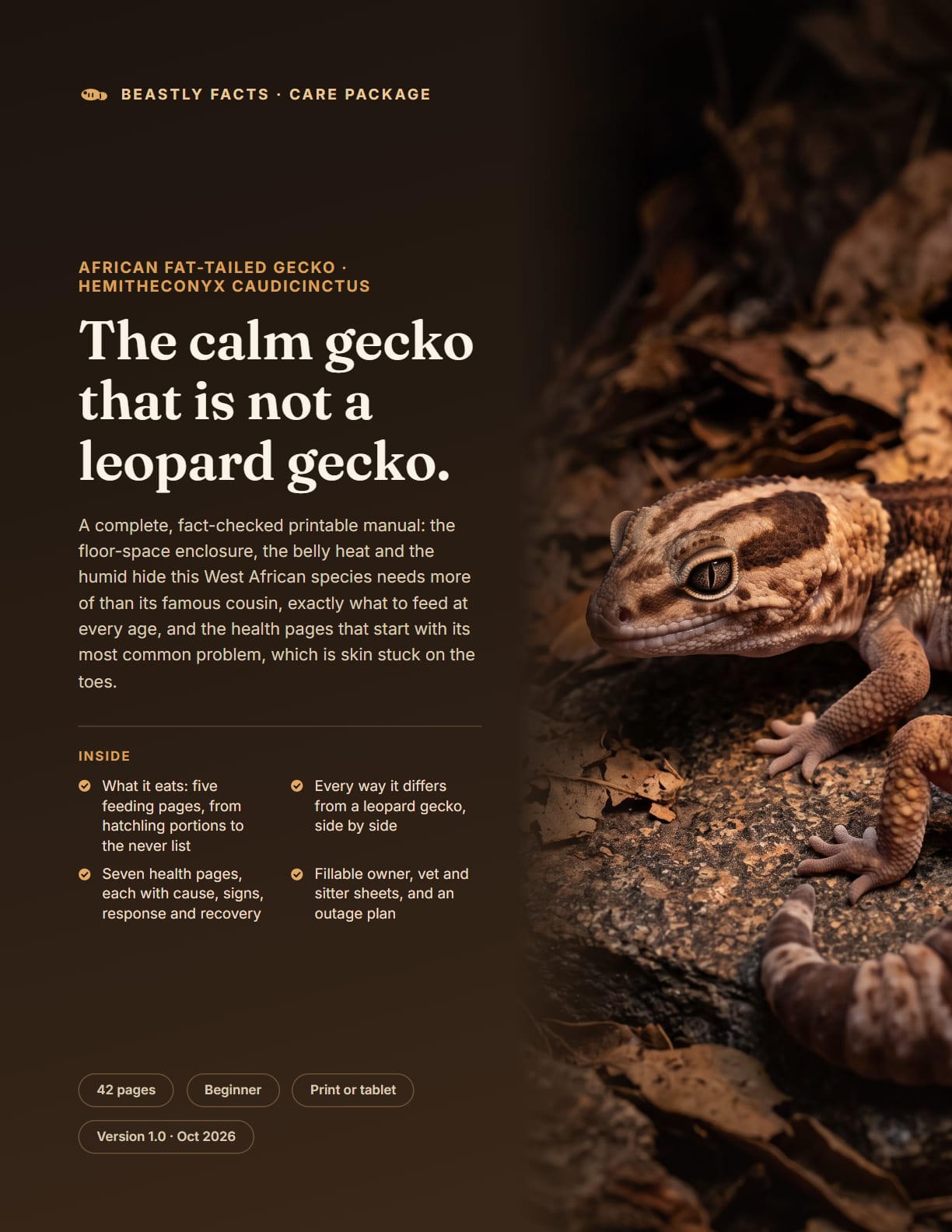
African Fat-Tailed Gecko Care Package
45 pages · PDF · $8.99
Deep Dive
🦎 How Much Does an African Fat-Tailed Gecko Really Cost?
🦎 How to Handle an African Fat-Tailed Gecko
🦎 Common African Fat-Tailed Gecko Health Issues
🦎 African Fat-Tailed Gecko Enclosure Setup: Built for the Ground, Not the Branches
🦎 African Fat-Tailed Gecko Feeding: Schedule, Diet, and Why They Stop Eating
🦎 African Fat-Tailed Gecko Enrichment: The Closest Cousin Was Studied
Health and More
🔌 Reptile Emergency Plan: Power Outages, Travel, and Pet Sitters
💧 Reading Reptile Stool, Urates, and Hydration: A Daily Health Check
🧼 Salmonella and Reptile Hygiene: The Rules That Actually Matter
🌡️ Reptile Heating and Thermostats: Preventing Burns
🧫 Reptile Quarantine: Why New Snakes and Lizards Need Months, Not Weeks
🦎 Understanding Reptile Shedding (Ecdysis)
Fun Facts
🦎 Gecko Toe Magic
Geckos can walk on walls thanks to millions of tiny hair-like structures on their toes called setae. Each foot has about 500,000 of them, using molecular forces to stick to surfaces!
🦎 Climbing the Walls
Geckos have millions of microscopic hairs on their feet that allow them to stick to even molecularly smooth surfaces! This amazing ability comes from van der Waals forces, making them one of nature's great climbers.
Explore More