How Much Does a Veiled Chameleon Really Cost?
On This Page▾

Veiled chameleons are one of the more affordable chameleons to buy, one of the cheapest entry points into the species. The setup and the vet costs are where this pet gets more expensive than the sticker price suggests.
The Chameleon: $20 to $100
Captive-bred juveniles are the cheapest option. Unlike many reptiles, veiled chameleons don't have a large morph market, hypomelanistic and hypermelanistic color mutations exist and cost more, but the selection is genuinely limited compared to species like ball pythons or geckos. Females sometimes cost less than males, worth knowing given the lifespan difference covered below.
Two places will not let you keep one at any price. Washington DC permits only non-venomous snakes, fish and turtles, so every lizard is out, and Hawaii bars anything not on an approved list, which this species is not. New Jersey wants a permit.
Upfront Setup: $345 to $800
| Item | Cost Range |
|---|---|
| 24x24x48 in all-screen enclosure, larger if the space allows | $150 - $300 |
| Strong UVB (T5 HO Arcadia 6% or ReptiSun 5.0; check the length against your enclosure) | $70 - $115 |
| Basking bulb | $5 - $40 |
| Dripper system and automatic mister | $35 - $100 |
| Live plants (pothos, hibiscus, ficus) | $15 - $80 |
| Laying bin with moist sand/soil (females) | $15 - $30 |
| Thermostat for the basking bulb | $25 - $80 |
| Thermometer and hygrometer | $10 - $20 |
| First supply of plain calcium without D3 or phosphorus | $10 - $15 |
| First supply of calcium with D3 | about $5 |
| First supply of a multivitamin with a real vitamin A source | $5 - $15 |
| Setup total | $345 - $800 |
Typical price ranges across retailers.
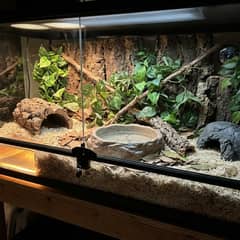
A tall screen or hybrid enclosure sized for an adult from the start, a linear T5 HO UVB fixture and bulb, and a basking heat bulb make up most of the bill. A misting system or dripper is genuinely essential, not optional. Round it out with live plants, branches, and drainage, plus a thermometer and hygrometer. Experienced keepers commonly report around $500 for a complete single-animal setup, with elaborate builds, multiple cages, an automated mister, extensive planting, reaching $1,200 or more.
Ongoing Costs: Roughly $30 to $60 a Month
| Item | Annual Cost |
|---|---|
| Gut-loaded feeder insects (variety) | $150 - $280 |
| Calcium w/ and w/o D3 + multivitamin | $25 - $35 |
| UVB bulb replacement | $70 - $110 |
| Electricity (heat, lighting, mister) | $50 - $90 |
| Annual vet wellness check (chameleon-experienced) | $60 - $100 |
Typical price ranges across retailers.
Feeder insects such as crickets, dubia roaches, and silkworms make up the bulk of the monthly total, alongside calcium and multivitamin supplements and occasional plant or substrate replacement.
A female veiled chameleon will produce egg clutches on a regular cycle even if she has never been near a male in her life. The eggs simply come out infertile. It's the reason her lifespan budgeting looks so different from a male's, laying clutches is a real physical cost whether or not there was ever a mate involved.
Vet Costs
A routine exotic exam runs roughly $50 to $100, with a fecal test adding $25 to $50. This is a species where emergency costs can escalate fast: egg-binding in females can require medical management around $200 to $400, or surgery running $800 to $1,500 or more. Budget accordingly if you're considering a female specifically.
Lifespan: Short, and Different by Sex
This is the detail that changes how you should think about the whole cost picture. Males commonly live 6 to 8 years. Females typically live considerably shorter, often just 2 to 6 years, and many don't make it past 2 to 3, driven by the physical toll of producing egg clutches. Spaying removes the ovaries and ends the egg-laying cycle behind that difference, which takes follicular stasis and egg binding off the table. It is an elective surgery that exotic vets perform on chameleons, worth discussing if you're set on keeping a female long term.
Two very differently priced alternatives for anyone still deciding are the ferret and the hognose snake.
Three Pets Whose Drama Isn't the Real Story puts all three side by side.
Sources & Further Reading
Frequently Asked Questions
How much does a veiled chameleon itself cost?
$20 to $100 for a captive-bred juvenile. Unlike geckos or ball pythons, veiled chameleons don't have a large morph market, hypomelanistic and hypermelanistic color mutations exist and cost more, but selection is limited. Females sometimes cost less than males.
What does the upfront setup cost?
Roughly $345 to $800 for a tall screen or hybrid enclosure sized for an adult, T5 HO UVB fixture, basking bulb, a misting system or dripper, live plants, and drainage. Experienced keepers commonly report around $500 for a complete single-animal setup, with elaborate builds reaching $1,200 or more.
What are the ongoing monthly costs?
Roughly $30 to $60 a month, covering feeder insects like crickets, dubia roaches, and silkworms, calcium and multivitamin supplements, and occasional plant or substrate replacement.
How much should I budget for vet care?
A routine exotic exam runs $50 to $100, with a fecal test adding $25 to $50. Egg-binding in females is the emergency risk, medical management runs $200 to $400, and surgery can run $800 to $1,500 or more.
Do males and females cost the same to keep long term?
No, and this changes the whole budgeting picture. Males commonly live 6 to 8 years, while females typically live just 2 to 6 years, often not past 2 to 3, due to the physical toll of producing egg clutches, which happens even without a male present. Spaying ends the egg-laying cycle and the reproductive emergencies that come with it, and is worth discussing with an exotic vet.
More on the Veiled Chameleon
Veiled Chameleon care guide
🦎 How to Handle a Veiled Chameleon (Carefully, and Not Often)
🦎 Common Veiled Chameleon Health Issues and What Causes Them
🦎 Veiled Chameleon Enclosure Setup: The Dripper Isn't Optional
🦎 Veiled Chameleon Feeding: Schedule, Diet, and the Supplement Schedule That Actually Matters
🦎 Veiled Chameleon Enrichment: The First Two Months Change the Animal
Recommended Gear
As an Amazon Associate I earn from qualifying purchases through the links above, at no extra cost to you.
Written by Michael Ryan
Mike keeps two rescued bearded dragons, Dex and Cera, and writes the care guides on BeastlyFacts from his own research and mistakes. He is not a veterinarian.
More about Michael Ryan →