Veiled Chameleon Enrichment: The First Two Months Change the Animal
On This Page▾

Most reptile enrichment advice has to borrow its evidence from another species. This species does not need the borrow.
Veiled chameleon hatchlings reared in isolation for their first two months grew into animals that were more submissive, darker and duller in color, and worse at finding food. That is a direct finding on this exact species. It is also not a license to house adults together, because adults are territorial and cohabiting them goes badly.
What the Research Says
Ballen, Shine and Olsson took hatchling Chamaeleo calyptratus and reared them either alone or in groups of four, using a split-clutch design so siblings were divided across both treatments. That design matters: it separates the effect of rearing from the effect of which clutch an animal came from.
Two months later they tested the animals against unfamiliar chameleons and on a foraging task. The isolated group was more submissive, adopted darker and duller colors, and performed worse at finding food.
The conclusion the authors drew is the one worth carrying: early social isolation can impair the development of a squamate reptile in roughly the way it does in a mammal or a bird. The default assumption in the hobby, that a solitary lizard is a lizard with no social development to speak of, does not survive this study.
Color is doing real work in that result. A veiled chameleon's color is a signal, not camouflage, and the isolation-reared animals were signaling submission. They had not only behaved differently, they had grown up into a different social position.
What This Does Not Mean
Say the caveat clearly, because this study gets cited to justify things it does not support.
Adult veiled chameleons are territorial and should be housed alone. Cohabiting them produces chronic stress, suppressed feeding, fighting and injury, and no part of the isolation study contradicts that. The finding is about the first two months, and the practical version for a pet keeper is a question you ask a breeder rather than a change you make to your enclosure.
If you have the choice, take the animal reared in a clutch group over the one reared alone in a tub.
Planting Density, the Item Most Enclosures Miss
The single biggest change you can make. A 24x24x48 screen enclosure is a reasonable adult footprint, and what goes inside it decides whether the animal behaves like a chameleon.
Dense live planting, layered, not lined up against the back wall, so the animal can cross the enclosure at several heights without ever being fully exposed. The test: stand in front of the cage and try to find your chameleon. If it is always immediately visible, the layout is too sparse, and a permanently exposed chameleon is a stressed one.
Live plants also hold humidity and catch the water this species drinks from.
Branches at Varied Diameter
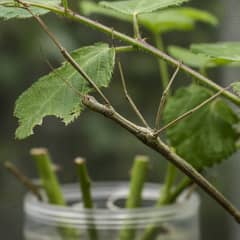
Chameleon feet are built to grip, in opposed bundles, and a cage furnished entirely with one dowel thickness gives that anatomy nothing to work with. Mix thin flexible stems with branches thick enough that the animal has to spread its grip, and run them diagonally so climbing involves decisions instead of a single route up.
Vary the height too. Basking, feeding and resting should not all happen in the same square foot.
Water That Moves
Veiled chameleons drink droplets running off leaves. A misting system makes that reliable in a way hand spraying rarely is, with proper drying cycles between mistings and not constant saturation. Drippers, misters and foggers do different jobs, and the chameleon hydration guide separates them.
This is closer to husbandry than enrichment, and it is on the list because a dehydrated chameleon will not do any of the rest of it.
Feeding as Hunting
Given the foraging result in the isolation study, feeding presentation deserves more attention here than it usually gets. Release insects into the planting so they have to be located and shot at, rather than presenting everything in a cup. Vary where and when prey appears.
A cup has its place for tracking intake and dusting, and it should not be the only way food ever arrives.
Visual Barriers
A chameleon that can see through the side of its enclosure at a person, a pet, or another chameleon is being asked to hold a threat display it cannot resolve. Cover two or three sides, keep the cage out of a high-traffic path, and give the animal the option of being out of sight of the room.
Priority Order
- Planting dense enough to disappear into
- Reliable moving water with real drying cycles
- Branches at varied diameter and angle
- Visual barriers and a low-traffic location
- Prey released to be hunted, never only cupped
- Supervised free-roam, if the room is warm and safe
- Rearranging the layout, occasionally and gently
What Not to Do
Do not read the isolation study as permission to cohabit adults, because that is the one conclusion it does not support. Do not furnish a tall cage with a single bare stick. Do not keep the enclosure saturated around the clock, which trades dehydration for respiratory infection. And do not treat handling as stimulation for an animal that mostly tolerates it at best.
Sources & Further Reading
Last reviewed 14 Sep 2026 · 4 sources
- Ballen C, Shine R and Olsson M (2014). Effects of early social isolation on the behaviour and performance of juvenile lizards, Chamaeleo calyptratus. Animal Behaviour
- Diaz RE et al. (2015). Captive Care, Raising, and Breeding of the Veiled Chameleon. Cold Spring Harbor Protocols
- Chameleons. Handbook of Exotic Pet Medicine
- Burghardt GM (2013). Environmental enrichment and cognitive complexity in reptiles and amphibians
Frequently Asked Questions
Is there enrichment research on veiled chameleons?
Yes, and it is unusually good. Ballen, Shine and Olsson reared hatchling veiled chameleons either alone or in groups of four using a split-clutch design, then tested them. Animals raised in isolation were more submissive toward unfamiliar chameleons, went darker and duller in color, and performed worse on a foraging task.
Does that mean I should house veiled chameleons together?
No, and this is the part that gets misread constantly. The study was about the first two months of life. Adult veiled chameleons are strongly territorial, and cohabiting them causes chronic stress, fighting and injury. Solo housing for anything past the juvenile stage remains correct.
So what do I do with that finding?
Ask the breeder how the animal was reared, prefer one raised in a clutch group over one raised in a deli cup, and take the enrichment side of the enclosure seriously rather than treating a chameleon as an ornament that needs a branch. The finding is a reason to care about early life, not a housing instruction.
What is the single biggest enrichment item for this species?
Planting density. A chameleon that can move through the enclosure without being visible from outside behaves completely differently from one sitting exposed on a bare stick, and that is the difference most enclosures are missing.
Do they need a misting system?
For most keepers, yes. Veiled chameleons drink moving droplets off leaves, and hand spraying enough times a day to keep that reliable is difficult to sustain. This is one of the few pieces of equipment that changes outcomes rather than convenience.
Is free-roaming a chameleon enrichment?
It can be, supervised, in a warm room with real plants and no hazards. It is not a substitute for an enclosure that works, and a chameleon loose in a cold room with nothing to climb is being exposed rather than enriched.
More on the Veiled Chameleon
Veiled Chameleon care guide
🦎 How Much Does a Veiled Chameleon Really Cost?
🦎 How to Handle a Veiled Chameleon (Carefully, and Not Often)
🦎 Common Veiled Chameleon Health Issues and What Causes Them
🦎 Veiled Chameleon Enclosure Setup: The Dripper Isn't Optional
🦎 Veiled Chameleon Feeding: Schedule, Diet, and the Supplement Schedule That Actually Matters
Recommended Gear
As an Amazon Associate I earn from qualifying purchases through the links above, at no extra cost to you.
Written by Michael Ryan
Mike keeps two rescued bearded dragons, Dex and Cera, and writes the care guides on BeastlyFacts from his own research and mistakes. He is not a veterinarian.
More about Michael Ryan →